How to Transfer Bonds and Debentures Using a Demat Account
Blog by Aliceblue News Desk
11 May 2026
9 minutes
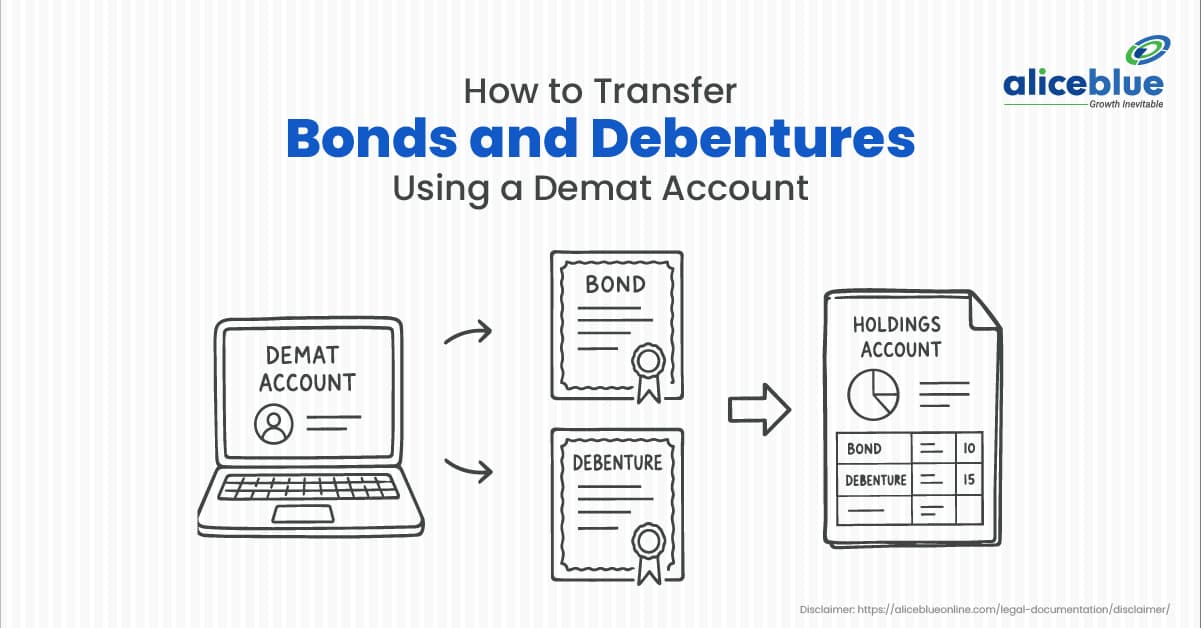
Many investors buy bonds or debentures and then later wonder what happens if they want to move them to another demat account. You may want to shift them to a new broker, transfer them to a family member, or move them between your own accounts. That is where understanding how to transfer bonds and debentures using a demat account becomes important.
If your bonds or debentures are held in demat form, the transfer usually happens electronically through your Depository Participant, or DP. In this article, you will learn what the transfer means, how the process works, when it is useful, what mistakes to avoid, and what beginners in India should know before starting.
What is Transfer of Bonds and Debentures Through a Demat Account?
Transfer of bonds and debentures through a demat account means moving these securities electronically from one demat account to another.
In the past, securities could be held in physical certificate form. Today, most investors hold listed bonds and debentures in dematerialised form, which means the holdings appear electronically in a demat account. Once they are in demat form, ownership can be moved by giving transfer instructions through the depository system.
In India, demat holdings are maintained through two depositories:
- NSDL
- CDSL
Your broker or bank usually acts as the Depository Participant (DP), which is the intermediary between you and the depository.
This kind of transfer may be needed in situations such as:
- moving holdings from one broker to another
- transferring securities between your own demat accounts
- gifting bonds or debentures to a family member
- handling transmission after the death of the holder
- shifting holdings while closing an old demat account
SEBI’s investor material states that shares and debentures in demat form can be transferred to another demat account through instructions given to the Depository Participant using a Delivery Instruction Slip.
How to Transfer Bonds and Debentures Using a Demat Account
The transfer process is usually simple once you know the steps.
1. Check that the securities are held in demat form
First, confirm that the bonds or debentures are already credited to your demat account. You should also verify the ISIN, which is the unique identification number of the security.
If the security is not in demat form, you may first need to dematerialise it before a transfer is possible.
2. Identify the type of transfer
There are two main types of demat transfer:
Intra-depository transfer
This happens when both demat accounts are with the same depository.
Example:
- CDSL to CDSL
- NSDL to NSDL
Inter-depository transfer
This happens when the source and target accounts are with different depositories.
Example:
- CDSL to NSDL
- NSDL to CDSL
Most Indian broker guides explain transfers using this same structure.
3. Choose the transfer mode
You can usually transfer bonds and debentures in one of these ways:
Offline transfer through DIS
A Delivery Instruction Slip (DIS) is a paper form provided by your DP. You fill in the transfer details, sign it, and submit it to the DP. This is the traditional method and is still widely used.
Online transfer through depository facilities
Online transfer is also possible in many cases.
- CDSL Easiest allows account holders to submit off-market, on-market, and inter-depository instructions online. CDSL also says that when instructions are submitted through Easiest, a physical DIS is not required.
- NSDL SPEED-e allows NSDL demat account holders to submit delivery instructions online.
4. Fill in the transfer details carefully
Whether you use DIS or online transfer, you generally need to enter:
- Your demat account details
- the recipient’s demat account details
- DP ID and Client ID / BO ID
- ISIN of the bond or debenture
- quantity to be transferred
- transfer type
- execution date
- reason for transfer, where needed
A small mistake in the account number, depository, or ISIN can delay the transfer or lead to rejection.
5. Submit and authenticate the request
After you submit the request:
- The DP checks the instruction
- The depository processes it
- The securities are debited from the source account
- The securities are credited to the target account
Timing varies from one DP to another. Many broker guides say transfers often take a few working days, with online requests often moving faster than paper-based requests.
6. Check charges and tax impact
Your DP may charge a fee for an off-market transfer, depending on the broker and the type of request. Some brokers waive charges in special cases, such as account closure.
If the transfer is a gift or legacy transfer without consideration, the official FAQ material says stamp duty is not charged because duty is linked to the price or consideration involved.
Tax treatment depends on the reason for transfer. A gift, sale, inheritance, and self-transfer are not treated in the same way.
Example of Bond Transfer Through a Demat Account
Let us take a simple example.
Arjun holds 15 listed non-convertible debentures (NCDs) of a company in his demat account. Each debenture has a face value of ₹1,000. His total holding is ₹15,000.
He wants to transfer 5 debentures to his wife as a gift.
Here is how the process may work:
- Arjun checks that the NCDs are already in demat form.
- He confirms the ISIN of the debenture.
- He checks whether both demat accounts are with the same depository.
- Since both accounts are with CDSL, this becomes an intra-depository off-market transfer.
- He enters:
- recipient BO ID
- ISIN
- quantity: 5
- transfer reason
- The instruction is authenticated and processed.
- After completion:
- Arjun’s account shows 10 debentures
- His wife’s account shows 5 debentures
This example helps show that the transfer changes ownership in the depository records without selling the security on the exchange.
Key Features of Transferring Bonds and Debentures Through a Demat Account
- Electronic process
The transfer happens through the depository system, not by handing over physical certificates. - Can be done offline or online
Investors may use a DIS slip or facilities such as CDSL Easiest and NSDL SPEED-e. - Useful for many situations
It can be used for gifting, broker change, self-transfer, account closure, and succession-related cases. - Supports both intra- and inter-depository movement
Securities can move within the same depository or across NSDL and CDSL. - Recorded electronically
This makes it easier to track the transaction and verify holdings after transfer.
Advantages of Transferring Bonds and Debentures Through a Demat Account
1. Helps when changing brokers
If you want to move to another broker, you may transfer the bonds or debentures instead of selling and buying them again.
2. Good for gifting securities
Demat transfer makes it easier to gift listed bonds or debentures to family members.
3. Better record-keeping
Since the transfer is electronic, there is a clear audit trail in the demat system.
4. Lower paperwork than physical transfer
Compared with old paper-based methods, demat transfer is easier to manage.
5. Useful for long-term investors
Investors who hold fixed-income securities for income or stability often need transfer options for planning, succession, or account changes.
Risks or Limitations
1. Wrong details can cause rejection
Entering the wrong BO ID, DP ID, or ISIN is one of the most common reasons for failed transfer requests.
2. Some securities may not be freely transferable at that moment
CDSL operating guidance notes that only free balances are transferred. Securities under lock-in, pledge, pending remat, or certain pending statuses may not move until the restriction is removed.
3. Charges may apply
Off-market transfer charges differ from one DP to another.
4. Tax treatment may vary
A gift transfer, sale transfer, and inheritance case can lead to different tax outcomes.
5. Online transfer may require prior setup
CDSL’s Easiest facility may require registration and DP authentication, and some modes may need extra authentication, such as PIN or digital signature, depending on the transfer option used.
Bonds and Debentures Transfer vs Selling Them
Basis | Transfer Through Demat Account | Selling on Exchange |
Purpose | Move ownership | Exit investment for cash |
Money received | Not always | Yes |
Route | DP / depository transfer | Stock exchange trade |
Use case | Gift, self-transfer, broker shift, succession | Booking profit or exiting |
Consideration | Maybe with or without consideration | Sale value always applies |
Result | Security moves to another demat account | Security is sold, and proceeds are received |
Note: If you only want to move the holding, transfer is the relevant process. If you want money from the investment, you usually need to sell.
Common Mistakes Beginners Make
1. Entering the wrong recipient account details
A demat transfer depends on exact account matching. Always recheck the BO ID, DP ID, and depository type.
2. Using the wrong ISIN
Do not rely only on the company name. Always confirm the correct ISIN for the bond or debenture.
3. Confusing transfer with sale
A transfer moves the security. A sale converts it into cash. These are different actions.
4. Ignoring restrictions on the holding
If the security is pledged or under lock-in, it may not transfer immediately.
5. Not checking charges in advance
Some investors assume demat transfer is always free. That is not always true.
6. Missing paperwork or a wrong signature on DIS
If you are using the offline route, incomplete or incorrect DIS details may lead to rejection.
Conclusion
Knowing how to transfer bonds and debentures using a demat account can help you manage your investments more smoothly. If the securities are already in demat form, the transfer usually happens through your DP, either by using a DIS slip or an online facility such as CDSL Easiest or NSDL SPEED-e.
The main things to focus on are the right account details, the correct ISIN, the type of transfer, and the charges or tax treatment that may apply. Once these basics are clear, the process becomes much easier to handle.
FAQs
Yes. If bonds or debentures are held in demat form, they can usually be transferred from one demat account to another by giving instructions through your Depository Participant (DP). This can be done either through an offline Delivery Instruction Slip (DIS) or through an online transfer facility, depending on your depository and broker setup. SEBI’s investor material states that shares and debentures in demat form can be transferred to another demat account through instructions given to the DP.
The process usually involves four steps: first, confirm that the bonds are held in demat form and note the correct ISIN; second, identify whether the transfer is within the same depository or between NSDL and CDSL; third, submit the transfer request either through a DIS slip or an online system such as CDSL Easiest or NSDL SPEED-e; and finally, verify that the bonds are debited from the source account and credited to the recipient account. CDSL says Easiest allows off-market, on-market, and inter-depository instructions online.
Not always. A DIS is commonly used when you transfer securities offline through your DP. But if your account is enabled for an online transfer facility, a physical DIS may not be required. For example, CDSL states that account holders who submit instructions through Easiest do not need to submit a physical instruction slip to their DP.
An intra-depository transfer happens when both the source and target demat accounts are with the same depository, such as CDSL to CDSL or NSDL to NSDL. An inter-depository transfer happens when the source and target accounts are with different depositories, such as CDSL to NSDL or NSDL to CDSL. Inter-depository transfers may involve extra checks because the securities are being moved across two depository systems.

Blog by Aliceblue News Desk


