
What Are TReDS and How Does It Benefit MSMEs in India
Blog by Aliceblue News Desk
29 May 2026
11 minutes
Let me start with something every small business owner in India knows too well.
You bag a big order from a large company. You work hard, deliver on time, and raise your invoice. And then you sit and wait. 30 days. 60 days. Sometimes 90 days. Your invoice is approved. The money is coming. But it is not here yet.
Your supplier wants payment this week. Your staff need salaries. You have a new order you could take up, but you need cash to buy raw materials first.
This is not a problem of growth. This is a cash flow timing problem. And it quietly kills thousands of small businesses in India every year.
TReDS was built specifically to fix this.
So what exactly is TReDS
TReDS stands for Trade Receivables Discounting System. It is an online platform approved and regulated by the Reserve Bank of India.
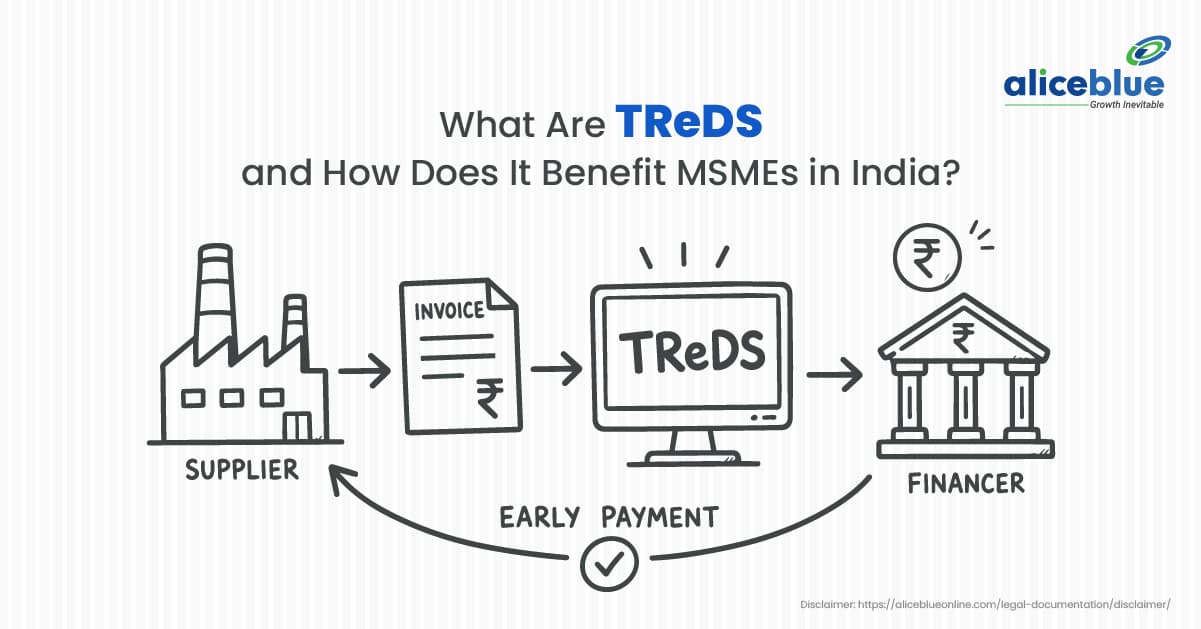
In simple terms, it lets you sell your approved invoice to a bank or NBFC today and get paid immediately, rather than waiting for the buyer to pay you later. The buyer still pays on the original due date, but they pay the bank, not you. You already have your money.
It is not a loan. There is no EMI. There is no collateral required. You are simply selling a future payment for a smaller amount today. The difference between what you receive now and what the buyer pays later is the bank’s fee for providing early cash.
Why was this platform needed in the first place?
Before TReDS came along, an MSME in India had very few options when it needed money against a pending invoice.
One option was a working capital loan from a bank. But that meant submitting financial statements, pledging property, waiting weeks for approval, and often paying 15 to 18% interest per year, sometimes more.
Another option was to approach a private financier or NBFC for bill discounting. Rates were sometimes even higher. Relationships mattered more than the quality of the invoice.
The third option was to just wait and manage somehow. Borrow from family. Dip into personal savings. Delay payments to suppliers and hope nobody pushes back too hard.
None of these was a good option.
The real frustration was this: the invoices were solid. The buyers were large, creditworthy companies. A Maruti, a Reliance, a government department. These buyers were not going to disappear overnight. The money was coming for certain. But because the MSME itself had a thin credit history or no collateral, banks still treated it like a risky borrower.
TReDS changed this logic entirely. Instead of looking at the MSME’s creditworthiness, it looks at the buyer’s creditworthiness. If your buyer is a large-rated company, the bank’s risk is low, and therefore your cost of borrowing comes down significantly.
How TReDS actually works
Three parties are involved. You are the MSME supplier. Your large buyer. And the bank or NBFC that steps in as the financier.
Here is the process from beginning to end.
- You register on the platform
Both you and your buyer need to be registered on one of the RBI-approved TReDS platforms. In India right now, the main ones are RXIL, M1xchange, Invoicemart, C2FO, and DTX by KredX. Registration requires your GST certificate, PAN, Udyam or Udyog Aadhaar registration, and standard KYC documents.
- You upload the invoice
Once you have supplied the goods or services and raised the invoice, you upload it to the TReDS platform. At this stage, it is listed as a Factoring Unit.
- Your buyer approves it
The buyer logs in and confirms that the goods or services were received and the invoice amount is correct. This approval step is critical because banks will only bid on invoices that the buyer has already accepted. It removes the risk of disputes later.
- Banks and NBFCs place their bids
Once the buyer approves the invoice, multiple banks and NBFCs on the platform can see it. Each one places a bid mentioning the discount rate at which they are willing to finance it. Because they are all competing with each other on the same platform, the rates tend to be more reasonable than what you would get from a single bank.
- You pick the best bid
You look at all the bids and choose the one offering the lowest discount rate. The financier then transfers the discounted amount directly to your bank account. This usually happens within 24 to 72 hours of you accepting the bid.
- Your buyer pays the bank on the original due date
Nothing changes for the buyer. They pay on the same date they were always going to pay. The only difference is that they pay the bank instead of you. You already have your money.
One more thing worth knowing: in most TReDS transactions, the arrangement is without recourse to you as the MSME. That means if the buyer fails to pay on the due date for some reason, the bank cannot come back to you asking for the money. The risk of buyer default sits with the financier, not with you.
A real example, so the numbers make sense
Here is a straightforward example.
A small packaging company in Nashik supplies corrugated boxes to a large consumer goods company. Invoice value is ₹8 lakh. Payment terms are 60 days.
The packaging company needs cash this week to pay wages and restock cardboard. Without TReDS, the owner takes a short-term loan from a private lender at 20% annual interest. For 60 days on ₹8 lakh, that interest works out to roughly ₹26,000.
With TReDS, the owner uploads the invoice. The consumer goods company approves it the same day. Three banks bid. The lowest offer is a discount rate of 0.75% per month, which works out to roughly 1.5% for the 60 days, or about ₹12,000 on ₹8 lakh.
The owner accepts the bid and receives ₹7.88 lakh the next morning.
On day 60, the consumer goods company pays the full ₹8 lakh to the bank.
The packaging company saved roughly ₹14,000 compared to the private loan. More importantly, it got the money the next day at a formal, regulated rate instead of scrambling for an informal loan.
The real benefits for MSMEs and why they matter
- Getting paid faster changes how the business runs
When you know the money will arrive within 72 hours of the invoice being approved, you can commit to production timelines, pay suppliers on time, and take new orders without hesitation. Cash flow predictability is worth a lot for a small business.
- Interest costs are genuinely lower
The 8 to 10% per year range that most TReDS transactions fall into is significantly lower than the 15 to 18% that most MSMEs pay on working capital loans. For a business doing ₹5 crore worth of invoice discounting annually, even a 5% rate difference saves ₹25 lakh a year. That is not a little money.
- No property on the line
This matters to a lot of MSME owners personally. When you pledge your house or your factory to get a business loan, you are mixing personal and business risk in a way that keeps you up at night. TReDS removes this requirement entirely.
- You stop mixing personal and business money
Many small business owners in India quietly borrow from family or use their own savings to keep the business going during lean payment periods. TReDS gives you a formal business-level tool to manage these gaps without touching personal finances or asking relatives for help.
- New orders become possible to take
One of the hidden benefits nobody talks about enough: when you are not waiting on unpaid invoices, you have the bandwidth to take on new orders. Growth stops getting blocked by the working capital problem.
Where TReDS does not work and what to watch out for
- Your buyer has to be on the platform
TReDS is not useful if you sell to small traders, individual customers, or informal businesses. The buyer needs to be a large company, PSU, or government department registered on a TReDS platform. If your buyer is not on TReDS, you cannot use it for those invoices.
- Buyer approval speed is not in your hands
Your buyer’s finance team needs to log in and approve the invoice before any bank bids. Some large companies are slow about this. If approval takes five to seven days, your 24-hour disbursement benefit is already reduced. Before you start using TReDS seriously, have a conversation with your buyer’s accounts team about their internal approval timeline.
- The cost needs to go into your pricing
This one catches many MSME owners off guard. If you regularly discount invoices at 0.8% per month, that is nearly 10% annually. That cost needs to be built into your selling price. If you are already working on thin margins, adding this cost without adjusting prices will hurt profitability.
- TReDS is not a substitute for financial discipline
Some business owners start using TReDS as a crutch. They discount every invoice regardless of whether they actually need the cash. The discount charges add up. TReDS should be used when there is a genuine working capital need, not out of habit.
- New businesses may face registration difficulties
TReDS platforms require proper documentation. GST registration, Udyam or Udyog Aadhaar, and clean KYC. Businesses that are very new or still operating informally may not qualify yet.
- Stay aware of policy changes
The government has made it mandatory for all companies with an annual turnover above ₹250 crore and all Central Public Sector Enterprises that purchase from MSMEs to register on TReDS. The original deadline was 31 March 2025. It was extended to 30 June 2025. This is actually good news for MSMEs because it means more large buyers are now on these platforms.
How TReDS compares to traditional options
What are you comparing | TReDS | Regular MSME bank loan | Bank bill discounting |
What the lending is based on | Your buyer’s approved invoice | Your business health and collateral | Individual bills at one bank |
Do you need collateral | Usually no | Usually yes | Sometimes |
How many lenders can you choose from | Several banks and NBFCs bid simultaneously | Typically one bank | Typically one bank |
What interest rate can you expect | 8% to 10% per year, sometimes lower | 15% to 18% per year or more | Negotiated with one bank |
How fast do you get the money | Within 24 to 72 hours | Days or weeks | Several days |
How you repay | The buyer pays the bank directly on the due date | You repay in EMIs over months or years | The buyer pays the bank on the bill date |
What happens if the buyer defaults | Usually, the financier bears the risk | You, as the borrower, are fully liable | Usually, you, as the borrower, are liable |
How the process works | Fully online, no branch visit needed | Mostly manual, requires branch visits | Partly manual |
Mistakes to avoid when using TReDS
- Discounting invoices when you do not need to
Every discounting transaction costs you money. Be selective. Use it when you actually need working capital, not as a default habit. - Forgetting to account for the cost in your pricing
If discounting costs you 9% per year and you have not built that into your selling price, you are quietly losing money on every invoice you discount. Review your pricing with this cost in mind. - Assuming all buyers will approve invoices quickly
Some large company finance departments are slow. Do not assume the money will arrive in 24 hours if your buyer typically takes a week to approve invoices. Plan your cash flow based on realistic approval timelines, not the best-case scenario. - Registering but not telling your buyer
TReDS only works if both parties are on the platform. Many MSMEs register and then wonder why it is not working. Make sure your key buyers are also registered, and their teams know how to use the platform.
Who is this actually useful for
TReDS works best for businesses that:
- Regularly supply goods or services to large corporates, PSUs, or government departments
- Are properly registered with GST, Udyam or Udyog Aadhaar, and have basic KYC in order
- Face tight cash flow cycles and need money before the invoice due date
- Want working capital without pledging property or borrowing personally
TReDS is less useful for businesses that:
- Mostly sell to small, informal buyers who cannot be on a TReDS platform
- Are they very new or not yet formally registered
- Already have strong, low-cost credit lines from their existing bank relationships
- Prefer to handle all banking offline and are not comfortable with digital platforms
Frequently Asked Questions
It is a government-regulated online platform where small businesses can sell their approved invoices to banks and get paid immediately instead of waiting for the buyer to pay later.
No. It is an invoice-discounting facility. You are selling a receivable, not borrowing money. There is no loan account, no EMI, and no long-term repayment involved.
Usually, within 24 to 72 hours of accepting a financier’s bid. The buyer needs to have approved the invoice first.
No. The financing is based on the buyer’s creditworthiness, not your property or assets.
MSMEs participate as sellers of invoices. Large companies, PSUs, and government departments participate as buyers. Banks and NBFCs participate as financiers. Only MSMEs can be sellers.
Yes, typically. Most TReDS transactions happen at discount rates equivalent to 8% to 10% per year. Regular MSME working capital loans usually cost 15% to 18% per year or more.
Yes. Companies with annual turnover above ₹250 crore and Central Public Sector Enterprises that buy from MSMEs were required to register on TReDS by 30 June 2025. For MSMEs as sellers, it remains voluntary.

Blog by Aliceblue News Desk


