What Is a Contingency Fund? Meaning, Formula, Benefits and Where to Keep It
Blog by Aliceblue News Desk
01 April 2026
7 minutes
Most people in India set up a SIP, open a demat account, and feel their finances are sorted. Then one unplanned expense hits and months of disciplined investing gets undone in one shot.
A contingency fund prevents exactly this. It is not an investment. It is what keeps your investments safe.
What Is a Contingency Fund?
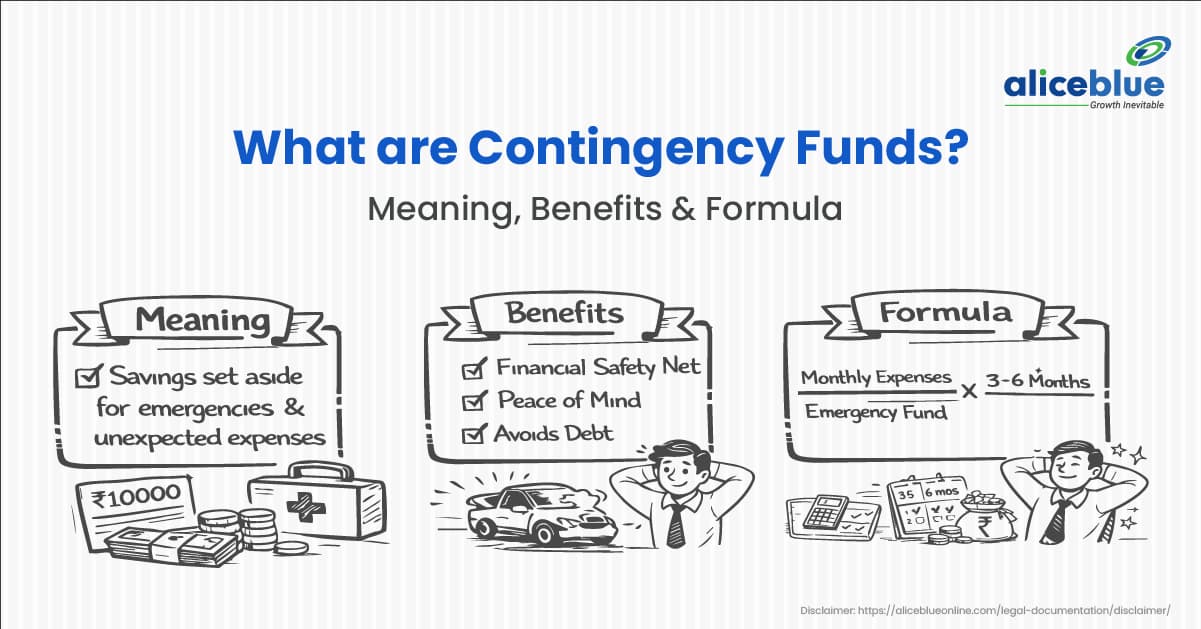
A contingency fund is a fixed amount of money kept separately and in liquid form, used only for genuine unexpected financial emergencies.
It is not for a vacation, a new phone, or a shopping sale. It is for events like:
- A sudden medical expense not covered by insurance
- Job loss or a gap in freelance income
- An urgent home or vehicle repair
- A family emergency that needs immediate cash
Without this fund, most people take a personal loan at 10 to 30% annual interest or redeem SIPs at the wrong time. Both hurt your long term financial plan.
How Much Do You Need? The Formula
Formula 1: Monthly Expense Method
Contingency Fund = Monthly Essential Expenses × 3 to 6 Months
List only the expenses you cannot skip. Rent, groceries, EMIs, utility bills, insurance premiums, and commute costs. Leave out dining out, OTT subscriptions, and any optional spending.
Your Situation | Target Coverage |
Salaried, stable job, no dependants | 3 months |
Salaried, single income, with dependants | 6 months |
Freelancer or consultant | 6 to 9 months |
Business owner with irregular income | 9 to 12 months |
Formula 2: Risk Based Method
Contingency Amount = Estimated Cost of Risk × Probability It Happens
Example: A medical procedure could cost ₹1,50,000. You estimate a 40% chance it happens this year.
₹1,50,000 × 40% = ₹60,000 earmarked for that specific risk
For most salaried individuals, Formula 1 is sufficient.
A Real Example
Arjun, 33, works in Bengaluru. His monthly essential expenses:
Expense | Amount |
Rent | ₹18,000 |
Groceries and utilities | ₹7,000 |
EMI | ₹9,000 |
Insurance premium | ₹2,500 |
Transport | ₹2,500 |
Total | ₹39,000 per month |
Target at 6 months: ₹39,000 × 6 = ₹2,34,000
He keeps ₹1,00,000 in a sweep in FD and ₹1,34,000 in a liquid mutual fund. When his company went through layoffs, he withdrew from the liquid fund. His SIPs kept running. He took no loans.
Where to Keep Your Contingency Fund in India
The money must reach your account within 24 to 48 hours. Beyond that, earn a reasonable return on it.
Instrument | Approx. Returns | Liquidity | Best For |
Savings Account (SBI, HDFC, ICICI) | 2.5 to 3.5% per year | Instant | First ₹30,000 to ₹50,000 as an instant buffer |
Sweep In FD (SBI, HDFC, ICICI) | 6.5 to 7% per year | Same day, no penalty | A stable middle layer for quick access |
Liquid Mutual Fund (Nippon, HDFC, Parag Parikh) | 6.3 to 7.2% per year | Next working day | Best option for amounts above ₹1 lakh |
Overnight Fund | 6 to 6.5% per year | Next working day | Ultra safe option with marginally lower returns |
Note on Small Finance Banks: Banks like Ujjivan SFB and AU SFB advertise high savings account rates, but the 7% rate applies only for balances above ₹10 lakh. For a typical contingency fund of ₹2 to ₹3 lakh, the rate at Ujjivan is just 3% per year. This is not a strong option for most people.
Avoid: Equity mutual funds, 3 to 5 year FDs, ULIPs, and any instrument with a lock in. These cannot be accessed quickly in an emergency.
Tax note: Gains from liquid mutual funds are taxed at your income slab rate if redeemed within 3 years. Factor this in when comparing net returns against a sweep in FD.
DICGC cover: All bank deposits including savings accounts and FDs are insured up to ₹5 lakh per depositor per bank under DICGC.
How to Build Your Contingency Fund from Scratch
- Calculate your monthly essential expenses using actual bank statements, not estimates
- Multiply by 3 to 6 months based on your income stability to set your target
- Set aside 5 to 10% of your take home salary every month toward this fund
- Open a separate bank account only for this purpose
- Do not link a debit card to that account to avoid casual spending
- Review the target once a year as your income and expenses change
Most salaried professionals can build a 6 month fund in 12 to 18 months without pausing any other financial goal.
Benefits of a Contingency Fund
- Your investments stay invested
Equity investments need time to compound. Pulling money out during a crisis locks in losses and breaks your long term plan. - No emergency loans
Personal loan rates in India start from 9.98% and go up to 30% or more at NBFCs as of March 2026. Every rupee borrowed in a panic costs significantly more than the emergency itself. - Financial independence during a crisis
You do not need to ask family, borrow from colleagues, or wait on loan approvals. This matters more than most people realise until they are actually in that situation. - Career flexibility
With 6 months of expenses saved, switching jobs, negotiating a better offer, or taking a short career break becomes financially possible.
Contingency Fund vs Emergency Fund
Contingency Fund | Emergency Fund | |
What it covers | Specific unexpected cost events | Living expenses during income loss |
Key trigger | Medical bill, urgent repair, one time expense | Job loss, business closure, income gap |
Ideal size | 3 to 6 months of essential expenses | 6 to 12 months of living expenses |
Calculation | Probability × estimated cost, or monthly × months | Monthly expenses × months without income |
For most individuals in India, one combined reserve of 6 months covers both adequately.
Common Mistakes to Avoid
- Starting SIPs before building this fund
One early emergency forces you to redeem at a loss. Build the contingency fund first. - Keeping the amount too small
A ₹20,000 buffer covers one hospital bill and nothing more. Base the number on your real monthly expenses. - Using it for non emergencies
Once the balance grows, it starts looking like a bonus fund. It is not. A trip or a gadget is not an emergency. - Locking it in illiquid products
A 5 year FD defeats the entire purpose. Accessibility is the whole point of this fund. - Not updating it after a life change
Marriage, a child, a salary hike, a new EMI: all of these change your monthly expenses and your required target. Review once a year.
Conclusion
A contingency fund will not grow your wealth. That is not what it is for. It keeps the rest of your financial plan intact when something unexpected happens.
Build your target, automate the monthly transfer, keep it liquid, and leave it alone. Once that reserve is in place, every other financial decision you make becomes steadier.
Frequently Asked Questions
A dedicated reserve kept liquid and separate from regular savings, used only for genuine unexpected financial emergencies such as medical bills, job loss, or urgent repairs.
3 to 6 months of essential monthly expenses for salaried individuals. Freelancers and business owners should target 6 to 12 months depending on income stability.
Monthly Essential Expenses × 3 to 6 months is the most practical approach. For specific risk planning, use: Estimated Cost × Probability of Occurrence.
A sweep in FD combined with a liquid mutual fund works well for most people. Avoid equity funds or anything with a lock in period.
Liquid funds offer next day redemption and returns of 6.3 to 7.2% per year. Sweep in FDs are simpler and penalty free. The return difference is small; accessibility matters more here.
Both serve the same purpose for most individuals. A contingency fund is often tied to a specific risk calculation; an emergency fund covers living expenses during income disruption. A 6 month reserve covers both.
A constitutional reserve under Article 267, held by the President, used to meet urgent government expenditure when Parliament is not in session. It has no connection to personal finance.
If your target is ₹2,40,000 and you save ₹15,000 to ₹20,000 per month, you reach it in 12 to 16 months. Automating the transfer on salary day makes it consistent.

Blog by Aliceblue News Desk


