
What Is a Correspondent Bank and How Does It Affect Your International SWIFT Transfer in India
Blog by Aliceblue News Desk
29 May 2026
16 minutes
Your US client sent $5,500. Your bank account got credited with $5,490. Your bank says the transfer is complete. Your client says they sent the full amount. Nobody is wrong. A bank you never heard of took $10 somewhere in the middle of the transfer.
That bank is called a correspondent bank. If you receive or send money internationally through SWIFT, this happens on every single transfer. This article covers what correspondent banks are, how they work inside India’s banking system, what they actually charge, what the RBI requires you to do after receiving foreign money, and how to stop losing money on every transfer.
What Is a Correspondent Bank
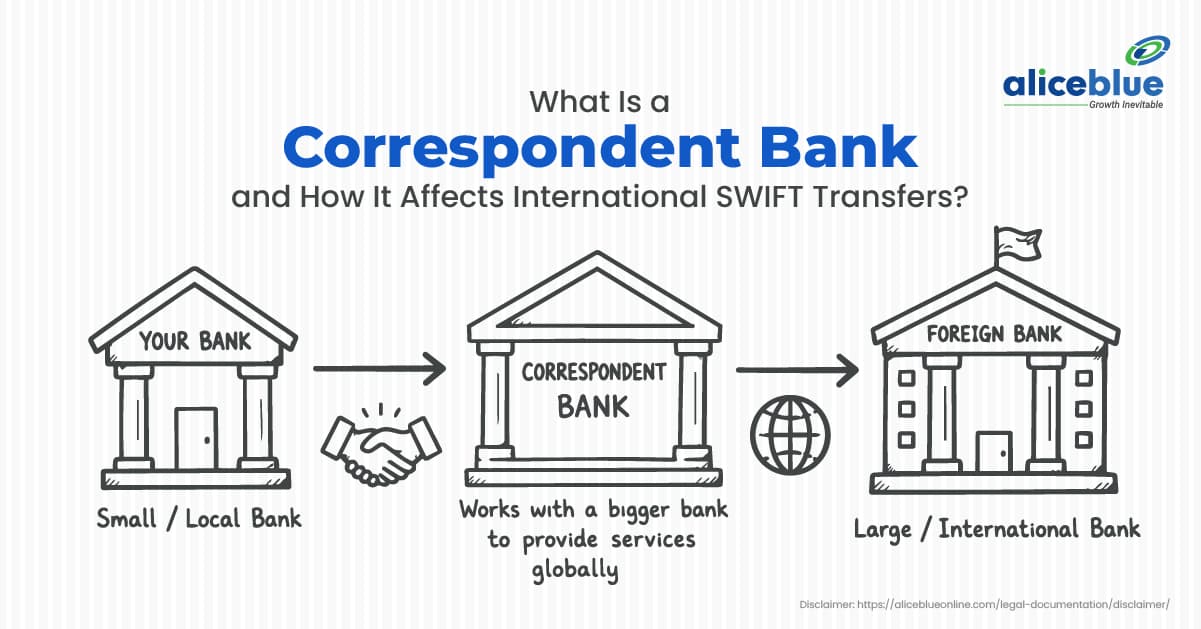
A correspondent bank is a large international bank that processes a cross-border SWIFT transfer on behalf of two banks that have no direct banking relationship with each other.
When your Indian bank sends or receives money from a foreign bank, the two institutions often have no shared accounts and no bilateral agreement. A third, larger bank that already has relationships on both sides steps in to process the payment. That is the correspondent bank.
Banks like Citibank, JPMorgan Chase, Deutsche Bank, Bank of New York Mellon, and Standard Chartered are the most commonly used correspondent banks for Indian transactions. Union Bank of India, for example, maintains Nostro accounts with JPMorgan Chase New York (SWIFT code CHASUS33), Citibank New York (CITIUS33), Bank of New York Mellon (IRVTUS3N), Deutsche Bank Frankfurt (DEUTDEFF), and Barclays London (BARCGB22), among others. The same structure applies across SBI, Canara Bank, Indian Bank, and most public and private sector banks.
The Indian bank using the correspondent’s network is called the respondent bank. The large international bank providing the service is the correspondent bank.
Why Indian Banks Need Correspondent Banks
India has over 1,500 scheduled commercial banks, cooperative banks, regional rural banks, and small finance banks. Building direct accounts and bilateral agreements with banks across 180-plus countries is not feasible for any of them individually, not even SBI.
Even the country’s largest banks use correspondent banks for specific currencies and corridors. A cooperative bank in Coimbatore sending a SWIFT transfer to Vietnam will pass through two or three correspondent banks before the money reaches its destination. This is not a system flaw. It is how global banking infrastructure is built and has operated for decades.
The problem is not the structure. The problem is that the fees and delays are never explained up front, and most Indian bank staff do not mention them unless specifically asked.
How a SWIFT Transfer Moves Through Correspondent Banks
SWIFT stands for Society for Worldwide Interbank Financial Telecommunication. It is a secure messaging network that connects over 11,000 banks globally. It does not move money. It sends encrypted payment instructions between banks. The actual money moves through shared accounts that banks maintain at each other.
Here is the step-by-step flow for a typical inward SWIFT transfer to India:
- Your overseas client instructs their bank to send money to your Indian account, providing your bank’s SWIFT code, your account number, and your bank’s correspondent bank details.
- The overseas bank checks whether it has a direct relationship with your Indian bank. For most Indian banks other than the top five, it does not.
- The overseas bank routes the payment through a correspondent bank, typically a large US, UK, or European institution, where your Indian bank holds a pre-funded foreign currency account called a Nostro account.
- The correspondent bank deducts its handling fee, adjusts the Nostro account balance, and either credits your Indian bank directly or passes the transfer to one more intermediary bank if the route requires an additional hop.
- Your Indian bank debits its Nostro account, converts the foreign currency to INR, and credits the final amount to your account after deducting its own lifting fee and applying its FX conversion margin.
Nostro and Vostro Accounts: How Settlement Works
Two terms define how money actually settles across borders without physically moving cash each time.
A Nostro account is the account your Indian bank maintains at a foreign correspondent bank, denominated in foreign currency. Nostro is Latin for ours. From your bank’s perspective, it is money your bank holds abroad.
A Vostro account is the same account viewed from the correspondent bank’s side. They call it yours because the funds belong to their Indian banking partner.
When Canara Bank holds a USD account at JPMorgan Chase in New York, Canara calls it a Nostro account. JPMorgan calls it a Vostro account. Transfers are settled by debiting and crediting this shared pre-funded pool. No physical currency moves across borders for every individual transaction.
A Real Example: What Happens to Priya's Payment From the UK
Priya is a content strategist in Mumbai. Her UK client owes her GBP 3,000 for a completed project, approximately INR 3,18,000 at current rates. The client banks with Barclays UK and initiates a SWIFT transfer to Priya’s ICICI Bank account.
Here is every deduction, step by step:
Step in the Transfer Chain | Deduction | Amount Remaining |
Barclays UK initiates GBP 3,000 | None at initiation | GBP 3,000 |
Deutsche Bank Frankfurt processes the transfer as a correspondent | GBP 12 | GBP 2,988 |
ICICI Bank applies a lifting fee | INR 500 | |
ICICI Bank FX markup at 0.5% over the interbank rate | Approx INR 1,590 | |
Priya’s account is credited | Approx INR 3,14,500 |
Nothing went wrong. Priya receives INR 3,14,500 instead of INR 3,18,000 because of the combined effect of the correspondent bank fee, the lifting fee, and the FX conversion margin. Every one of these charges is avoidable or reducible with the right instructions before the transfer is sent.
What Correspondent Banks Actually Charge
Here are verified fee ranges based on publicly available information from Indian banks and international sources:
Fee Type | Typical Range | Who Pays |
Correspondent bank fee | USD 10 to USD 40 per transfer | Sender or recipient based on the charge option |
Sending bank SWIFT charge | INR 500 to INR 2,000 | Sender |
Receiving bank lifting fee | INR 500 to INR 1,500 | Recipient |
FX conversion markup | 0.5% to 2% over the interbank rate | Whoever converts |
Return fee if transfer fails | USD 10 to USD 30 | Sender, non-refundable |
FIRA issuance fee at PSU banks | INR 100 to INR 800 per certificate | Recipient |
HDFC Bank charges INR 500 for inward transfers up to $500 and INR 1,000 for transfers above $500 from Australia, and separately states that correspondent bank charges are outside its control and responsibility. ICICI Bank charges zero inward remittance fees but explicitly notes that the sender’s bank or correspondent bank may deduct charges before the funds reach India.
Indian banks themselves generally charge under USD 10 for outward SWIFT transfers, making the correspondent bank’s USD 10 to USD 40 fee the larger deduction in most cases.
OUR, SHA, and BEN: The Three Charge Options Nobody Explains
Every SWIFT transfer form at an Indian bank has a field for the charge option. Most bank staff select SHA by default without explaining what each option means. Here is exactly what they do:
OUR means the sender pays all fees, including the correspondent bank’s charge. The recipient receives the exact amount that was sent. This is the right option for all business payments where the recipient expects the full invoiced amount.
SHA means fees are split. The sender pays their own bank’s outward SWIFT charge. The correspondent bank deducts its fee from what the recipient receives. This is the default for most retail transfers and the most common reason Indian freelancers and NRIs receive less than expected.
BEN means the recipient pays all fees, including the sending bank’s charge. Rarely used in practice because the recipient has no visibility into what will be deducted before the money arrives.
The single most common complaint in Indian freelancer communities, specifically that the client sent the full invoice amount, but the recipient got less, is almost always a SHA transfer. The client paid their own bank’s fee. The correspondent bank took its cut from the recipient’s side. Agreeing on OUR before the transfer is initiated prevents this entirely.
FIRA: The RBI Document Every Indian Freelancer and Exporter Must Obtain
FIRA stands for Foreign Inward Remittance Advice. It is the RBI-mandated certificate that your Indian bank issues after crediting an incoming international payment to your account. It is the official proof that you received foreign income in compliance with FEMA, the Foreign Exchange Management Act.
Under RBI and FEMA provisions, the first Indian bank that receives the foreign currency inward remittance is responsible for issuing the FIRA.
You need FIRA for the following purposes in India:
Filing income tax returns where foreign income must be declared. Claiming GST zero rating as a service exporter under the LUT, Letter of Undertaking. Applying for export incentive schemes. Providing proof of foreign earnings to your CA during a tax audit or LUT renewal.
How to get it from your bank: Request it from your bank’s forex or NRI services desk, quoting your account credit date and the sender’s name. PSU banks, including SBI, Bank of Baroda, and Canara Bank, typically take 7 to 15 working days. Private banks vary. HDFC Bank is known within Indian freelancer communities for slow issuance requiring repeated follow-up. Your bank may charge INR 100 to INR 800 per certificate.
Fintech platforms, including Xflow, Skydo, and Wise Business accounts, generate FIRA automatically and free of charge within 24 hours of the credit.
The older term is FIRC, Foreign Inward Remittance Certificate. RBI transitioned to the FIRA system, but many CAs, government portals, and bank staff still use FIRC. Both refer to the same document.
RBI Purpose Codes: The Most Common Cause of Held Transfers in India
Every incoming SWIFT payment to India requires the overseas sender to declare an RBI purpose code. This is a classification that identifies the nature of the foreign income. It is a FEMA requirement, not optional. If the code is missing or incorrect, your Indian Authorised Dealer bank cannot credit the funds until it receives written clarification from the remitting bank. That process takes 5 to 10 working days minimum across time zones.
Common purpose codes for Indian freelancers and service exporters, verified against RBI classification:
Purpose Code | What It Covers |
P0802 | Software and IT consultancy services |
P0805 | IT-enabled services |
P0808 | Technical and engineering services |
P0813 | Digital and audiovisual content |
P0814 | Design, creative, and professional services |
P1007 | General business and professional services |
P0103 | Royalties, licence fees, and IP receipts |
Tell your overseas client to include your purpose code in the payment instruction before the transfer is initiated, typically in Field 70 or Field 72 of the SWIFT message. Most correspondent banks pass this information through the chain when it is present at the source. When it is absent on arrival at your Indian bank, the credit is held.
The MT103: Your Most Practical Tool When a Transfer Goes Wrong
When a transfer arrives short or does not arrive, most Indian bank staff tell you to wait a few more days. The MT103 gives you something specific to act on.
An MT103 is the official SWIFT payment instruction generated every time a bank processes a cross-border transfer. It contains every bank in the transfer chain in sequence, every fee deducted at each hop, the original amount, the charge option used, and the UETR, which is the Unique End-to-End Transaction Reference used for GPI tracking.
Ask your overseas client to share the MT103 the same day they initiate the transfer. Most banks generate it immediately. When a shortfall occurs, the MT103 shows exactly which bank deducted what amount. Your bank can resolve the issue in 48 hours with an MT103. Without it, the investigation involves manual queries across multiple banks in different time zones and routinely takes two to three weeks.
SWIFT GPI and UETR Tracking
SWIFT GPI, Global Payments Innovation, is now mandatory for supervised financial institutions on the SWIFT network. Since November 2020, all cross-border transactions processed via SWIFT carry a UETR.
Under SWIFT GPI, over 50% of transfers are credited to the recipient within 30 minutes of initiation. Every transfer carries a UETR, a 36-character unique identifier that follows the payment through every bank in the chain. Each bank in the chain must pass the UETR and fee deduction data forward.
HDFC Bank, ICICI Bank, SBI, Axis Bank, and Kotak Mahindra Bank support SWIFT GPI. When you initiate a transfer, ask your bank for the UETR number. If your bank supports GPI tracking, you can see exactly where your money is at any given point, which bank processed it, and whether a delay occurred.
One important limitation: for full end-to-end tracking to work, all banks in the chain must be GPI-enabled. If one bank in the chain is not GPI-enabled, the tracking becomes partial, and manual follow-up is required.
Correspondent Bank vs. Intermediary Bank
Bank forms use these terms in adjacent fields. Bank staff use them interchangeably. They are not identical.
Feature | Correspondent Bank | Intermediary Bank |
Formal relationship | Bilateral agreement with the Indian bank | May or may not have a formal agreement |
Account type | Holds dedicated Nostro and Vostro accounts | May not hold dedicated accounts |
Currency scope | Handles multiple currencies | Typically handles one specific corridor |
Indian bank forms | Listed as an Intermediary Bank SWIFT code | Same field, used interchangeably |
Indian example | Canara Bank uses JPMorgan Chase NY for USD | A small bank routes through SBI before reaching JPMorgan |
When an Indian bank form asks for an Intermediary Bank SWIFT code, it means the correspondent bank for that currency. For USD transfers from most Indian banks, the entries are JPMorgan Chase New York at CHASUS33, Bank of New York Mellon at IRVTUS3N, or Citibank New York at CITIUS33. For EUR transfers, commonly used correspondents include Deutsche Bank Frankfurt at DEUTDEFF and Commerzbank Frankfurt at COBADEFF. Your specific bank’s inward remittance instruction page publishes the exact correspondent bank name, SWIFT code, and Nostro account number. Providing these details to your overseas client is the single most effective way to prevent routing errors and return charges.
Modern Alternatives for Indian Recipients
For freelancers, NRIs, and small businesses making regular transfers under USD 50,000, three services now route money outside the traditional correspondent banking chain.
Wise uses local bank accounts in each country. A US client pays into Wise’s US bank account. Wise credits you from its RBI-registered Indian pool. The money never crosses a border, which eliminates correspondent bank fees. Wise issues e-FIRC automatically for business account holders.
Xflow provides a virtual USD, EUR, or GBP account number, called a VBAN, that overseas clients pay into. Xflow converts at a competitive rate, credits INR directly to your Indian savings account, handles RBI purpose code compliance, and generates FIRA automatically for free.
Skydo converts at the live FX rate with no markup, charges a flat fee per transaction, and generates FIRA automatically for every inward payment.
For large business transfers above USD 50,000, LC settlements, FDI receipts, and export advance payments, traditional SWIFT through your Indian Authorised Dealer bank remains the required route. FEMA documentary compliance for these transactions requires the full correspondent banking chain and cannot be substituted with fintech platforms.
Common Mistakes That Cost Indian Senders and Recipients Money
- Choosing SHA without informing the recipient: Under SHA, the correspondent bank deducts its fee from what the recipient receives. If the client sends the exact invoice amount under SHA, the recipient gets less. Fixing this requires a second transfer and a second round of fees. Agree on OUR before the first transfer leaves the client’s bank.
- Not providing the correct correspondent bank SWIFT code and Nostro account number: Federal Bank, Canara Bank, and most Indian banks require the sender to include the Indian bank’s correspondent bank SWIFT code and Nostro account number in the wire instruction. When this is missing, the transfer queues for manual review or is returned after 5 to 7 days, with non-refundable return charges deducted.
- Sending on Friday after 3 PM IST: A transfer initiated late Friday in India does not reach the correspondent bank’s processing queue until Monday morning in New York or Frankfurt. For time-sensitive payments, send by Wednesday afternoon.
- Not providing the RBI purpose code to your client: An incorrect or missing purpose code causes your Indian bank to hold the incoming credit and request a written clarification from the sending bank. Across time zones, resolution takes 5 to 10 working days.
- Ignoring the FX conversion margin: On an INR 10 lakh transfer, a 1.5% FX markup costs INR 15,000 more than the mid-market rate. Check your bank’s buying rate against the live rate on XE.com or Google Finance before converting any amount above INR 5 lakh.
- Not requesting FIRA within one week of the credit: PSU banks take 7 to 15 working days to issue FIRA. Waiting three months and then chasing a bank for a document about an old transaction wastes time that is entirely avoidable.
- Not asking for the MT103: When a transfer arrives short, the MT103 resolves the issue in 48 hours. Without it, a manual query across multiple banks in different time zones takes two to three weeks.
Conclusion
Correspondent banks sit inside every international SWIFT transfer involving India unless your bank has a direct relationship with the recipient’s institution, which is rare outside the largest global banking corridors. The fees are real: USD 10 to USD 40 per correspondent bank hop, a FX margin of 0.5% to 2%, and a processing time of 2 to 5 business days.
Four steps protect you on every transfer: select OUR when the recipient must receive the full invoice amount; share your correct RBI purpose code with your client before the transfer is initiated; request your FIRA within one week of every inward credit; ask your client for the MT103 the same day they send the payment. If you receive regular payments below USD 50,000 per transfer, compare what Xflow, Skydo, or Wise Business actually costs against your current SWIFT route. The annual fee difference is often significant.
Frequently Asked Questions
A correspondent bank is a large international bank that processes a cross-border money transfer when the sending bank and the receiving bank have no direct relationship. It charges a fee of approximately USD 10 to USD 40 per transaction for this service.
The most likely reason is the SHA charge option. The correspondent bank deducted its fee from what you received rather than from the sender. Ask your client for the MT103 to see exactly which bank deducted what amount. For future transfers, ask your client to select OUR so the full invoiced amount reaches you.
FIRA is the RBI-mandated certificate your Indian bank issues after crediting an incoming international payment. You need it to file income tax returns with foreign income declared, claim GST zero rating as a service exporter, and provide proof of foreign earnings to your CA. PSU banks take 7 to 15 working days to issue it. Xflow, Skydo, and Wise Business generate it automatically within 24 hours.
OUR means the sender pays all fees and the recipient gets the full amount. SHA means fees are split, and the correspondent bank fee is deducted from what the recipient receives. BEN means the recipient pays everything. Use OUR for all business and invoice payments.
For software and IT consultancy, use P0802. For IT-enabled services, use P0805. For design and creative services, use P0814. For general business and professional services, use P1007. Share this code with your client before they initiate the transfer and ask them to include it in Field 70 or 72 of the SWIFT message.
An MT103 is the official SWIFT message generated for every bank-to-bank international transfer. It shows every bank in the chain, every fee deducted, the charge option used, and the UETR tracking number. When a transfer arrives short or is delayed, the MT103 allows your bank to trace the issue to a specific point in the chain within 48 hours.
Ask your bank for the UETR number. HDFC Bank, ICICI Bank, SBI, Axis Bank, and Kotak Mahindra Bank all support SWIFT GPI tracking. The UETR lets you trace the transfer through every bank in the chain. Note that if any one bank in the chain is not GPI-enabled, tracking becomes partial, and you will need the MT103 for a complete investigation.

Blog by Aliceblue News Desk


