
What Is CKYC in Banking? Meaning, Process, Benefits, and How It Works
Blog by Aliceblue News Desk
31 May 2026
10 minutes
Suppose you open a bank account today, apply for a Demat account next month, and later start investing in mutual funds. In most cases, every institution may ask you to submit the same KYC documents again, such as your PAN card, Aadhaar card, photograph, and address proof.
Repeating the same verification process can become time-consuming, especially for people using multiple financial services.
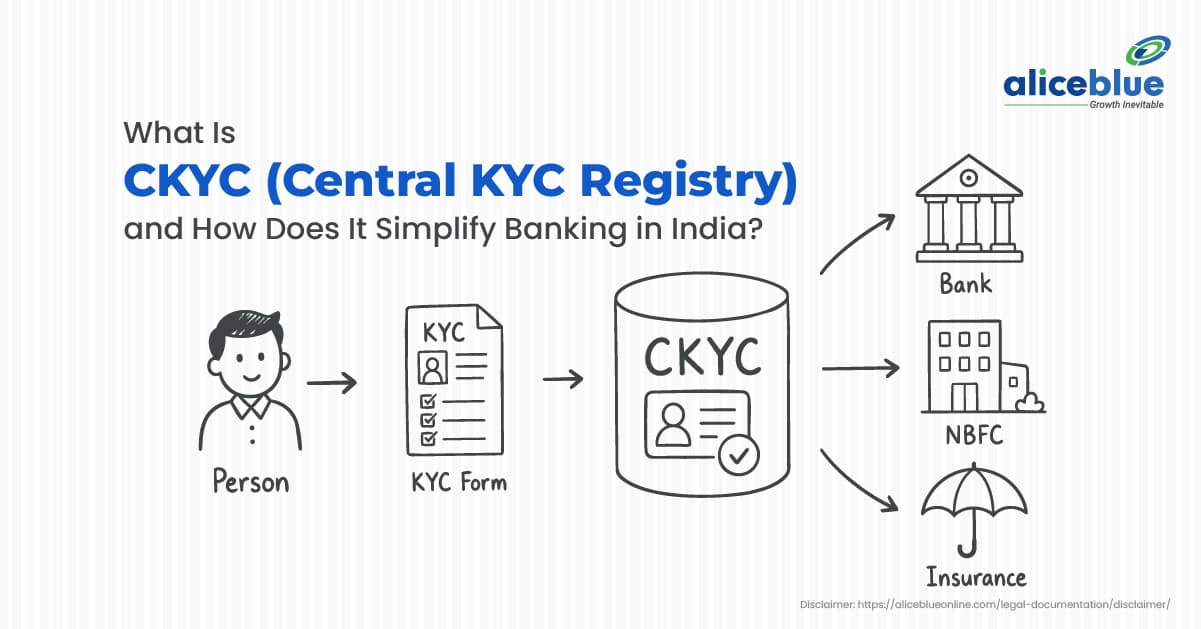
To make this process easier, the Government of India introduced the CKYC system. CKYC allows financial institutions to access a customer’s verified KYC records from one central database instead of collecting the same documents repeatedly.
For investors and traders, this means:
- Less paperwork
- Faster account opening
- Easier verification
- Smoother onboarding across financial platforms
In this article, you will learn what CKYC is, how the Central KYC Registry works, its benefits and limitations, and why it is important for stock market investors in India.
What Is CKYC in Banking?
CKYC stands for Central Know Your Customer. It is a centralised system that stores customer KYC records in one common database.
The CKYC Registry is managed by CERSAI (Central Registry of Securitisation, Asset Reconstruction, and Security Interest of India). The system was introduced to reduce repeated KYC submissions across banks and financial institutions.
Once your CKYC registration is completed, your verified KYC details can be accessed by:
- Banks
- Stockbrokers
- Mutual fund companies
- Insurance companies
- NBFCs
This is done using your unique CKYC number.
In simple terms, CKYC works like a common KYC record that can be used across different financial services.
Before CKYC was introduced, customers had to complete separate KYC verification every time they opened:
- A Bank account
- A Demat account
- A Trading account
- A Mutual fund account
- An Insurance policy
This created unnecessary paperwork and delayed account opening. CKYC was introduced to make the verification process simpler and more organised.
Main Purpose of CKYC
The main purpose of CKYC is to store verified customer records in one central registry so that financial institutions can access them whenever required.
This helps customers avoid submitting the same documents repeatedly while opening new financial accounts.
CKYC helps to:
- Reduce repeated KYC submission
- Make customer verification faster
- Improve accuracy in customer records
- Reduce fake identities and fraudulent accounts
- Make financial onboarding easier
For investors, CKYC is especially useful while opening:
- Demat accounts
- Trading accounts
- Mutual fund accounts
- Commodity trading accounts
How Does CKYC Work?
The CKYC process follows a centralised verification system where customer records are stored in one place and later shared with authorised financial institutions.
Here is how the process works step by step.
Step 1: Submit KYC Documents
When opening an account with a bank, broker, or mutual fund company, customers usually submit:
- PAN card
- Aadhaar card
- Address proof
- Passport-size photograph
- Signature
The institution verifies these documents to confirm the customer’s identity and address.
Step 2: KYC Details Are Uploaded to the CKYC Registry
After verification, the institution uploads the customer’s KYC information to the CKYC Registry maintained by CERSAI.
The records are stored securely in a centralised database.
Step 3: CKYC Number Is Generated
Once registration is completed successfully, the customer receives a unique 14-digit CKYC number, also called the KIN (KYC Identification Number).
Example:
CKYC Number: 12345678901234
This number acts as a permanent KYC reference for future financial activities.
Step 4: Financial Institutions Access Existing KYC Records
Suppose the customer later wants to:
- Open a Demat account
- Start a SIP
- Apply for an IPO
- Open another bank account
Instead of asking for all documents again, the institution can retrieve the customer’s existing KYC records from CKYC using the 14-digit CKYC number. In most cases, the customer only needs to provide:
- CKYC number (14 digits)
- PAN (or Form 60 if PAN is not available) (Reserve Bank of India)
- A quick verification/update document only if asked (for example, when your address/name has changed or the CKYC record needs refresh):
- One Officially Valid Document (OVD) as proof of identity/address — Passport, Driving Licence, proof of possession of Aadhaar number, Voter ID, NREGA job card, or NPR letter (Reserve Bank of India)
- Recent photograph (some institutions may take a live photo/selfie for verification)
Note: Even with CKYC, the institution may ask for extra documents depending on the product (example: income proof for certain accounts/loans/investments).
This makes verification quicker and reduces repeated paperwork.
How to check CKYC number
1. Check the SMS / Email you already received
When a CKYC record is created, the CKYC number is usually shared with the customer through SMS or email (often via the bank/AMC/insurer).
Search your inbox/SMS for: “CKYC”, “CERSAI”, “KYC Identifier”, “KIN”.
2. Give a missed call (official method)
Give a missed call from your mobile number registered with CKYC to: 7799022129.
You’ll receive an SMS link to view/download the CKYC card (the CKYC number is printed on it).
3. Fetch your CKYC Card on the official CKYC portal (OTP-based)
Use the official “Fetch your CKYC Card” page, verify your registered mobile number via OTP, and you’ll get an SMS link to download the CKYC card.
4. Ask your bank / broker / mutual fund / insurer
If your mobile number has changed (or you can’t get the OTP), contact the institution where you last did KYC. They can help you retrieve your CKYC number after verifying your identity.
Tip: Don’t share OTPs or card download links with anyone. Only use the official CKYC site or your institution’s official support.
Example of CKYC in Real Life
Let us understand this with a simple example.
Ananya opens a savings account with a bank and completes her KYC verification using her PAN card, Aadhaar card, and address proof. After verification, the bank uploads her details to the CKYC Registry, and she receives a 14-digit CKYC number.
A few months later, Ananya decides to open a Demat and trading account to start investing in the stock market.
Instead of uploading all her documents again:
- Ananya shares her CKYC number with the broker
- The broker accesses her verified KYC details from the registry
- Verification gets completed much faster
This saves time and makes the account opening process easier.
Important Features of CKYC
1. Centralised KYC Storage
CKYC stores customer KYC records in one common registry instead of maintaining separate records with every financial institution.
Authorised institutions can access verified customer information whenever required.
2. Unique CKYC Number
Every registered customer receives a unique 14-digit CKYC number.
This number can be used across different financial services and institutions.
3. Reduced Paperwork
Customers usually do not need to repeatedly upload the same KYC documents while opening new accounts.
This makes the verification process easier and less time-consuming.
4. Accepted Across Multiple Financial Services
CKYC can be used across:
- Banks
- Stockbrokers
- Mutual fund companies
- Insurance providers
- NBFCs
This allows customers to use one KYC record across different financial products.
5. Faster Verification Process
Since institutions can directly access verified customer records, account opening and onboarding become quicker.
This is especially useful during online account opening.
6. Digital Record Management
CKYC records are stored electronically instead of depending entirely on physical paperwork.
This reduces manual work and improves record management.
Types of CKYC Accounts
CKYC Type | Description |
Normal CKYC Account | Created using officially valid documents such as PAN and Aadhaar |
Simplified CKYC Account | Created using simplified documents for low-risk customers |
Small CKYC Account | Designed for customers with limited KYC documents |
OTP-Based eKYC Account | Created through Aadhaar OTP verification during online onboarding |
Benefits of CKYC
1. One-Time KYC Registration
Once CKYC registration is completed, customers usually do not need to repeat the full KYC process every time they open a new financial account.
2. Faster Account Opening
Banks and brokers can quickly access existing customer records through the CKYC Registry.
This helps speed up:
- Demat account opening
- Trading account activation
- Mutual fund onboarding
- IPO applications
3. Better Accuracy of Customer Information
Since institutions use the same verified records, the chances of mismatched customer details become lower.
This helps reduce verification errors.
4. Lower Risk of Fraud
Centralised verification helps reduce fake identities and fraudulent account openings.
This improves security for both customers and financial institutions.
5. Easier Access to Financial Services
After completing CKYC once, customers can use different financial services more conveniently without repeating the same process again and again.
6. Useful for Active Investors
Investors who use multiple brokers or investment platforms can save time because they do not need to repeatedly submit the same documents.
Risks or Limitations of CKYC
Although CKYC offers several advantages, it also has a few limitations.
1. Delays in Updating Information
If a customer changes:
- Address
- Mobile number
- Email ID
The updated information may take time to appear across all connected institutions.
2. Additional Verification May Still Be Required
Some institutions may still ask for extra documents or fresh verification based on their internal compliance policies.
3. Incorrect Details Can Create Problems
Mistakes in details such as:
- Name
- PAN number
- Date of birth
- Address
can create issues during verification and may delay account opening.
4. Technical Challenges
Some smaller financial institutions may face technical difficulties while integrating with the CKYC system.
5. Privacy Concerns
Since customer information is stored in a central database, some users may worry about data privacy.
However, regulated institutions follow security guidelines while handling CKYC records.
CKYC vs KYC vs eKYC
Feature | CKYC | KYC | eKYC |
Meaning | Centralised KYC registry | Standard identity verification | Electronic KYC verification |
Database | Central registry | Separate for each institution | Digital verification system |
Document Submission | Usually one-time | Often repeated | Depends on the provider |
Verification Method | Centralized access | Manual verification | Aadhaar OTP or biometric |
Usage | Across institutions | Single institution | Mostly online onboarding |
Speed | Faster after registration | Slower | Quick |
Common Mistakes Beginners Make with CKYC
1. Thinking CKYC Means No Documents Will Ever Be Needed
Some people believe that once CKYC is completed, they will never need to submit documents again. However, banks or brokers may still ask for additional proof in certain situations.
2. Entering Incorrect Information
Mistakes in details like name spelling, PAN number, or address can create problems during verification.
Even small errors may delay account approval.
3. Not Updating CKYC Details
If your address, mobile number, or email ID changes, your CKYC records should also be updated.
Old information may create issues later.
4. Confusing CKYC with Demat KYC
Many beginners think CKYC and Demat KYC are the same.
CKYC works across multiple financial services, while Demat KYC mainly relates to stock market accounts.
5. Not Checking CKYC Status
Some customers complete their KYC process but never check whether their CKYC registration was updated successfully.
This can sometimes delay future account opening.
Who Should Use CKYC?
CKYC is useful for almost every financial customer in India, especially people who regularly use banking or investment services.
It is particularly helpful for:
- Stock market investors
- Mutual fund investors
- Frequent traders
- Bank customers
- Insurance buyers
- People opening multiple financial accounts
Even customers who currently use only one financial institution may benefit from CKYC in the future.
How to Check Your CKYC Status
Customers can check their CKYC status through:
- Banks
- Stockbrokers
- Mutual fund platforms
- Financial institutions connected with CERSAI
Generally, customers may need:
- PAN number
- CKYC number
- Mobile verification
Some institutions also provide online CKYC status tracking.
How CKYC Helps the Stock Market and Investors
CKYC makes account opening and verification easier for stock market investors.
Since brokers can access verified customer records directly from the CKYC Registry, investors do not need to repeatedly upload the same KYC documents while opening:
- Demat accounts
- Trading accounts
- Mutual fund accounts
This becomes especially useful during:
- Online account opening
- IPO applications
- Broker onboarding
For active investors, CKYC saves time and reduces repeated paperwork.
Conclusion
CKYC has made customer verification more convenient across India’s financial system. Instead of completing separate KYC processes for every institution, customers can use one centralized KYC record across banks, brokers, mutual funds, and insurance companies.
For stock market investors, CKYC makes account opening easier and reduces repeated document submission.
At the same time, customers should ensure that their information remains updated and accurate to avoid verification issues later.
Frequently Asked Questions (FAQs)
CKYC stands for Central Know Your Customer. It is a centralised system where customer KYC records are stored and shared across banks, brokers, mutual fund companies, and other financial institutions.
This helps reduce repeated paperwork and makes account verification easier.
In normal KYC, customers may need to submit documents separately to every institution.
CKYC stores customer records in one central registry that can be accessed across multiple financial institutions.
A CKYC number is a unique 14-digit identification number given after successful CKYC registration.
It acts as a common KYC reference across different financial services.
Most brokers require KYC verification before allowing stock market investments.
CKYC helps make this verification process faster and more convenient for investors.
Yes. Customers can update details such as address, mobile number, and email ID through institutions connected with the CKYC system.
Keeping your information updated helps avoid future verification problems.
Aadhaar is commonly used for CKYC verification, but other officially valid documents, such as a PAN card, a passport, or a voter ID, may also be accepted.
The accepted documents may vary depending on the institution.
CKYC generally remains valid unless customer information changes or updated verification is required.
Customers should keep their KYC details updated regularly.

Blog by Aliceblue News Desk


