
What Is an Exit Load in Mutual Funds and How to Avoid It?
Blog by Aliceblue News Desk
15 April 2026
6 minutes
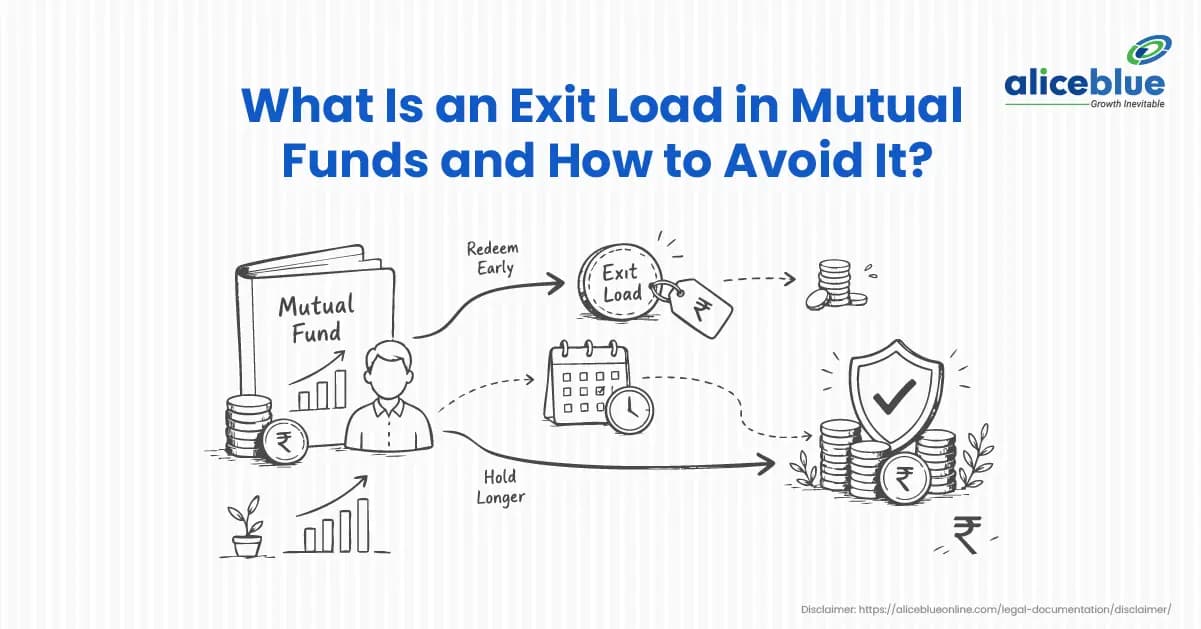
You redeemed your mutual fund and expected ₹110,000, but got less. What happened? That small deduction is called an exit load, and most investors don’t notice it until it’s too late.
This article explains what an exit load in mutual funds is, how it works, and simple ways to avoid it. We’ll cover SEBI rules, India‑specific examples, and practical tips for beginners. You’ll also learn how to structure redemptions, so you pay as little as possible.
What Is an Exit Load in Mutual Funds (India)?
An exit load in mutual funds is a fee a fund house charges when you sell or redeem your units before a set period. This period is usually short, such as 6 or 12 months, depending on the scheme.
The main purpose is to discourage short‑term trading. When too many investors exit early, the fund may have to sell assets quickly, which can hurt returns for long‑term holders.
SEBI Rules on Exit Load in Mutual Funds (India)
SEBI (Securities and Exchange Board of India) allows exit loads with clear limits:
- The maximum exit load cannot exceed 2% of the redemption amount.
- It applies only to the amount redeemed, not your entire investment.
- The fund must disclose exit load rules in its Scheme Information Document (SID) and Key Information Memorandum (KIM).
Most equity funds in India charge 1% if redeemed within 12 months. Some debt funds charge for 6-15 days. Liquid and overnight funds usually have no exit load.
How Does Exit Load Work in Mutual Funds?
Exit load follows a clear process. Here’s how it works step by step.
Step 1: Check the holding period
Every scheme has an exit‑load window. For example:
- Equity growth fund: 1% exit load if redeemed within 12 months.
- Short‑term debt fund: 0.5% if redeemed within 15 days.
Always check the SID before redeeming.
Step 2: Calculate the exit load
Exit load is a percentage of the redemption value:
- Redemption value = Number of units × NAV on redemption date
- Exit load = Redemption value × Exit load %
If you redeem ₹110,000 at 1% load, the fee is ₹1,100.
Step 3: Deduct from your payout
Mutual fund platforms automatically deduct the exit load. The rest goes to your bank account. No load applies if you hold beyond the specified period. Some funds use tiered structures, like 1% for 6 months, 0.5% for 12 months, and 0% after.
Example: How Exit Load Affects Your Returns
Suppose you invest ₹100,000 in an equity fund with a 1% exit load if redeemed within 12 months. After 6 months, your investment is worth ₹110,000.
- Exit load: 1% of ₹110,000 = ₹1,100
- Payout: ₹110,000 – ₹1,100 = ₹108,900
If you hold for 13 months, the value is still ₹110,000, and you get the full amount minus taxes. This shows how timing matters.
Key Features of Exit Load in Mutual Funds
- Time‑bound: Applies only if you redeem within the specified period.
- Percentage‑based: Usually 0.5%-2%, scheme‑specific.
- Scheme‑specific: Equity funds often have it; liquid funds usually don’t.
- Non‑refundable: Fees go back into the fund to cover costs.
- Disclosed upfront: Clear in SID and KIM.
Advantages of Exit Load for Investors
- Exit load helps control portfolio churn by discouraging frequent buying and selling.
- It keeps the fund more stable, which benefits long‑term investors, especially in equity schemes.
- It encourages disciplined investing for long‑term goals like retirement or children’s education.
- Less frequent redemptions can support better fund performance over time.
Risks and Limitations of Exit Load
- Redeeming early reduces liquidity in emergencies. For example, redeeming ₹50,000 at 1% exit load costs ₹500.
- It can lock you into an underperforming fund because you may avoid paying the fee even when the fund is not delivering.
- The concept adds complexity for beginners, especially if they overlook the exit load details in the SID.
- Exit load, when combined with short‑term capital gains tax (15% for equity funds held less than 12 months), makes early exits more costly overall.
Exit Load vs Entry Load: How It’s Different
Entry loads are banned. Exit loads are allowed.
Feature | Exit Load | Entry Load (Banned) |
When charged | At redemption | At purchase |
Purpose | Discourage short exits | Recover distribution costs |
Current status | Up to 2% | Banned |
Impact | Reduces payout | Reduces initial investment |
SEBI rule | Disclosed in documents | Phased out |
Common Mistakes with Exit Load
- Skipping the SID and KIM: Many investors ignore these documents. Check the exit load before investing.
- Redeeming fresh SIP instalments: If you redeem all units at once, newer SIP instalments may still be within the exit load period.
- Not using FIFO in SIPs: Platforms follow FIFO (First In, First Out). The oldest units are redeemed first. If you redeem after 11 months, the earliest units may still attract a load.
- Ignoring fund‑type differences: Equity funds often charge for 12 months. Debt funds may charge for 6-15 days. Liquid funds usually have no load.
- Not planning for emergencies: Reacting in a panic forces you to pay. Keep an emergency fund in liquid instruments.
Who Should Use Funds with an Exit Load?
- Exit load suits long‑term investors who plan to stay invested for many years.
- It works well for SIP investors who want to build wealth gradually and avoid frequent exits.
- It is suitable for goal‑based planners, such as those saving for retirement, children’s education, or major life goals.
- It is less suitable for short‑term traders who frequently buy and sell mutual funds.
- It is not ideal for investors who need regular liquidity or may often withdraw money.
How to Avoid Exit Load in Mutual Funds (India)
- Hold beyond the exit load period: Stay invested longer than the window, usually 12 months for equity.
- Use FIFO and redeem older SIP instalments: Redeem the oldest units first. Wait until they cross the exit load period.
- Choose no‑exit‑load or low‑exit‑load funds: Liquid, overnight, and some index funds often have no exit load.
- Plan partial redemptions: Redeem only load‑free units. Let the rest grow.
- Use direct plans: Direct plans have lower expense ratios and sometimes lower loads.
- Maintain a separate emergency fund: Use bank savings, liquid funds, or FDs for emergencies.
Exit load in mutual funds is a clear fee that discourages short‑term exits and protects long‑term investors. By holding beyond the specified period, using FIFO in SIPs, and choosing no‑load or low‑load funds, you can usually avoid paying it.
Before your next redemption, take 2-3 minutes to check the exit load period and your holding dates. This small step helps you keep more of your returns and stay focused on your long‑term financial goals.
Frequently Asked Questions
Exit load is a fee charged when you redeem units before the scheme’s specified period, usually 12 months for equity funds. It is disclosed in the SID and aims to reduce short‑term exits.
Exit load = Redemption value × Exit load %.
For example, redeeming ₹80,000 at 1% exit load means paying ₹800 and receiving ₹79,200.
Most equity funds and many debt funds charge an exit load for short periods. Liquid funds, overnight funds, and some index funds usually do not.
Exit load is rarely waived, but some funds reduce or remove it after you cross their holding period. Always check the SID or contact customer support before redeeming.
SEBI allows up to 2% exit load, applied only on the amount redeemed and only within the specified period.
Yes, exit load applies if any of your SIP instalments are still within the exit load period. Platforms usually follow FIFO, so the oldest units are redeemed first.

Blog by Aliceblue News Desk


