
What Is Forward Market? Meaning, Types, and How It Works in India
Blog by Aliceblue News Desk
28 November 2025
12 minutes
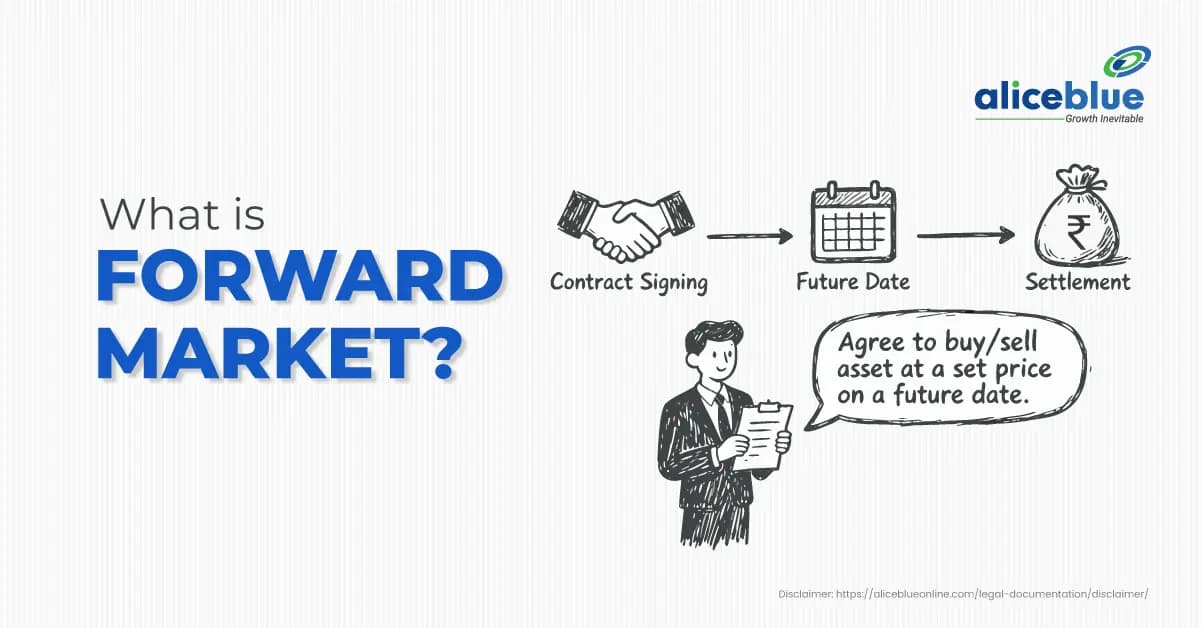
Every year, thousands of Indian exporters invoice in dollars, euros, or pounds, and then spend the next 90 days hoping the rupee does not move against them. A garment exporter in Surat books an order today at ₹92.43 per dollar, which is exactly where the rate sits as of March 2026. If the rupee strengthens to ₹89 by the time the payment arrives, that exporter loses over ₹16 lakh on a USD 5,00,000 invoice, without making a single wrong business decision.
The rupee has moved between ₹89.53 and ₹92.59 in just the last 90 days. For a USD 5,00,000 receivable, that swing alone is a ₹15 lakh difference. This is not a hypothetical risk; it is what has actually happened in the market in early 2026.
The forward market exists because of exactly this problem. It lets you lock in a price today for a deal that happens later, removing the uncertainty that sits between signing an invoice and getting paid.
What Is a Forward Market?
At its core, a forward market is where two parties, say, an exporter and a bank, agree today on a price for a currency or commodity that will actually change hands on a future date. The rate is fixed now. The transaction happens later.
The contracts in a forward market are called forward contracts, and they work differently from what most retail investors are used to. There is no stock exchange involved. No NSE, no BSE, no MCX. These are private deals, negotiated directly between a business and a bank, which is why they are called Over-The-Counter (OTC) instruments.
In India, this market runs across three main areas. Currency forwards, mostly USD/INR, EUR/INR, and GBP/INR, are the most widely used, especially by exporters and importers. Commodity forwards cover agricultural produce, crude oil, and metals. Bullion forwards are heavily used by gold jewellers and refiners who need to plan purchases months.
Since September 2015, when the Forward Markets Commission (FMC) merged with SEBI, all forward market activity in India has come under SEBI’s regulatory oversight. For currency forwards specifically, the Reserve Bank of India sets the rules, and Indian businesses can only book forward contracts through RBI-authorised dealer banks.
How a Forward Contract Actually Works
Take Priya Textiles, a Surat-based garment exporter. They have just shipped an order worth USD 5,00,000 to a US buyer. Payment is due in 90 days. Today’s exchange rate is ₹92.43 per dollar, March 18, 2026, which keeps their margins healthy.
Priya calls their relationship manager at HDFC Bank. They agree on a forward rate of ₹92.75 per dollar for delivery in 90 days. The slight premium over the spot rate reflects forward points the bank calculates based on the interest rate differential between India and the US. The contract is signed. No money moves today.
Ninety days later, when the US payment arrives, it does not matter whether the rupee is at ₹89 or ₹96. Priya receives ₹92.75 for every dollar, exactly as agreed. The bank settles the difference, and Priya’s INR receivable is exactly what they planned for when they priced the order.
The key thing to understand is that nothing is settled daily. Unlike futures contracts on NSE, which are marked to market every single session, a forward contract just sits quietly until the settlement date. There are no daily margin calls, no account statements showing daily gains and losses. The full outcome, protection or missed upside, lands on one day.
The Numbers: What Hedging Actually Saves (and Costs)
Here is what the same USD 5,00,000 receipt looks like across different rupee scenarios, with and without a forward contract locked at ₹92.75:
|
Situation |
Spot Rate at Maturity |
Without a Forward Contract |
With Forward at ₹92.75 |
Net Impact |
|
Rupee strengthens |
₹89/dollar |
₹4,45,00,000 |
₹4,63,75,000 |
Hedge saves ₹18,75,000 |
|
Rupee weakens |
₹95/dollar |
₹4,75,00,000 |
₹4,63,75,000 |
Hedge costs ₹11,25,000 |
|
Rate stays flat |
₹92.75/dollar |
₹4,63,75,000 |
₹4,63,75,000 |
No difference |
The forward contract did not make Priya richer; it made her income predictable. That is the entire point of using it.
How to Calculate Payoff on a Forward Contract
When the contract matures, calculating who gains and who loses is straightforward:
Seller’s Payoff (exporter):
Seller Payoff=Forward Price−Spot Price at Maturity
Seller Payoff=Forward Price−Spot Price at Maturity
Buyer’s Payoff (bank or importer):
Buyer Payoff=Spot Price at Maturity−Forward Price
Buyer Payoff=Spot Price at Maturity−Forward Price
Using Priya’s case — forward rate ₹92.75, spot at maturity ₹89:
- Priya’s payoff = ₹92.75 − ₹89 = ₹3.75 per dollar gain
- On USD 5,00,000: Total gain = ₹18,75,000
- Bank’s payoff = ₹89 − ₹92.75 = −₹3.75 per dollar loss
Every rupee one party gains, the other loses. Forward contracts are zero-sum by design.
Types of Forward Contracts Used in India
Not all forward contracts work the same way. Indian businesses use several variations depending on their situation.
- Deliverable Forwards are the most common for Indian exporters and importers; the actual currency changes hands on the settlement date. An IT firm in Bengaluru receiving USD from a US client and converting to INR through their bank is typically using this structure.
- Non-Deliverable Forwards (NDFs) work differently; no currency physically moves. Only the cash difference between the agreed rate and the actual spot rate is paid out. The Indian Rupee NDF market is active in Singapore, Dubai, and London, where overseas investors and FIIs hedge their INR exposure since the rupee is not fully convertible.
- Fixed Date Forwards settle on one specific date. A crude oil importer with a known invoice due date, say, the 15th of next month, uses this structure to match exactly.
- Option Dated (Flexible) Forwards allow settlement on any date within a window rather than one fixed date. This suits exporters like garment manufacturers whose overseas buyers rarely pay on the exact promised date. Under RBI guidelines, this is called an “option period forward.”
- Long-Dated Forwards run beyond one year. Indian infrastructure companies, power sector players, and firms with long-term foreign currency loans use these to manage multi-year currency or rate exposure.
- Forward Rate Agreements (FRAs) are used by Indian banks and large corporates to lock in a borrowing rate for a future period. If a company is planning to raise a ₹500 crore loan six months from now, an FRA fixes the interest rate today, protecting them from any rate hike between now and then.
Key Features
- Forward contracts are private OTC deals, not traded on any exchange
- Every term is negotiable: currency pair, amount, forward rate, and settlement date
- No upfront margin is required, unlike NSE futures
- RBI rules require genuine underlying exposure for currency forwards; Indian businesses cannot book forwards purely for speculation
- Booking happens through authorised dealer banks, SBI, HDFC Bank, ICICI Bank, Axis Bank, which are the most common channels for Indian corporates
- Cancellation is allowed but carries a cost, the mark-to-market loss on the cancellation date
Add Your Heading Text Here
- Price certainty: You know exactly what rate you will receive or pay, even 90 days in advance, when markets can swing by ₹3 or more per dollar, as seen in early 2026
- Sized to your actual need: A Surat exporter with a USD 3,47,000 invoice does not need to fit a standard lot size; the forward contract covers exactly that amount
- No margin calls during the contract: Unlike NSE futures, there are no daily margin top-up requirements; businesses manage cash flow without sudden surprises mid-contract
- Accessible through your existing bank: No Demat account, no broker, just your bank relationship and a genuine export or import transaction
- RBI has simplified access for MSMEs: Small exporters can book forward cover based on past performance without submitting fresh documentation every time
Risks and Limitations
Counterparty default risk is real but often overlooked. Since no clearinghouse stands behind the contract, the only protection you have is the financial strength of your counterparty — usually a bank. For most large Indian banks, this is not a concern, but for smaller or private counterparties, it matters.
Rollover risk is the one that catches businesses off guard most often. Suppose Priya Textiles’ US buyer delays payment by 30 days. The forward contract still matures on the original date. Priya has to roll the contract forward, closing the original at its current mark-to-market value and booking a new one. Depending on which way the market has moved, this rollover has a cost.
Cancellation cost works the same way. If the export order gets cancelled, Priya cannot simply walk away. The bank charges the mark-to-market loss on the cancellation date.
Missed upside is a softer risk but worth understanding. The rupee stood at around ₹83 in early 2024 and has depreciated to ₹92.43 today. An Indian importer who locked in their dollar payable at ₹88 a year ago watched the rupee weaken further and saved substantially. But an exporter who locked in at ₹88 missed the additional ₹4+ per dollar that the market eventually offered. The hedge protected against downside but closed the door on that extra gain.
Forward Market vs Futures Marke
|
Feature |
Forward Market |
Futures Market on NSE/MCX |
|
Where it trades |
Directly with a bank (OTC) |
On NSE Currency Derivatives or MCX |
|
Who regulates it |
SEBI + RBI (for currency forwards) |
SEBI |
|
Contract size |
Fully customisable |
Standardised — fixed lot sizes |
|
Counterparty risk |
Yes — no clearinghouse backing |
No — NSE Clearing guarantees settlement |
|
Margin requirement |
Not required |
Mandatory initial + maintenance margin |
|
Daily settlement |
No — only at maturity |
Yes — marked to market every day |
|
Liquidity |
Low — cannot exit on the exchange |
Higher — square off anytime on the exchange |
|
Underlying exposure |
Required under RBI rules |
Not mandatory for retail investors |
|
Who typically uses it |
Corporations, exporters, importers, banks |
Retail traders, HNIs, institutions |
Futures contracts are, in many ways, a standardised version of forward contracts built for exchange trading. The core idea is the same: fix a price today for a future transaction, but the execution, regulation, and risk profile are quite different.
Common Mistakes Indian Businesses Make
Booking without actual documentation is a common error among first-time users. Under RBI guidelines, currency forwards must be backed by purchase orders, invoices, or shipping documents. Using forwards purely to speculate on the rupee direction is not permitted, and banks report contract utilisation to the RBI.
Not checking the FX limit with their bank is another frequent problem. Many businesses try to book a forward contract without realising their bank has not set up a forex derivative limit for them. Without that limit, the bank cannot execute the contract.
Confusing forwards with currency futures on NSE leads to poor decisions. A retail investor trading USD/INR futures through Alice Blue’s platform is dealing with standardised, exchange-traded contracts with daily settlement. A corporate booking a forward with their bank is in a completely different structure, governed by different rules.
Hedging 100% of exposure rigidly is also worth reconsidering. Many experienced treasury teams take a layered approach, hedge 40–50% of the exposure when the order is confirmed, another 30% at shipment, and leave the rest open. This gives the business some protection while keeping flexibility if the market moves in its favour.
Who Should Use the Forward Market in India?
Indian exporters with thin margins and long payment cycles benefit most. In sectors like garments, IT services, and pharma, where 60 to 90 day payment terms are standard, a ₹3 per dollar swing on a large invoice is not small. With USD/INR at ₹92.43 today, the rupee’s 11% depreciation from ₹83 in early 2024 has been a significant tailwind for exporters. The question is: will it continue? Forward contracts remove the need to guess.
Importers sit on the other side. A company importing capital equipment, crude oil, or electronics in USD needs to know in advance what the rupee cost will be.
Agri-businesses and commodity traders, wheat buyers, sugar mills, and edible oil importers use forwards to lock in procurement prices before harvest or before supply contracts are signed.
Large corporates with foreign currency debt also use forwards and FRAs to manage interest rate and currency risk across multi-year periods.
Retail investors and individual traders are not the target audience here. For individuals who want derivative exposure, NSE’s currency futures and MCX commodity futures are more accessible, regulated, and liquid. The forward market is for businesses with actual underlying cash flows to protect.
The forward market gives Indian businesses a way to take price uncertainty off the table before it turns into a financial loss. A Surat garment exporter, a Mumbai crude oil importer, or a wheat buyer in Punjab all face the same core problem. They know a transaction is coming, but they do not know what price they will face when it arrives.
With USD/INR at ₹92.43 today and having moved over 11% in the last two years, that uncertainty is not theoretical. A forward contract draws a line around the future price and says, ” This is what we agreed, and this is what we transact at, regardless of what happens to the market between now and then.
It is not a tool to make extra money. It is a tool to make sure you do not lose the money you were already counting on. For Indian businesses with genuine foreign exchange or commodity exposure, it remains one of the most practical hedging instruments available.
Want to explore currency and commodity derivative instruments on a regulated exchange? Check out Alice Blue’s guides on Currency Futures on NSE and Commodity Derivatives on MCX.
A forward market is where a buyer and seller agree today on a price for something, a currency, commodity, or security, that they will actually exchange on a future date. With the rupee at ₹92.43 per dollar today, an exporter can lock in that rate now and receive exactly that amount three months later, regardless of where the market moves.
Mainly exporters, importers, large corporates, banks, commodity traders, and bullion dealers. An IT company in Bengaluru hedging USD receivables, a crude oil importer in Mumbai fixing their dollar payable, or a wheat buyer locking in prices before the rabi harvest, these are the typical users.
No, it is not compulsory. But RBI permits Indian exporters and importers to book forward contracts based on past performance or on declared exposure, without needing to produce documents upfront every time. Most experienced exporters hedge at least part of their exposure.
Cancellation is allowed, but the bank will charge the mark-to-market loss on the date of cancellation. If the market has moved against your original position, that loss can be significant. It is not a free exit.
A currency forward is a private contract with a bank, customisable, OTC, and accessible mainly to corporates with genuine exposure. NSE currency futures are standardised contracts traded on the exchange, with daily settlement, clearinghouse protection, and open access to retail investors. Both fix a future exchange rate, but the mechanics and risk profiles are quite different.
The Non-Deliverable Forward market for the rupee operates offshore, primarily in Singapore, Dubai, and London. It lets foreign investors and NRIs hedge their INR exposure without going through Indian banks, since the rupee is not fully convertible. RBI watches this market closely because offshore NDF sentiment regularly influences domestic rupee rates.
Yes. RBI has simplified norms for small exporters and MSMEs to access forward cover based on past performance, without needing detailed documentation every time. Most nationalised and private banks offer this facility to businesses that have an existing credit or current account relationship.

Blog by Aliceblue News Desk


