
What Is Pledging of Shares by Promoters and Why Is It a Red Flag?
Blog by Aliceblue News Desk
13 April 2026
13 minutes
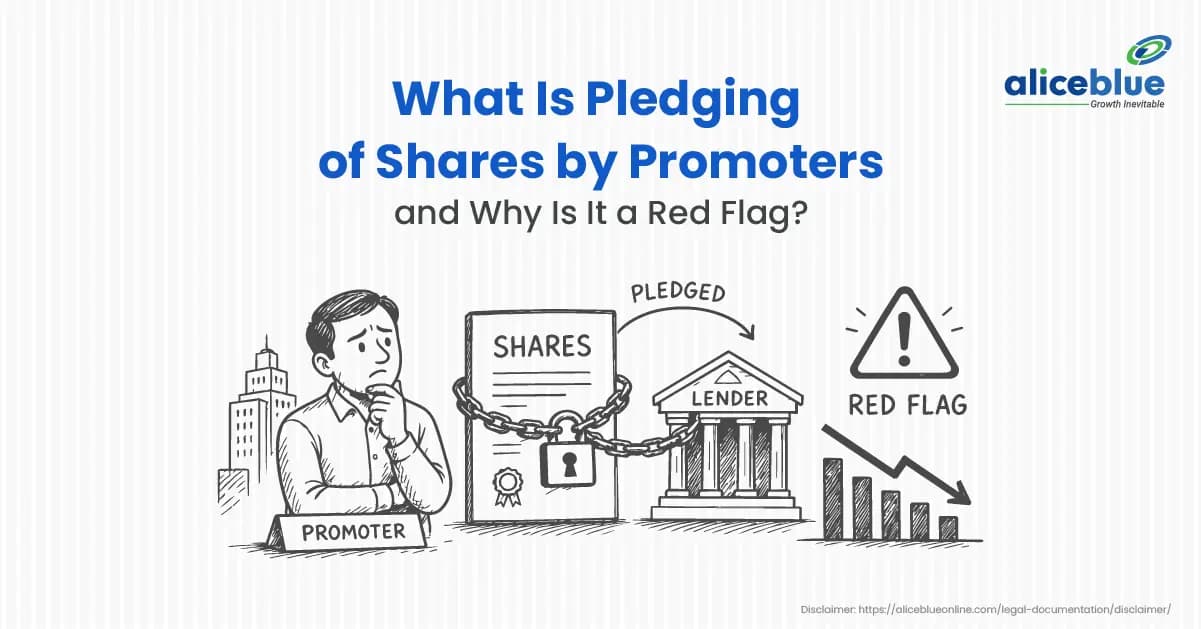
You are looking at a company with clean financials, decent growth, and promoters who own 60% of the business. On the surface, it looks like a safe bet. But then you scroll down to the shareholding pattern and spot one line: 80% of promoter shares are pledged.
That single number can change everything.
Pledging of shares by promoters is one of the most overlooked risk signals in the Indian stock market. Most beginners focus on revenue, profit, and the P/E ratio. Very few check how much of the promoter stake is tied up with a lender. This article explains what promoter pledging means, how it works, when it becomes dangerous, and what you should check before you invest.
Who Is a Promoter?
A promoter is the person or group that founded, controls, or manages a listed company. In most Indian mid-cap and small-cap companies, the founding family or individual holds a large percentage of shares. That holding is called a promoter holding.
When promoters hold a large stake, many investors see it as a positive sign because they have money on the line. The story changes when a lender pledges those same shares.
What Is Pledging of Shares by Promoters?
Pledging of shares means a promoter uses their shares as collateral to borrow money. The shares are not sold. Ownership stays with the promoter on paper. But the shares are handed to a lender as security against a loan.
Think of it like a home loan. You still live in the house, but the bank has a claim on it until the loan is repaid. If you stop paying, the bank can sell the house. The same applies to pledged shares, except shares are far more volatile than property.
SEBI classifies a pledge under a broader category called encumbrance, which also includes liens, non-disposal undertakings, and any other arrangement that restricts the free transfer of those shares. Promoters sometimes use structures beyond a standard pledge to borrow money, and SEBI requires them to disclose all of it.
Promoter Pledging vs Retail Investor Pledging
These two are not the same thing, and the difference matters.
When you read about pledging in a trading app or demat account, it usually refers to retail investor pledging, where you pledge your own shares as margin to trade derivatives or take leveraged positions. That is a personal trading tool with no connection to the company you are invested in.
Promoter pledging is different. The people who own and run the company are borrowing money against their personal stake. The promoter is saying, ‘I personally need funds, and my shares in this company are what I am offering as security.’
Promoter Pledging | Retail Investor Pledging | |
Who does it | Company founders or controlling shareholders | Individual traders or investors |
Purpose | Business funding, debt repayment, or personal liquidity | Getting margin to trade derivatives or buy more stocks |
Impact on the company | Can affect promoter control, stock price, and minority investors | No impact on the company at all |
Investor concern | High signals potential financial stress at the ownership level | Personal risk only, no signal about any company |
Where to track it | Shareholding pattern in exchange filings | Your own broker’s margin statement |
As an investor analysing a stock, the only pledging that matters to you is the promoter’s.
How It Works
The mechanics are straightforward. This is how it typically plays out:
- A promoter needs funds for business expansion, personal use, or servicing existing debt.
- Instead of selling shares, which would reduce holdings and send a negative signal to the market, the promoter pledges them with a bank or NBFC.
- The lender does not give 100% of the share value as a loan. They apply a haircut, lending only a portion of the current market value to protect themselves if the price falls.
- When the stock price holds steady, there is no problem. The promoter services the loan, the lender sits on the collateral, and nothing changes on the surface.
- If the stock price falls, the value of the collateral drops. The lender issues a margin call, asking the promoter to add more shares or repay part of the loan immediately.
- If the promoter cannot meet that demand, the lender invokes the pledge and sells those shares in the open market to recover the dues.
- That forced selling drops the stock price further, triggering more margin calls on remaining pledged shares. The chain can spiral quickly.
Once the loan is fully repaid and the lender releases the pledged shares, it is referred to as ‘revocation’. A pledge-revoked disclosure on an exchange means the promoter has cleared the dues, and the shares are free again. That is generally a positive development.
Under SEBI’s Substantial Acquisition of Shares and Takeovers (SAST) Regulations, promoters must disclose the creation, invocation, or release of encumbrance to stock exchanges within seven working days.
What Is a Haircut?
When a lender accepts pledged shares as collateral, they do not lend the full market value. They lend only a portion of it. The gap between the market value and the actual loan amount is called the haircut.
The haircut exists because share prices move. A lender who gives Rs. 100 against shares worth Rs. 100 today is fully exposed if the price falls to Rs. 80 tomorrow. So lenders apply a buffer and lend less than the full value.
RBI mandates a minimum 40% haircut on equity shares accepted as collateral by banks under its revised prudential directions for broker lending, effective 2026. SEBI also prescribes a 50% loan-to-value cap on loans against shares for stockbrokers and NBFCs under its guidelines.
Here is how the haircut affects the actual loan received:
Share Market Value | Haircut Applied | Loan Amount Received | Loan-to-Value Ratio |
Rs. 100 | 20% | Rs. 80 | 80% |
Rs. 100 | 30% | Rs. 70 | 70% |
Rs. 100 | 40% | Rs. 60 | 60% |
Rs. 100 | 50% | Rs. 50 | 50% |
For a stable large-cap stock, lenders may apply a 20% to 30% haircut. For a mid-cap or small-cap stock with higher volatility, it can go to 40% to 50% or more.
Now here is why this matters. The haircut directly determines when a margin call gets triggered.
If the promoter pledged shares worth Rs. 100 with a 40% haircut and received Rs. 60 as a loan, and the stock then falls to Rs. 75, the loan of Rs. 60 is now 80% of the collateral value. The lender’s buffer is nearly gone. At that point, the lender will ask for more shares or start selling.
The tighter the haircut, the faster a margin call arrives. For a promoter who borrowed the maximum amount allowed, even a moderate correction is enough to trigger forced selling.
A Real Example With Numbers
Take a simple scenario. Promoters of ABC Ltd own 50 lakh shares priced at Rs. 200 each, giving them a total stake worth Rs. 100 crore.
They pledge 30 lakh of those shares to borrow Rs. 30 crore, using a 50% loan-to-value ratio. At this point, 60% of their promoter stake is pledged.
Now the stock falls from Rs. 200 to Rs. 130. The pledged 30 lakh shares are now worth Rs. 39 crore. The outstanding loan is Rs 30 crore, and the margin buffer has nearly disappeared.
The lender issues a margin call. The promoter must add more shares or repay a portion of the loan immediately. If they cannot arrange funds in time, the lender starts selling those 30 lakh shares in the open market.
That bulk selling drops the price further to Rs 100. More margin erodes. More selling follows. A retail investor watching from outside sees the stock falling with no news to explain it.
This is not a textbook scenario. It has happened in real Indian markets.
In January 2019, a news report alleged that the Zee/Essel group had moved funds linked to the demonetisation period transactions. Zee Entertainment’s stock crashed nearly 26% to 33% in a single day on January 25, 2019. At the time, over 90% of the Zee promoter stake was pledged with lenders. Lenders issued margin calls. The promoter group could not meet them immediately. Between 2018 and 2020, Zee promoters’ stake fell from 43% to just 4% as shares were sold to pay off group debts. Retail investors who held the stock had no warning in advance.
What Percentage of Pledge Is Dangerous?
Not every pledge is a red flag. The risk depends on how much is pledged, whether the number is rising, and whether the company has the cash flow to support repayment.
Pledge Level | What It Suggests | What to Do |
Less than 15% | Low concern if cash flows are healthy | Monitor – no immediate worry |
15% to 30% | Needs context. Check why it is rising and whether it is rising | Review the company’s debt and cash flow |
30% to 50% | Reason for genuine caution | Check the purpose of borrowing and the repayment track record |
50% to 75% | Warning zone: stock is vulnerable to selling pressure | Be selective. Read recent filings carefully |
75% to 100% | High risk, very little margin of safety | Avoid unless you have full clarity on the business |
100% | No buffer at all | Serious red flag in almost every case |
What the Regulators Say
SEBI
SEBI requires promoters to disclose the creation, invocation, or release of encumbrance within seven working days under Regulation 31 of the SAST Regulations.
When combined promoter encumbrance crosses 50% of their shareholding or 20% of the total share capital, promoters must separately disclose the detailed reasons for the encumbrance. This additional disclosure must be made within two working days of the threshold being crossed. SEBI introduced this requirement through a circular issued on August 7, 2019, following concerns about structured lending to promoters through mutual funds and NBFCs.
The RBI
On the lending side, RBI has tightened rules around equity as collateral. Under its revised prudential directions effective April 1, 2026, RBI mandates that banks accept equity shares as collateral only with a minimum 40% haircut for prudential valuation. Banks are also restricted from providing fully unsecured credit to stockbrokers or accepting partial promoter guarantees without adequate collateral backing.
Together, the SEBI and RBI frameworks create a disclosure and lending structure meant to prevent unchecked promoter pledging from becoming a market-wide chain reaction. Investors should not rely on regulation alone and must read the filings themselves.
Why It Is a Red Flag
The reason high pledging worries experienced investors comes down to a few hard realities:
- Shares are not stable collateral. Property prices take months or years to correct. Share prices can fall 30% to 50% in weeks, and when they do, lenders do not wait.
- Forced selling is indiscriminate. When lenders sell, they do not consider the company’s fundamentals. They sell at whatever price the market offers to recover their money.
- It can signal hidden financial stress. When a promoter pledges shares repeatedly or at rising levels, it often means the business or the promoter group lacks access to funds through normal channels.
- Promoter control can weaken. If pledged shares are invoked and sold by lenders, the promoter stake falls. In extreme cases, like Zee in 2019, this can result in the founding family losing control of the company they built.
- Minority investors absorb the damage. The stock price falls, sentiment collapses, and ordinary shareholders suffer without any advance notice.
When Pledging Is Not a Problem
Not every instance of promoter pledging signals trouble. It has legitimate uses.
Loans secured against shares typically carry lower interest rates than unsecured loans, making it a cost-effective borrowing option for promoters. Since the shares are not sold, the promoter continues to receive dividends and retains voting rights during the loan period. Pledging also does not create a taxable event, unlike an outright share sale, which avoids an immediate capital gains tax liability.
For a promoter who wants to fund a new project or acquisition without diluting the shareholding, pledging can serve that purpose cleanly. In some cases, it is a short-term bridge arrangement to cover a funding gap while the business waits for receivables or a project milestone.
The distinction investors must make is between pledging for new business investment versus pledging to service existing debt or personal expenses. The first can make sense. The second is a warning sign that needs deeper review.
How to Check Promoter Pledged Data
The data is publicly available and takes less than five minutes to find.
- Go to NSE (nseindia.com) or BSE (bseindia.com) and search for the company.
- Open the Shareholding Pattern section in the filings.
- Look at the promoter-holding table. There is a column titled Shares pledged or otherwise encumbered.
- Note the number of pledged shares and the percentage of total promoter holdings that are pledged.
- Pull the same data for the last four to eight quarters and check the trend. A falling pledge is a positive sign. A rising pledge needs explanation.
You can also use Screener.in, Trendlyne, or Tickertape to compare pledge data across quarters for any listed company in one view, without going stock by stock on the exchange websites.
Common Mistakes Beginners Make
- Checking only the total promoter holding. A 65% promoter stake looks solid until you find that 80% of it is pledged. Always check what fraction of that holding is encumbered.
- Ignoring the trend. A pledge falling from 60% to 30% over two years is encouraging. A pledge rising from 10% to 50% over the same period is not.
- Assuming pledging equals fraud. It is not fraud. But it does require an explanation before you invest.
- Buying at a sharp price drop without checking the reason. When a stock falls hard with no public news, check the pledge filings first. Forced selling rarely comes with an announcement.
- Not reading the stated purpose of encumbrance. When combined encumbrance crosses SEBI thresholds, the reason must be disclosed. Reading that filing takes five minutes and tells you more than most analyst notes will.
Which sectors see more promoter pledging?
Promoter pledging is not spread evenly across the market. It has historically appeared most in:
- Real estate, where developers pledge shares to fund land acquisition and construction, because cash cycles in this sector can stretch over years.
- Infrastructure, where businesses carry heavy capital requirements and long project timelines before revenue starts flowing.
- Debt-heavy conglomerates, where promoter groups run multiple businesses and often use shares from one entity to fund another.
This does not mean every promoter in these sectors is in financial trouble. But if you are analysing a stock in one of these sectors and find high or rising pledge levels, you should look harder than you would for a capital-light, cash-generating business.
Conclusion
Pledging of shares by promoters is a borrowing arrangement, and sometimes a practical one. But when pledge levels are high, rising, or being used to service existing debt rather than build something new, the risk profile of that investment changes measurably.
Five minutes with the shareholding pattern can tell you whether a promoter is running the company from a position of strength or financial pressure. That difference matters, especially when the market turns.
Frequently Asked Questions
Most experienced investors treat a pledge below 15% as low concern when cash flows are healthy. Between 15% and 30%, the context and trend matter. Above 50%, the stock carries meaningful downside risk if prices fall, and brokers display a warning nudge at that level.
Go to NSE or BSE, open the shareholding pattern for the company, and look at the pledged shares column under promoter holding. Screener.in and Tickertape also allow you to display this data across multiple quarters in one view.
Invocation happens when the lender sells pledged shares to recover dues after a margin call that the promoter could not meet. Revocation is the opposite, when the promoter repays the loan, and the lender releases those shares. A revocation filing is generally a positive signal.
A haircut is the difference between the market value of the shares and the actual loan the lender provides. If shares are worth Rs. 100 and the lender gives Rs. 60, the haircut is 40%. RBI mandates a minimum 40% haircut on equity shares accepted by banks as collateral under its 2026 prudential directions.
Promoters must disclose the creation, invocation, or release of encumbrance within seven working days under SEBI SAST regulations. If combined promoter encumbrance crosses 50% of their shareholding or 20% of total share capital, they must also disclose the detailed reasons for that encumbrance within two working days.
In limited cases, yes, if the company generates strong cash flows, the pledging is for a specific new investment, and the pledge trend is falling. But these cases require scrutiny and carry a higher risk than a comparable company with no pledge.

Blog by Aliceblue News Desk


