
What is the Cut-Off price in an IPO Application?
Blog by Aliceblue News Desk
01 June 2026
13 minutes
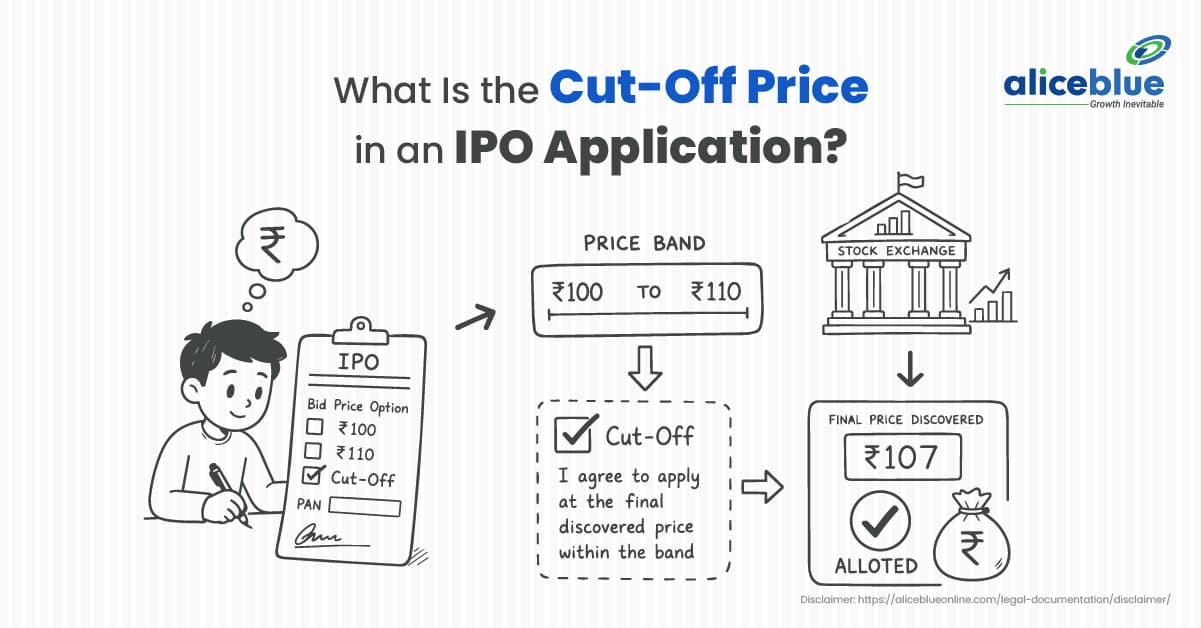
If you are new to the Indian stock market, applying for an Initial Public Offering(IPO) can feel confusing and a bit intimidating. In the IPO application form, one of the first things you see is the price section. Here, you either enter a price within the given range or choose the “Cut-Off” option. Many beginners are not sure what Cut-Off really means or how it affects the final price they pay for the shares.
This blog explains in simple, everyday language what the Cut-Off price in an IPO application is, how it works in real life, and whether you should use it the next time you apply for an IPO. We will use easy examples, clear points, and practical tips that are easy to follow for Indian retail investors who are just starting.
Meaning of Cut-Off Price in an IPO
In an IPO, the Cut-Off price is the final price at which shares are allotted to investors. It is decided after the book-building process, based on the price band announced by the company. For example, if the IPO shows a price band of ₹190–₹200, the final Cut-Off price might be ₹198. This ₹198 is the Cut-Off price for that issue.
When you apply at the Cut-Off in the IPO form, you are not entering a specific bid price. Instead, you are telling the system that you are okay to buy the shares at whatever final price is decided, as long as it is within the IPO price band. In short, you accept the discovered price and let the company and its book runners decide the exact level.
To keep it clear:
- The cut-off price is the final offer price discovered after book building, within the IPO price band. Successful applicants receive shares at this price, subject to allotment rules.
- Cut-Off option in the form = your choice to accept that final price.
This option is only available in book-built IPOs, where there is a price band. In fixed price IPOs, the price is already fixed, so the Cut-Off option does not apply.
How Cut-Off Works in an IPO
Most IPOs in India today use the book-building method. Here is how the Cut-Off works in simple steps.
Step 1: The company sets the price band
The company and its bankers announce a price band, for example, ₹190–₹200 per share. Investors can place bids anywhere within this range. Retail investors can also choose the Cut-Off option, which means they do not pick a specific price.
Step 2: Investors place bids
When you, as a retail investor, log in through your broker or bank’s ASBA/UPI IPO window, you see two choices:
- Limit bid: You enter a specific price inside the band, say ₹195.
- Cut-Off bid: You leave the price field blank and tick the Cut-Off option.
You also choose the number of lots and confirm the application. At this stage, the system blocks funds based on the upper band amount for the number of lots you apply for.
Step 3: Book building and price discovery
After the subscription window closes, the book runners look at all the bids placed by retail, HNI, and institutional investors. They study the demand at different price levels and decide the final Cut-Off price. This price is always within the announced band. For example, for a band of ₹190–₹200, the Cut-Off price might be ₹198.
Step 4: Allotment based on the Cut-Off or limit
If you applied at the Cut-Off, you are eligible for allotment at the final Cut-Off price, provided your application is valid. If you applied with a limit bid:
- Bid equal to or above the Cut-Off price → you get shares at the Cut-Off price.
- Bid below the Cut-Off price → you get no shares.
Step 5: Funds and final amount
When you apply for an IPO, your bank or UPI system blocks an amount based on the upper band price and the number of lots. After the Cut-Off price is announced and allotment is done, the actual amount debited is the Cut-Off price multiplied by the shares allotted. The difference between the blocked upper band amount and the final amount is released back to your account.
Simple Example to Understand Cut-Off
Imagine you’re applying for an IPO as a retail investor in India. Here’s how Cut-Off works in practice:
IPO details:
- Price band: ₹190–₹200
- Lot size: 30 shares
- Final Cut-Off price: ₹198
Scenario 1: You apply at Cut-Off
- You select the Cut-Off option for 1 lot (30 shares)
- Amount blocked: ₹200 × 30 = ₹6,000 (based on the upper band)
- Final price charged: ₹198 × 30 = ₹5,940
- Difference released: ₹6,000 − ₹5,940 = ₹60 back to your account
- You didn’t pick a price. You simply accepted whatever price the company finalised, and you paid the Cut-Off price.
Scenario 2: You bid ₹192 (below Cut-Off)
- You enter a limit bid of ₹192 for 1 lot (30 shares)
- Final Cut-Off price: ₹198
- Your bid (₹192) < Cut-Off (₹198) → No shares allotted
- The blocked amount is fully released back to your account
- You saved money, but you didn’t get any shares.
Scenario 3: You bid ₹200 (at or above Cut-Off)
- You enter a limit bid of ₹200 for 1 lot (30 shares)
- Final Cut-Off price: ₹198
- Your bid (₹200) ≥ Cut-Off (₹198) → 30 shares allotted at ₹198
- Final amount charged: ₹198 × 30 = ₹5,940
- You set a price you were okay with, and you got shares at the final Cut-Off price.
From this, you can see that the Cut-Off option helps you stay eligible as long as the Cut-Off price is within the band, while a limit bid below the Cut-Off price leads to no allotment.
Real-Time Example: IRCTC IPO (October 2019)
IRCTC IPO details:
- Issue Date: September 30 – October 3, 2019
- Price Band: ₹315–₹320 per share
- Issue Price: ₹320 per share
- Lot Size: 40 shares
- Retail Discount: ₹10 per share (paid ₹310)
- Listing Date: October 14, 2019
Retail investor applying at the upper band (₹320):
- Applied for 1 lot (40 shares) at ₹320
- Amount blocked: ₹320 × 40 = ₹12,800
- Final price charged: ₹310 × 40 = ₹12,400 (after ₹10 retail discount)
- Got 40 shares at ₹310 each
- Listing price: ₹644 (BSE)
- Listing gain: 101.25% on issue price
- Profit on listing: (₹644 − ₹310) × 40 = ₹13,360
What this teaches:
Investing in IPOs at the upper price band gives an allotment chance. Retail investors got 10% discount. IRCTC was one of India’s best-performing IPOs with 101% listing gain.
Cut-Off vs Limit Bid in IPO
This table shows how Cut-Off and limit bids differ in practice.
Feature | Cut-Off Bid | Limit Bid |
Price entered in the form | No price; you accept the final Cut-Off price | You choose a price within the band (₹190–₹200) |
Final price you pay | Same as Cut-Off price (₹198) | Same as the Cut-Off price if your bid is ≥ the Cut-Off price |
Chances of the price being high | Higher (you accept any price in the band) | Lower (if your limit is below the Cut-Off, you get no shares) |
Control over the maximum price | Low | High |
Best for | Beginners who want to participate | Investors who want strict price limits |
Key Features of the Cut-Off Price in an IPO
- Cut-Off is a single final price: Allotment happens at one price decided after book building, not at your own bid.
- Always within the price band: The final Cut-Off price cannot be outside the announced band (₹190–₹200).
- Retail investors’ only option: Retail investors can choose to bid at Cut-Off; big HNI and institutional bids must quote a price.
- Everyone pays the same price: All successful bidders pay the final Cut-Off price, not their own bid.
Only for book-built IPOs: Fixed price IPOs do not have a price band and do not use a Cut-Off in the same way.
Advantages of Using a Cut-Off in an IPO
For a new investor, using a Cut-Off in an IPO has clear and simple benefits.
- It reduces the risk of your application becoming invalid because of a low bid price. It does not guarantee allotment. If you choose a limit price that is too low and the final Cut-Off price turns out higher, you get no shares. When you apply at the Cut-Off, you accept whatever final price is decided within the band, so you do not miss out because of an incorrect bid.
- You do not have to guess the exact price. Instead of stressing over whether ₹190, ₹195, or ₹200 is the right choice, you let the book-building process decide the final price. This makes life easier if you are unsure about the right entry level.
- It is simple and beginner-friendly. You can focus on reading the IPO details and the company’s business instead of spending time on fine-tuning the price.
- Cut-Off works well in oversubscribed IPOs. When many investors are applying, choosing a Cut-Off keeps your application valid across the entire price band, which helps you stay in the pool of possible allottees.
- It also reduces mistakes in the application. When you are new to IPOs, confusing the bands or choosing a price by mistake is common. Using a Cut-Off avoids this error and keeps the process straightforward for retail investors.
Risks and Limitations of the Cut-Off
Using a cut-off in an IPO is simple, but it has a few important downsides:
- You might pay more than you expected. If the final Cut-Off price is near the upper band, your cost per share will be higher than if you had chosen a lower limit price.
- You give up control over the maximum price. With Cut-Off, you accept whatever final price is decided within the band, even if it feels high later.
- Your funds are blocked at the upper band level. The system locks money based on the highest price and the number of lots, which can temporarily reduce your usable balance.
- Cut-Off does not work in fixed-price IPOs. In fixed-price issues, the price is already set, and there is no price band, so Cut-Off is not used.
- Cut-Off does not guarantee shares. Even if you apply at Cut-Off, you may not get any allotment if the IPO is heavily oversubscribed.
Common Mistakes Beginners Make with Cut-Off
Many new investors misunderstand the Cut-Off option and repeat the same mistakes:
- Using Cut-Off in a fixed-price IPO
Cut-Off only works in book-built IPOs with a price band. In fixed-price IPOs, the price is already set, so Cut-Off is not applicable.
- Thinking Cut-Off guarantees shares
Cut-Off keeps your application valid across the price band, but it does not guarantee allotment. Oversubscription and lottery rules still decide how many lots you get.
- Not checking the blocked amount.
When you apply at Cut-Off, funds are blocked based on the upper band price and number of lots. If your balance is too low, your application may fail.
- Confusing Cut-Off with market orders
Cut-Off is only for IPO applications. On the stock exchange, you use market or limit orders, which are different from the IPO Cut-Off option.
- Skipping IPO details
Always check the price band, lot size, and IPO dates in the IPO notice or on your broker’s page. Missing these can lead to application errors or insufficient funds.
Who Should Use a Cut-Off in an IPO
Cut-Off is best suited for certain types of investors.
Use Cut-Off if:
- Use a cut-off if you are comfortable buying at any final price within the price band and want your bid to stay valid.
- You want to participate without spending time on price selection.
- You are okay with the final Cut-Off price, even if it is closer to the upper band.
- You care more about getting some shares than about fine-tuning the exact price.
Do not rely only on the Cut-Off if:
- You are a strict price-conscious investor.
- You prefer to place a limit bid slightly below the upper band.
- You are applying mainly for listing gains and want stricter control over your entry price.
- You cannot afford to have funds blocked at the upper band level for a few days.
Important SME IPO Update
Cut-Off price is no longer available for SME IPOs.
From mid-2025, stock exchanges removed the Cut-Off price option for all investor categories in SME IPOs. This means:
- You cannot apply at Cut-Off in any SME IPO application.
- You must bid a specific price within the price band when applying for an SME IPO.
- Once you place a bid in an SME IPO, you cannot modify it (especially downward) or cancel it.
Because of this rule, the “Use Cut-Off if” advice above applies only to regular IPOs, not to SME IPOs. If you are applying for an SME IPO, you must:
- Choose a limit bid price within the price band.
- Be comfortable with that price before bidding, since you cannot change it later.
- Apply for roughly 2 or more lots, with a minimum application size of around ₹2 lakhs or a bit more, if you are an Individual Investor.
Practical Tips for Beginners
- Check the price band and lot size in the IPO notice on your broker or bank app. This tells you how many shares you’re applying for and how much money will be blocked.
- Decide between a cut-off and a limit bid. If you’re unsure about the price, use Cut‑Off. If you want more control, place a sensible limit bid within the band.
- Keep a little extra funds in your bank or UPI wallet, since the system blocks money based on the upper band price.
- Apply early and check your status after the IPO closes. The window is open for only a few days, and you can later see if you got shares and how much was refunded.
- Remember that the cut-off is not available in SME IPOs. For SME IPOs, you must choose a specific limit price within the band and cannot rely on the cut-off.
Conclusion
The Cut-Off price in an IPO means you’ll buy at whatever price is finalised within the announced band. It removes the stress of guessing the right price and keeps your application valid across the entire range. For beginners, Cut-Off is practical because you focus on the company rather than fine-tuning the price, and you pay the same price as every successful bidder. Keep in mind that Cut-Off doesn’t guarantee shares, funds block at the upper band level, and it only works in book-built IPOs, not fixed-price or SME IPOs, where you must bid a specific price. If you’re price-conscious, a limit bid gives more control, but for simplicity, Cut-Off is the better choice. Just apply early, check the band and lot size, and keep enough funds available.
Frequently Asked Questions
The Cut-Off price is the final price at which shares are allotted after the book-building process. When you choose to Cut-Off in the application, you are agreeing to pay whatever final price is decided within the IPO price band.
No, the Cut-Off is only available in book-built IPOs that have a price band. In fixed price IPOs, the issue price is already fixed, and there is no Cut-Off option like this.
Yes, to some extent. If you bid below the Cut-Off price, you get no shares. Applying at the Cut-Off or choosing a limit price equal to or above the Cut-Off keeps your application valid and improves your chances of getting some allotment.
No. When you apply, your bank or ASBA/UPI blocks an amount based on the upper band price and the number of lots. After the IPO, the system debits only the Cut-Off price multiplied by the shares you get, and the extra amount is released back to your account.
Yes. The amount blocked at the time of your IPO application is based on the highest price in the band, but you are charged only the final listing price. The difference between the blocked amount and the final charged amount is automatically credited back to your account.
If your bid price is lower than the final discovered price, your application does not receive any shares. HNIs commonly use larger limit bids or institutional participation routes to manage allocation and price exposure, so choose a limit price that reflects the level you’re willing to accept.
Applying at the listing price can increase your chances of getting an allocation in SME IPOs when you are willing to accept the final discovered price. If you prefer control over the exact entry price or if the SME stock may be illiquid, consider placing a sensible limit bid instead.

Blog by Aliceblue News Desk


