
What Is the Importance of a Demat Account in the Indian Capital Market?
Blog by Aliceblue News Desk
18 May 2026
12 minutes
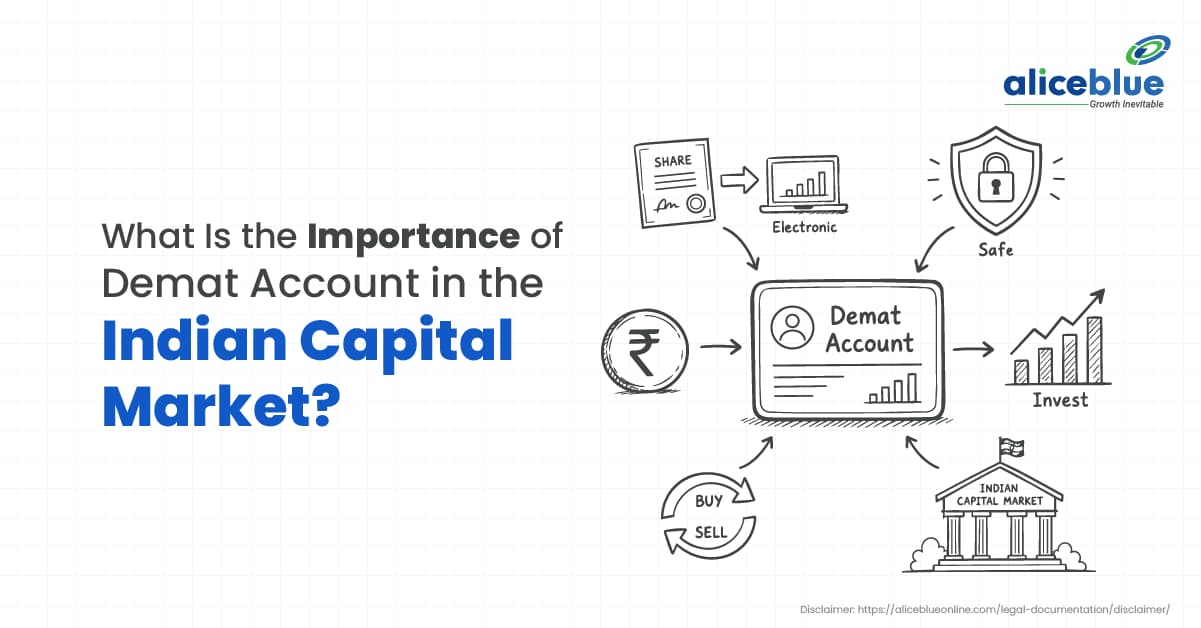
Before 1996, buying shares in India meant waiting weeks for a paper certificate to arrive by post. Losing that certificate meant losing proof of ownership. There were no backups, no digital records, and no straightforward process to resolve disputes. Today, when you buy shares, they are credited to a digital account within one business day. That account is your Demat account. This article explains what it is, how it works, and why it is central to the Indian capital market.
What Is a Demat Account?
A Demat account, short for Dematerialised account, stores your financial securities in digital form. When you buy shares, they do not arrive as paper. They appear as a digital entry against your name, showing the company, the number of shares, and the current value.
Two SEBI-regulated depositories manage all Demat accounts in India:
- NSDL (National Securities Depository Limited) was established in 1996 and is primarily linked with NSE.
- CDSL (Central Depository Services Limited) was established in 1999 and is primarily linked with BSE.
Your broker acts as the Depository Participant (DP), the registered intermediary between you and either NSDL or CDSL. India crossed 17 crore active Demat accounts in 2024, up from under 4 crore a decade earlier. That growth reflects how accessible retail investing has become since the paper system was replaced.
Why India Abandoned Physical Share Certificates
The paper system created recurring problems for every category of investor:
- Ownership disputes: Paper certificates could be forged or altered. Disputes over genuine ownership dragged on through the courts for years.
- Settlement delays: Transferring ownership required physical delivery of certificates, signed transfer forms, and manual verification at registrar offices. This took two to three weeks at a minimum.
- Permanent risk of loss: A certificate damaged in a flood or fire would simply be gone. Replacing it involved a lengthy legal indemnity process with no guaranteed outcome.
- High transaction costs: Every transfer attracted stamp duty, courier charges, and handling fees that made frequent trading impractical for small investors.
Dematerialisation removed all four problems. SEBI mandated electronic settlement for listed securities, and the market shifted accordingly.
How a Demat Account Works
Your Demat account functions as part of a three-account system:
- A bank account holds your cash before and after trades.
- A trading account is where you place buy and sell orders through your broker’s platform.
- A demat account is where your securities are stored after purchase and from where they leave when you sell.
The process during a purchase works as follows:
- You place a buy order for 20 shares of Tata Consultancy Services at Rs 3,800 per share through your broker’s app
- Your broker routes the order to NSE or BSE
- The exchange matches your order with a seller and confirms the trade
- By the next trading day (T+1), your bank account is debited, and 20 TCS shares are credited to your Demat account
- NSDL or CDSL sends an SMS and email confirmation of the credit to your registered mobile number and email address
When you sell shares, they are debited from your Demat account, and the sale proceeds reach your bank account by the following business day.
Three Scenarios That Show How This Works in Practice
Scenario 1: Regular buy and sell
Rahul buys 50 shares of HDFC Bank at Rs 1,600 per share in January. By the next trading day, 50 shares appear in his Demat account. Three months later, the stock trades at Rs 1,850. He sells 25 shares. Those 25 shares leave his Demat account, and Rs 46,250 (before charges) reaches his bank account the next business day. His account now shows 25 remaining HDFC Bank shares.
Scenario 2: IPO allotment
Priya applies for an IPO using the ASBA (Application Supported by Blocked Amount) facility through her broker. Her bank blocks the application amount. On allotment day, her allocated shares are credited directly to her Demat account. The blocked amount for any unallotted portion is released automatically. No physical form, no courier, and no follow-up is required.
Scenario 3: Bonus share credit
Ramesh holds 100 shares of a company that announces a 1:1 bonus. On the record date, 100 additional shares are credited to his Demat account without any action from his side. The same automatic process applies to stock splits and rights entitlements.
Types of Demat Accounts in India
Account Type | Who It Is For | Linked Bank Account | Fund Repatriation |
Regular Demat | Resident Indians | Standard savings account | Not applicable |
BSDA | Resident Indians with holdings under Rs 10 lakh | Standard savings account | Not applicable |
Repatriable | NRIs investing foreign-earned income | NRE bank account | Fully allowed |
Non Repatriable | NRIs with Indian sourced income, such as rent or dividends | NRO bank account | Limited to USD 1 million per year |
NRIs cannot open a regular Demat account. They must open either a repatriable account linked to their NRE bank account or a non-repatriable account linked to their NRO bank account, depending on where the funds they are investing originate.
What Can You Hold in a Demat Account?
A single Demat account can hold:
- Equity shares listed on NSE and BSE
- Government securities and Treasury Bills
- Corporate bonds and debentures
- Exchange Traded Funds (ETFs)
- Sovereign Gold Bonds
- Mutual fund units, when held in Demat form
- IPO allotments
Charges to Know Before Opening a Demat Account
Charge Type | Amount | Notes |
Account opening fee | Nil at most brokers | Most discount brokers waive this entirely |
Annual maintenance charge (AMC) | Rs 0 to Rs 800 per year | Zero for BSDA holders with holdings below Rs 4 lakh |
CDSL transaction charge (sell side) | Rs 3.50 per debit transaction | Applied per ISIN on delivery sell trades |
NSDL transaction charge (sell side) | Rs 4.00 per debit transaction | Applied per ISIN on delivery sell trades |
Margin pledge initiation | Rs 5 per instruction | Charged when pledging shares for margin |
Re pledge charge | Rs 1 per instruction | Applied to each re-pledge event |
Margin pledge release or invocation | Rs 5 per instruction | Charged on release or invocation by the clearing member |
Dematerialisation | Rs 50 per certificate | For converting old physical certificates to digital form |
Credits (receiving shares into your account) attract no charge. Charges apply primarily on the sell or transfer side.
This is exactly how a 0 AMC demat account works in India; it isn’t a separate account type, but a fee waiver that applies automatically once your holdings and eligibility meet BSDA’s criteria, covered in full below.
BSDA and Zero AMC Demat Account: What Small Investors Often Do Not Know
A Zero AMC demat account in India isn’t a special broker product; it’s the direct result of qualifying for a Basic Services Demat Account (BSDA), a SEBI-mandated category that most brokers apply automatically once your holdings fall within the eligible limit.
SEBI introduced the Basic Services Demat Account to reduce holding costs for small investors. The revised BSDA rules took effect on 1 September 2024, significantly raising the eligible thresholds from the original 2012 limits.
Under current SEBI rules:
- Holdings valued at or below Rs 4 lakh attract zero AMC
- Holdings between Rs 4 lakh and Rs 10 lakh attract Rs 100 plus GST per year
- Holdings above Rs 10 lakh are automatically converted to a regular Demat account, and standard AMC applies
One individual can hold only one BSDA, linked to their PAN. Joint accounts are not eligible. Most brokers automatically classify eligible accounts as BSDA. Confirm this with your broker when opening your account to avoid paying unnecessary charges.
Why the Demat Account Matters to the Indian Capital Market
- It made retail investing accessible. Opening a Demat account now requires only a PAN card and Aadhaar verification, completed entirely online. Before this system, the process required a physical visit to a broker’s office, multiple documents, and days of waiting.
- It removed scope for benami ownership. Every Demat account in India is linked to a verified PAN. Before dematerialisation, shares could be registered under fictitious or third-party names. That became operationally near impossible once the electronic system took over.
- It allowed India to move to T+1 settlement. Faster settlement reduces counterparty risk. The T+1 cycle that India now runs was not operationally possible when settlements depended on physical certificate delivery.
- It enabled ASBA for IPO applications. The system that blocks application funds in your bank account and credits allotted shares directly to your Demat account relies entirely on the electronic depository infrastructure. Without it, IPO applications would still require demand drafts and manual reconciliation.
Physical Shares Compared to Demat Shares
Feature | Physical Shares | Demat Shares |
Security | Can be lost, stolen, or destroyed | Stored electronically under verified PAN identity |
Settlement time | Two to three weeks | T+1, the next business day |
Corporate action credits | Requires manual forms and follow-up | Credited automatically on record date |
IPO participation | Manual application with a demand draft | Online via ASBA, credited on allotment date |
Transfer of ownership | Physical forms, stamp duty, and courier | Online instruction via DIS, completed in days |
Annual holding cost | Stamp duty and courier per transaction | Zero AMC for BSDA holders with holdings below Rs 4 lakh |
Who Needs a Demat Account and Who Does Not
You need one if you:
- Buy or sell equity shares on NSE or BSE
- Apply for IPOs
- Invest in ETFs or Sovereign Gold Bonds
- Want to hold mutual fund units in Demat form
- Plan to pledge securities as collateral for a loan
You may not need one if you:
- Invest only in direct mutual funds through an AMC website or MF Central. Direct plans are processed through your bank account and do not require a Demat account
- Trade only in Futures and Options. F&O contracts are not securities stored in a Demat account, as they expire on a fixed date. Technically, an F&O-only trader has no use for Demat holdings, though most brokers open one by default during onboarding
Common Mistakes Beginners Make
- Treating the trading account and the Demat account as the same thing. They are separate accounts. The trading account places orders. The Demat account stores what you own. If they are not properly linked, your transactions will not settle correctly.
- Never check the account statement. CDSL and NSDL send periodic statements to your registered email. Checking once a month helps catch errors or entries you do not recognise.
- Opening multiple accounts without a reason. Each additional Demat account carries its own AMC. Unless you have a specific reason, such as separating long-term and short-term portfolios, one account is enough.
- Skipping the nominee registration. If you hold securities and no nominee is on record, your family must go through a legal transmission process to claim your holdings. Adding a nominee during account setup takes a few minutes.
- Sharing login credentials with agents. Handing over your username and password to a sub-broker who claims to manage your account on your behalf is against SEBI regulations and exposes your account to misuse.
What Happens to Your Holdings If Your Broker Shuts Down
Your securities are held by NSDL or CDSL, not by your broker. If your broker loses its licence or shuts down, your holdings remain safe at the depository level.
To move your securities to a new broker:
- Open a new Demat account with your chosen broker
- Request a Delivery Instruction Slip (DIS) from your old broker
- Fill in the new Demat account number, ISIN codes of each security, and quantity
- Submit the signed DIS to your existing broker
- Securities are transferred under NSDL or CDSL supervision to the new account
Shares under a lock-in period cannot be transferred using this method.
Conclusion
The Demat account replaced a paper system that made investing slow, risky, and inaccessible for most Indians. It is the infrastructure that connects retail investors to the capital market today. Before you open one, confirm whether your account qualifies for BSDA to avoid paying AMC unnecessarily, register a nominee at the time of opening, and check your account statement at least once a month. These three habits cost no money and prevent the most common problems beginners face in their first year.
Frequently Asked Questions
Yes. SEBI requires all listed securities to be held in electronic form. You cannot purchase or hold equity shares on NSE or BSE without a Demat account.
A trading account is used to place buy and sell orders. A Demat account stores what you own after a trade settles. Both are needed to invest in Indian equities and are linked by your broker.
BSDA stands for Basic Services Demat Account. If your holdings are valued at or below Rs 4 lakh, you pay zero AMC. Between Rs 4 lakh and Rs 10 lakh, the charge is Rs 100 per year plus GST. Any resident individual holding only one Demat account in India is eligible, provided holdings do not exceed Rs 10 lakh at any point.
Both are SEBI-regulated depositories. NSDL is primarily associated with NSE and CDSL with BSE. They offer the same core service. Your broker determines which depository holds your account based on their own DP registration.
Yes. NRIs cannot open a regular Demat account. They need a repatriable account linked to an NRE bank account for foreign income, or a non-repatriable account linked to an NRO bank account for income earned within India.
Yes, if you invest through a broker or a stock exchange platform. If you invest directly through an AMC website or MF Central, a Demat account is not required.
Yes; a 0 AMC demat account in India is achieved through BSDA (Basic Services Demat Account) eligibility, not a separate product. If your total holdings across stocks, ETFs, and mutual funds are valued at or below Rs 4 lakh, SEBI rules mandate zero annual maintenance charge. Most brokers apply this classification automatically, but it’s worth confirming directly when you open your account.

Blog by Aliceblue News Desk


