What Is the NAV of a Mutual Fund and How Is It Calculated Daily?
Blog by Aliceblue News Desk
08 April 2026
11 minutes
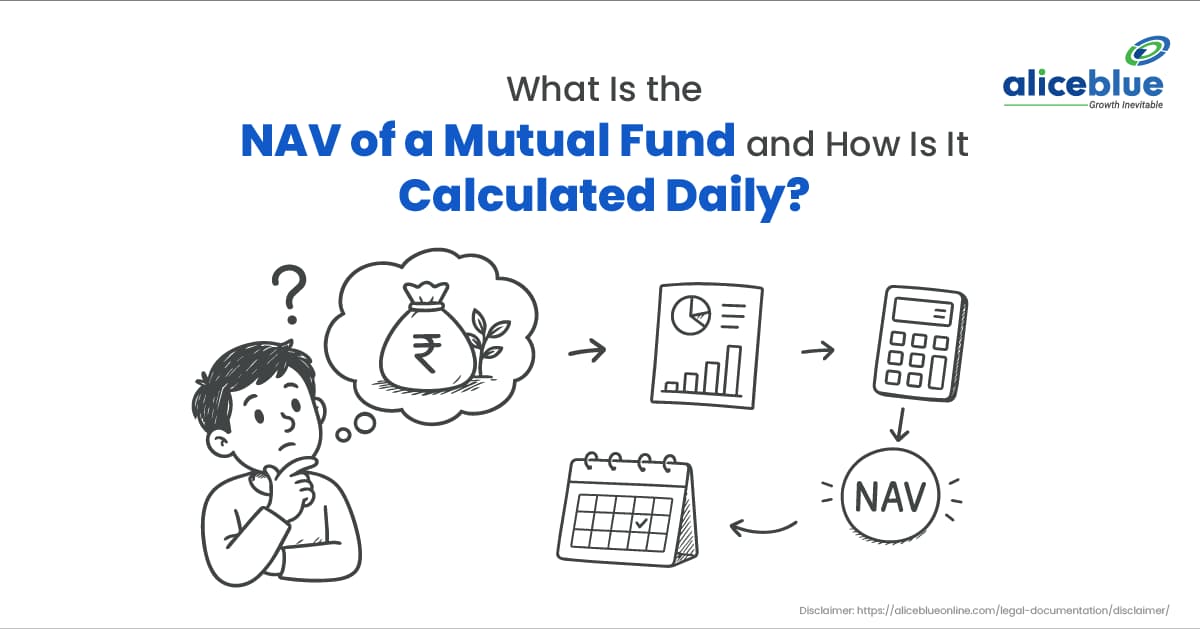
You bought units in a mutual fund – but do you actually know what each unit is worth today? That number has a name: NAV, or Net Asset Value. It’s the price of one unit of the fund, recalculated every single day based on how the fund’s investments perform. Whether you are putting in money for the first time or tracking your existing investments, understanding NAV helps you make smarter decisions.
This blog explains what NAV is, how it is calculated, and what it means for you as an investor.
Quick Definition
Net Asset Value is the per-unit market value of a mutual fund scheme. It’s calculated by subtracting total liabilities from total assets and dividing the result by the total number of outstanding units. It represents the official price at which you buy or redeem units on any given business day – not a market price driven by real-time supply and demand, but an accounting figure derived from the actual value of the fund’s underlying assets.
What NAV Actually Represents
- When you invest in a mutual fund, your money is pooled with capital from thousands of other investors. The fund manager uses this combined pool to purchase a portfolio of assets – equities, corporate bonds, government securities, or money market instruments depending on the fund’s mandate.
- Because you own a fractional portion of this entire asset basket rather than individual securities, the fund issues you “units.” The NAV is simply the rupee value of one unit at the close of business on a given day. It changes every day because the underlying portfolio changes in value as markets move.
- Unlike a stock price – which reflects the intersection of real-time buyer and seller bids throughout trading hours – the NAV is calculated once, after trading closes, based on the closing prices of every security the fund holds. It’s an accounting number, not a market-discovered price.
The NAV Formula
Five steps produce this number every business day.
Step 1 – Market Closure and Price Locking: At 3:30 PM IST, equity and bond exchanges close. Every stock and bond in the fund’s portfolio gets locked at its final closing price. No more price movement until the next trading session.
Step 2 – Portfolio Asset Aggregation: The fund calculates the total market value of all underlying assets – closing market value of equities and debt instruments, cash balance and liquid fund holdings, and accrued income including dividends declared but not yet received and interest earned but not yet collected.
Step 3 – Deduction of Liabilities and Operating Costs: All current liabilities are subtracted from total assets – pending payables for recently purchased securities and the daily portion of the annual Expense Ratio, which is 1/365th of the total annual management fee, custodian charges, audit fees, and administrative expenses.
Step 4 – Division by Outstanding Units: The remaining balance – Net Assets – is divided by the current total units outstanding across all investors in the scheme. The result is the NAV per unit.
Step 5 – Publication: By approximately 11:00 PM on business days, the AMC publishes the finalised NAV on its official website and regulatory databases. This is the price that applies to all transactions submitted before the relevant cut-off time that day.
A Complete Worked Example
Consider an equity mutual fund at market close with these figures:
- Market value of portfolio equities: ₹100 Crore
- Cash and accrued interest: ₹5 Crore
- Accrued operating expenses and payables: ₹3 Crore
- Total outstanding units: 50 Lakh (5,000,000 units)
Total Assets: ₹100 Cr + ₹5 Cr = ₹105 Crore
Total Liabilities: ₹3 Crore
Net Portfolio Value: ₹105 Cr − ₹3 Cr = ₹102 Crore (₹1,020,000,000)
NAV Per Unit: ₹1,020,000,000 ÷ 5,000,000 units = ₹204.00 per unit
If you invest ₹10,000 in this fund on that day, you receive ₹10,000 ÷ ₹204 = 49.0196 units.
The fractional unit allocation is standard – mutual funds don’t round to the nearest whole unit the way stock purchases do. You get exactly as many units as your investment amount divided by the NAV produces.
Key Features Worth Understanding
- Single daily price – NAV updates once per business day after markets close. There is no intraday price movement. No matter what time you submit your transaction, all investors in that day’s cut-off window receive exactly the same NAV.
- Net of fees – the NAV you see is already calculated after the day’s expense deduction. The management fee isn’t added separately when you redeem – it’s embedded in the daily NAV calculation across the entire year.
- Accounting metric, not valuation signal – NAV tells you the mathematical per-unit value of the fund’s assets. A high NAV doesn’t mean the fund is expensive. A low NAV doesn’t mean it’s cheap. This distinction is critical and gets confused constantly by new investors.
- Cut-off timing sensitivity – the NAV you receive depends on when your transaction is submitted and when your funds are received by the AMC. Submitting after the 3:00 PM equity fund cut-off pushes your order to the next business day’s NAV, exposing you to overnight market moves you didn’t intend to carry.
Mutual Fund NAV vs. Stock Price: The Core Differences
Feature | Mutual Fund NAV | Stock Price |
Pricing Frequency | Once daily after market close | Continuously during market hours |
Price Determination | Assets minus liabilities divided by units | Real-time buyer and seller supply and demand |
Intraday Trading | Not possible | Fully available on exchange |
High Value Interpretation | Indicates longer existence or asset growth | May indicate high valuation or historical splits |
Transaction Execution | Processed at end-of-day NAV | Executed instantly at live market price |
The practical implication: if you need intraday flexibility – the ability to buy or sell at a specific price during the trading session – mutual funds cannot provide that. ETFs do, but standard open-ended mutual fund schemes don’t. This isn’t a flaw; it’s simply how the instrument is structured.
Advantages of Understanding This Properly
- Accurate performance tracking becomes possible when you understand what NAV measures. Calculating your CAGR requires comparing your purchase NAV against your current NAV across a specific time period. Without understanding the metric, performance measurement is guesswork.
- Transparency is built into the mechanism. Every investor – regardless of whether they invested ₹500 or ₹5 crore – buys and redeems at the same audited NAV on the same day. There’s no price negotiation, no bid-ask spread advantage for larger investors, no information asymmetry in execution pricing.
- SIP execution becomes cleaner. Because fractional units are allocated based on the exact NAV, your monthly ₹5,000 SIP buys a precise number of units – sometimes more when NAV is lower after a market dip, sometimes fewer when NAV is higher. This is the rupee-cost averaging mechanism working exactly as intended.
Risks and Limitations
- No intraday trading is a genuine limitation for investors who want flexibility. Markets can move sharply during the day – and if you decide to act at 11:00 AM, your transaction will be processed at the NAV computed at 3:30 PM and published by 11:00 PM. The price you execute at is unknown at the time you decide to transact.
- Cut-off timing risk catches many investors off guard. Submitting an order at 3:05 PM instead of 2:55 PM means you get tomorrow’s NAV instead of today’s. If markets gap down overnight, you absorb that move without having chosen to. Knowing the cut-off times and building a meaningful buffer is basic operational hygiene for mutual fund investors.
- Psychological misinterpretation of NAV size is perhaps the most practically costly limitation – not of NAV itself, but of how investors use it. The instinct to see a ₹10 NAV as “cheaper” than a ₹500 NAV is both common and incorrect.
Practical Tips for Getting This Right
- Ignore NAV size entirely when selecting between funds. The only number that matters is performance – the percentage return the fund has generated on its underlying assets over relevant time periods. A fund that’s been around 15 years and has an NAV of ₹600 has compounded investor wealth significantly. The ₹10 NFO next to it hasn’t done anything yet. Choosing the NFO because it “looks cheaper” is a logical error with real financial consequences.
- Place transactions well before cut-off deadlines. For equity funds, the cut-off is typically 3:00 PM. Submitting at 2:00 PM rather than 2:55 PM provides buffer against processing delays and ensures you capture the intended day’s NAV.
- Use instant payment modes – IMPS or UPI – when investing. NAV allotment for mutual fund purchases depends on when the AMC actually receives your funds, not just when you initiate the transfer. Delayed fund realisation can push your NAV allotment to the following day even if your order was submitted on time.
Common Mistakes That Cost Investors
- Buying NFOs specifically because the ₹10 NAV seems like a bargain is one of the most persistent misconceptions in retail mutual fund investing. A new fund at ₹10 has no track record, no demonstrated investment process, and no performance history to evaluate. An established fund at ₹300 has 10 years of compounded returns that the ₹10 fund hasn’t begun to generate. The absolute NAV level says nothing meaningful about future performance potential.
- Expecting NAV to stay flat after dividend distributions reveals a misunderstanding of how the mechanism works. When a fund declares a dividend, that cash leaves the asset pool and goes to investors. Total assets shrink by exactly the dividend amount while unit count stays constant – so NAV falls by exactly the dividend per unit. The money didn’t disappear; it moved from your fund units to your bank account.
- Trying to time NAV dips for SIP investments adds complexity without adding value. Monthly SIP investing works through consistency and time in the market – the rupee-cost averaging benefit comes from investing regularly across different NAV levels, not from accumulating units precisely at the lowest NAVs. Holding cash waiting for the “right” NAV typically produces worse outcomes than simply investing on schedule.
Who Needs to Understand This
- SIP investors building wealth systematically need to understand how monthly investment amounts translate into units – and why accumulating units at lower NAVs during market corrections is beneficial rather than alarming.
- Lump-sum investors timing entry during market pullbacks need to understand NAV cut-off timing to ensure their transaction receives the intended day’s price rather than the next day’s.
- Investors using Systematic Withdrawal Plans for retirement income need to understand how unit redemption works at prevailing NAVs to model portfolio longevity accurately – withdrawing too many units when NAV is depressed after a market correction depletes the portfolio faster than projections based on average NAVs suggest.
Conclusion
NAV is the daily accounting heartbeat of every mutual fund scheme – an honest, transparent per-unit measure of what the fund’s assets are actually worth after all costs are deducted. Understanding how it’s calculated, what it does and doesn’t tell you, and how transaction timing affects which NAV you receive eliminates a surprising number of the mistakes that new investors make. The number itself isn’t complex. What matters is using it correctly – as a performance tracking tool and transaction reference price, not as a valuation signal about whether a fund is cheap or expensive. That distinction, internalised properly, removes one of the most common mental errors in retail mutual fund investing.
Frequently Asked Questions
No – not in any meaningful investment sense. A high NAV simply reflects that the fund has been running for longer or that its underlying assets have grown significantly. Fund performance depends entirely on the percentage return of its portfolio, not the absolute unit price. A fund at ₹500 NAV that grew from ₹100 over 10 years has delivered the same percentage return as a fund at ₹50 NAV that grew from ₹10 over the same period.
AMCs typically publish finalised NAVs by 11:00 PM IST on business days, after market prices are locked at 3:30 PM and portfolio valuations are completed. This figure is available on the AMC’s official website and regulatory databases like AMFI.
When a fund declares and pays a dividend, that cash exits the scheme’s asset pool and goes directly to investors’ bank accounts. Total assets decline by the dividend amount while the unit count remains the same – so NAV falls proportionately by exactly the dividend per unit. The total value to the investor is unchanged; it’s just split between fewer assets in the fund and more cash in the bank.
Direct plans don’t involve distributor commissions or broker fees, resulting in a lower daily expense deduction from the asset pool. Because less is deducted each day, the net assets grow faster – producing a higher NAV over time compared to the same scheme’s Regular plan. Over long investment horizons, this NAV gap can become substantial.
No. A large redemption increases total assets by the redemption proceeds and reduces outstanding units by the corresponding amount – in exact proportion. The per-unit calculation remains unaffected

Blog by Aliceblue News Desk


