
What Is Vega in Options and How Does It Affect Your Position?
Blog by Aliceblue News Desk
14 August 2026
8 minutes
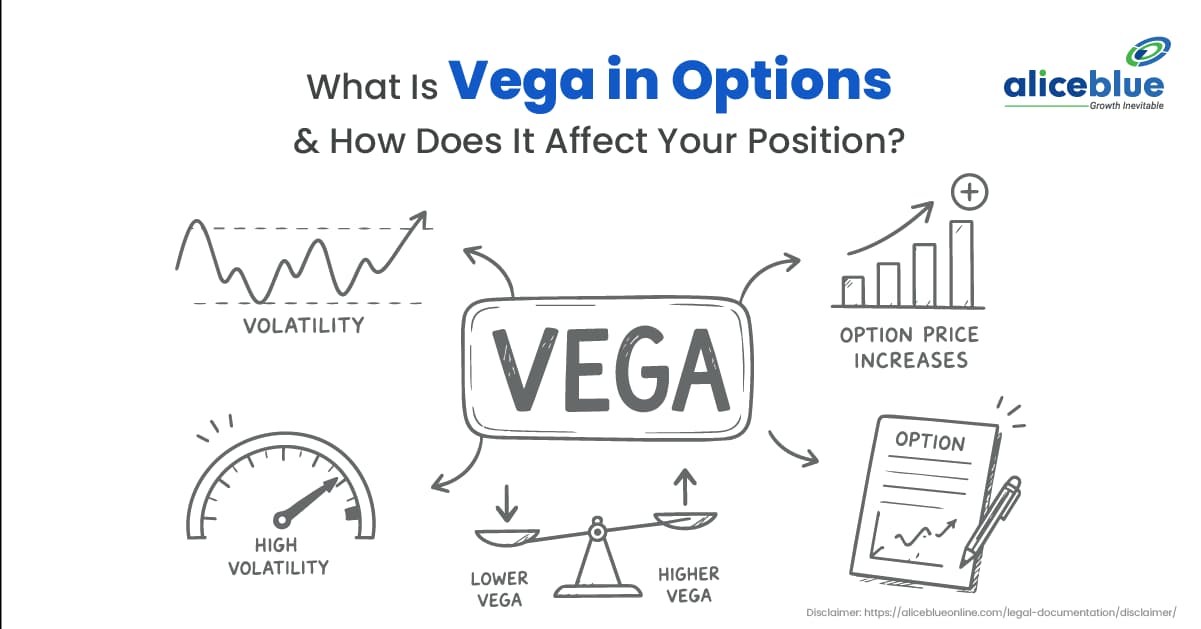
Vega shows how much an option’s premium can change when implied volatility moves by 1 percentage point. If Vega is 5, the premium may rise by about ₹5 when IV rises by 1%, and fall by about ₹5 when IV drops by 1%, assuming everything else stays the same. That is why option prices can jump or sink around RBI policy days, Budget announcements, or company results, even when the stock itself barely moves.
Table of Contents
- What Is Vega in Options
- Historical Volatility vs Implied Volatility
- How Vega Works Step by Step
- Practical Example With Numbers
- Long Vega vs Short Vega
- Key Features of Vega
- Advantages of Tracking Vega
- Risks and Limitations
- Tips for Beginners
- Vega vs Other Option Greeks
- Common Mistakes to Avoid
- Who Should Use This Concept
- Frequently Asked Questions
If you have ever bought an option, seen the stock move in your favour, and still ended up with a loss, Vega may be the reason. It is part of options pricing that many beginners miss because they focus only on direction. Once you understand it, you start seeing why some trades work on paper but fail in real life.
What Is Vega in Options?
Vega is one of the option Greeks. These are numbers that show how sensitive an option price is to different market factors. Vega tells you how much the premium may change when implied volatility changes by 1 percentage point.
An option price has two parts.
- Intrinsic value, which is the real value if you exercised the option right now.
- Extrinsic value, which is the extra amount paid for time and uncertainty.
Vega mainly affects extrinsic value. That is why it matters more when there is still time left in the contract and less when expiry is near.
In simple words, Vega shows how much traders are paying for uncertainty.
- If the market expects a big move, premiums can rise.
- If the expected move looks smaller, premiums can fall.
Historical Volatility vs Implied Volatility
Beginners often mix these two up, so it helps to keep them separate.
- Historical volatility shows how much a stock has moved in the past.
- Implied volatility shows how much the market expects it to move in the future.
- Vega reacts to implied volatility, not historical volatility.
This is why two stocks can look quiet on the chart, but their options may still be expensive if traders expect a sharp move soon. India VIX is often used as a broad market signal for expected volatility.
How Vega Works Step by Step
- A market event changes trader expectations.
- Implied volatility moves up or down.
- The option premium gets adjusted.
- Vega tells you how big that change may be.
- If you bought the option, rising IV helps you.
- If you sold the option, falling IV helps you.
Vega is usually higher in at-the-money options and lower in deep in the money or far out of the money options.
- Options with more time left usually have higher Vega.
- Options near expiry usually have lower Vega.
Practical Example With Numbers
Let us say a Nifty option is trading at ₹200 and has a Vega of 10. That means if implied volatility rises by 1 percentage point, the premium may increase by about ₹10, assuming nothing else changes.
If IV rises by 2 percentage points, the premium may rise by about ₹20.
- Premium at start: ₹200
- IV change: plus 2%
- Approx premium gain: ₹20
- New premium: around ₹220
If IV falls by 3 percentage points, the premium may fall by about ₹30.
- Premium at start: ₹200
- IV change: minus 3%
- Approx premium loss: ₹30
- New premium: around ₹170
This is why option buyers often get caught after big events. The market move may happen, but the fall in volatility can still pull the premium down.
Long Vega vs Short Vega
Position | Vega exposure | Gains when | Common strategy | Main risk |
Positive Vega | IV rises | Buying options before expected events | IV crush after the event | |
Sold call or put | Negative Vega | IV falls | Short straddle, covered call | Sudden spike in IV |
If you buy options before a known event, you are usually taking a long Vega view.
- Long Vega means you want volatility to rise.
- Short Vega means you want volatility to fall.
Key Features of Vega
- Vega is highest for at-the-money options because these contracts carry the most extrinsic value.
- Vega is lower for in-the-money and out-of-the-money options because those contracts react less to volatility changes.
- Vega falls as expiry gets closer.
- The less time you have, the less room there is for volatility to change the premium.
- Calls and puts with the same strike and expiry have the same Vega.
- The volatility effect is the same on both sides of the trade.
Advantages of Tracking Vega
Vega helps you judge whether an option is expensive or cheap from a volatility point of view. That is useful when you are planning trades around RBI policy, results, Budget announcements, or other market events.
It also helps you avoid one of the most common beginner mistakes in options trading, which is buying a trade with a good direction but paying too much for volatility.
- You can time entries better.
- You can avoid overpaying for options.
- You can choose strikes and expiry with more clarity.
- You can plan around high volatility events more carefully.
When you know Vega, you can make better choices about timing, strike selection, and expiry selection.
Risks and Limitations
Vega can hurt you even when your market view is right. If you buy options when IV is already high and it drops later, your premium can still fall because of the volatility drop.
Selling options also carries risk.
- If volatility jumps suddenly, the premium can rise fast against a short position.
- Option sellers can face sharp losses when IV expands quickly.
- Event-based trades can move against you very fast.
That is why many traders watch India VIX and event calendars before taking trades. Vega should never be checked alone. Delta, Theta, and Gamma also affect the premium, so the full position must be understood before you enter.
Tips for Beginners
Start by checking implied volatility before buying an option.
- If IV is already high, the premium may be costly.
- If IV is low, there may be room for premium expansion.
Use simple strikes first.
- At the money options are easier to understand.
- Vega is usually more visible there.
Avoid large trades around events until you have seen how volatility behaves in real time.
- A small position teaches more than a large one.
- Big size can turn a learning trade into an expensive mistake.
Keep an eye on India VIX.
- Rising VIX can mean higher premium pricing.
- A falling VIX can mean lower premium pricing.
Alice Blue’s What is India VIX? is a good starting point if you want to understand how market fear and option premiums connect.
Vega vs Other Option Greeks
Greek | What it measures | Where beginners use it |
Delta | How much the option moves with the stock price | Directional exposure |
Theta | How much value does the option lose every day | Time decay |
Gamma | How fast does Delta change | Fast price movement risk |
Vega | How much the option moves with IV changes | Volatility risk |
These Greeks work together.
- Delta tells you about the price direction.
- Theta tells you about time decay.
- Gamma tells you how fast Delta can change.
- Vega tells you how volatility can change the premium.
Vega answers the question of how much a volatility change can affect your premium, which is why it matters so much before events.
Common Mistakes to Avoid
- Buying options only because the chart looks strong. The chart may look right, but if IV falls sharply, the premium can still lose value.
- Ignoring expiry. Vega matters more when there is time left, so a weekly option and a monthly option can behave very differently.
- Using one Greek alone. If you only look at Vega and ignore Theta or Delta, you may misunderstand why the trade moved the way it did.
- Trading around events without checking IV. Event-based trades can get expensive if volatility is already stretched.
- Forgetting the position type. Buyers and sellers react in opposite ways to IV changes.
Who Should Use This Concept?
Vega is most useful for active options traders, especially those who trade around earnings, RBI policy days, and other event-driven setups. It is also helpful for option sellers who want to benefit from falling volatility.
- Event traders should watch Vega closely.
- Option sellers should watch Vega closely.
- Beginners should learn Vega before using strategies like straddles or strangles.
Long-term equity investors do not need Vega for daily investing decisions, but it is still worth knowing if they ever use options for hedging. For beginners, the best approach is to understand Vega first, then move to strategy building later.
Conclusion
Vega shows how much an option premium can change when implied volatility changes. It matters because options are not priced only on direction, but also on how uncertain the market feels. If you ignore Vega, you can get the direction right and still lose money. If you understand it, you can make better choices about when to buy, when to sell, and when to stay out.
Frequently Asked Questions
No. Volatility is the expected or actual movement, while Vega measures how much an option premium changes when that expectation changes.
At the money options have the most extrinsic value, so they react more to changes in implied volatility.
No. For the same strike and expiry, calls and puts have the same Vega.
IV crush is a sharp drop in implied volatility after an expected event. It can reduce option premiums quickly.
No. Vega should be studied along with Delta, Theta, and Gamma, because all of them affect the final premium.
Both. Buyers care when volatility is likely to rise, and sellers care when volatility is likely to fall.

Blog by Aliceblue News Desk


