
Why India’s EV Shift Feels Unstoppable Now
Blog by Aliceblue News Desk
24 June 2026
7 minutes
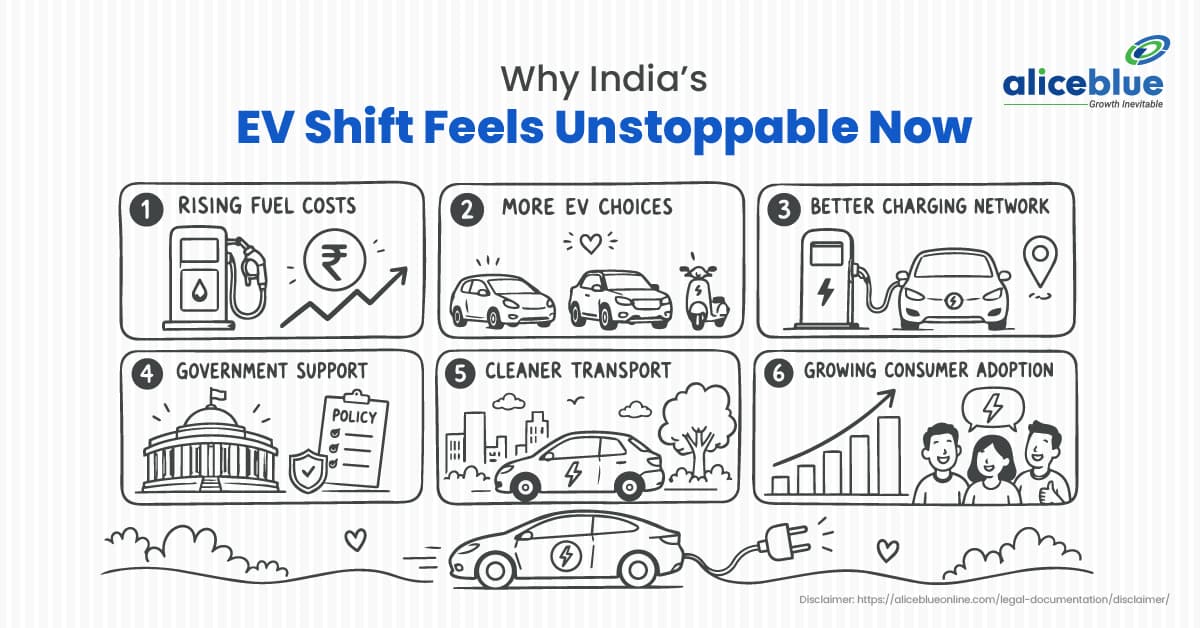
India’s electric vehicle journey no longer feels like a distant possibility. It is now visible in everyday life.
A few years ago, EVs were mostly discussed in policy meetings, startup events, auto expos, and climate-related conversations. They sounded promising, but for many Indian households, they still felt like a future option rather than an immediate choice.
That perception has changed.
Today, electric vehicles are becoming part of regular mobility. You may see an electric scooter outside a residential building, an electric auto near a metro station, an EV delivery vehicle outside a restaurant, or an electric bus on a busy city route. Even families planning to buy a new two-wheeler are now asking a practical question: “Should we consider an EV?”
This is how large consumer shifts begin. Not with one big announcement, but with repeated everyday visibility. When people begin seeing a new technology around them regularly, it slowly becomes familiar. And when it becomes familiar, it starts entering purchase decisions.
That is exactly what is happening with EV adoption in India.
EVs Are Becoming a Practical Money Decision
For a long time, electric vehicles were mainly positioned as an environmentally responsible choice. Lower emissions, cleaner air, and reduced fuel dependence were the main talking points.
Those benefits still matter. But in India, widespread adoption depends on something more direct: value for money.
Indian consumers are practical buyers. Before purchasing a vehicle, they compare fuel expenses, maintenance costs, EMI, resale value, daily usage, service support, and long-term affordability. In this calculation, EVs are starting to look more attractive.
For daily commuters, an electric scooter can reduce routine travel costs. For delivery riders, lower running expenses can directly impact monthly savings. For families, reduced fuel and maintenance costs can create visible benefits over time. For businesses, electric fleets can help manage operating costs more efficiently.
This is an important shift. EVs are no longer seen only as a “green” choice. They are increasingly being viewed as a financially sensible mobility option.
When sustainability and savings come together, adoption becomes much stronger.
India’s EV Revolution Led by Everyday Mobility
In several global markets, the EV transition began with premium electric cars. India’s story is different. Here, the strongest momentum is coming from vehicles used in daily life: electric scooters, motorcycles, autos, buses, and delivery vehicles.
This matters because India is a mass mobility market. A premium electric car may create aspiration, but an electric two-wheeler can affect a family’s monthly budget. An electric auto can improve last-mile transport. An electric bus can impact thousands of commuters every day. Electric delivery fleets can reshape business economics for logistics, food delivery, and local commerce.
That is why India’s EV shift feels powerful now. It is not limited to luxury buyers or early adopters. It is moving into practical categories that millions of people use regularly.
A mobility trend becomes a real movement when it improves everyday life for ordinary users. In India, EVs are gradually doing that for students, office-goers, delivery partners, small businesses, public transport users, and families.
The Buyer Mindset Has Changed
Earlier, many people asked, “Can EVs really work in India?” Now, the question has changed to, “Can an EV work for my daily routine?”
This change in mindset is significant.
Most Indian buyers do not make vehicle purchases impulsively. They compare models, ask friends, check reviews, calculate running costs, discuss with family members, and evaluate after-sales service. The fact that EVs are now part of this comparison process shows that consumer behaviour is changing.
People may still have concerns. Battery life, charging access, resale value, service availability, and long-distance travel are still important questions. But the key point is that EVs are no longer being dismissed immediately.
They are being considered. And markets often change before sales numbers fully reflect the shift. The real change begins when people start comparing a new option seriously. That is where electric vehicles in India stand today.
EVs have moved from curiosity to consideration.
Charging Anxiety Exists, But Daily Use Is Changing the Conversation
Charging remains one of the biggest concerns for EV buyers. Range, charging time, public charging stations, and highway travel are still important factors.
However, most daily vehicle usage in India is not about long-distance road trips. It is about office commutes, college travel, school drops, local errands, market visits, short city rides, and delivery routes.
For these use cases, EVs are becoming more practical, especially when users have access to home charging, workplace charging, or reliable local charging points.
This is slowly changing the conversation.
Instead of only asking, “How far can this EV go?”, buyers are asking, “Does this fit my daily travel pattern?”
That is a more practical question. And for many urban and semi-urban users, the answer is increasingly becoming yes.
This does not mean charging infrastructure is no longer a challenge. It still needs to improve significantly. But for everyday mobility, EVs are beginning to match real usage needs.
EVs Are Creating a Complete Ecosystem
One of the biggest reasons India’s EV shift feels unstoppable is that it is no longer only about vehicles.
A much larger ecosystem is developing around electric mobility.
This includes battery manufacturing, charging infrastructure, battery recycling, financing, insurance, vehicle software, fleet management, servicing, clean energy integration, and skilled employment.
This ecosystem effect is important. When an industry creates supporting businesses, jobs, investments, infrastructure, and consumer habits, it becomes harder to reverse.
EVs are not just a new vehicle category. They are becoming part of a wider mobility economy.
For example, charging networks create infrastructure opportunities. Battery recycling supports sustainability and resource efficiency. Fleet electrification changes logistics economics. EV financing helps make adoption easier. Software and connected mobility improve vehicle management.
Together, these developments make the EV transition deeper and more durable.
Businesses Are Also Driving EV Adoption
The EV shift is not being driven only by individual consumers. Businesses are playing a major role too.
Delivery companies, cab operators, logistics providers, fleet owners, and public transport operators are evaluating electric mobility because operating costs matter deeply in these segments.
For businesses, even a small reduction in cost per kilometre can become meaningful at scale. This makes EVs attractive not just from a sustainability angle, but from an efficiency perspective.
Electric fleets can also help companies meet environmental goals, improve brand perception, and reduce exposure to fuel price volatility.
As more businesses adopt electric mobility, public visibility increases. When people regularly see EVs being used in delivery, transport, and logistics, their trust in the category improves.
That visibility helps consumer adoption as well.
The Road Ahead Will Be Gradual, Not Perfect
India is not fully EV-ready yet.
Charging networks must expand. Battery confidence needs to improve. Rural adoption may take longer. Service networks must become stronger. Upfront cost remains an important factor. Consumers still need better awareness around battery warranties, safety, maintenance, and real-world range.
But these challenges do not make the EV shift weak. They show that the market is still building its foundation.
India’s mobility future will not become fully electric overnight. Petrol, diesel, CNG, hybrids, and EVs will continue to share the road for many years. The transition will be mixed, gradual, and uneven across regions and vehicle categories.
But the direction is becoming clearer.
EVs have moved from futuristic to visible. From premium to practical. From climate conversation to household calculation. From policy discussion to daily commute.
That is why the shift feels different now.
Conclusion
The strongest sign of India’s EV adoption is not that every household is buying one immediately. It is that more people are now open to considering one. The question has changed from “Why EV?” to “Why not EV?” That small shift matters.
When a new technology enters family discussions, office conversations, business planning, and daily mobility choices, it is no longer just a trend. It becomes part of the market’s future direction.
India’s EV shift feels unstoppable, not because the journey is complete, but because the mindset has already begun to change. And once that happens at scale, the future has already started moving.

Blog by Aliceblue News Desk


