

IndiGo Q3 Profit Drops 15% as Crude Oil Price Hits $95
News by Aliceblue News Desk
19 May 2026
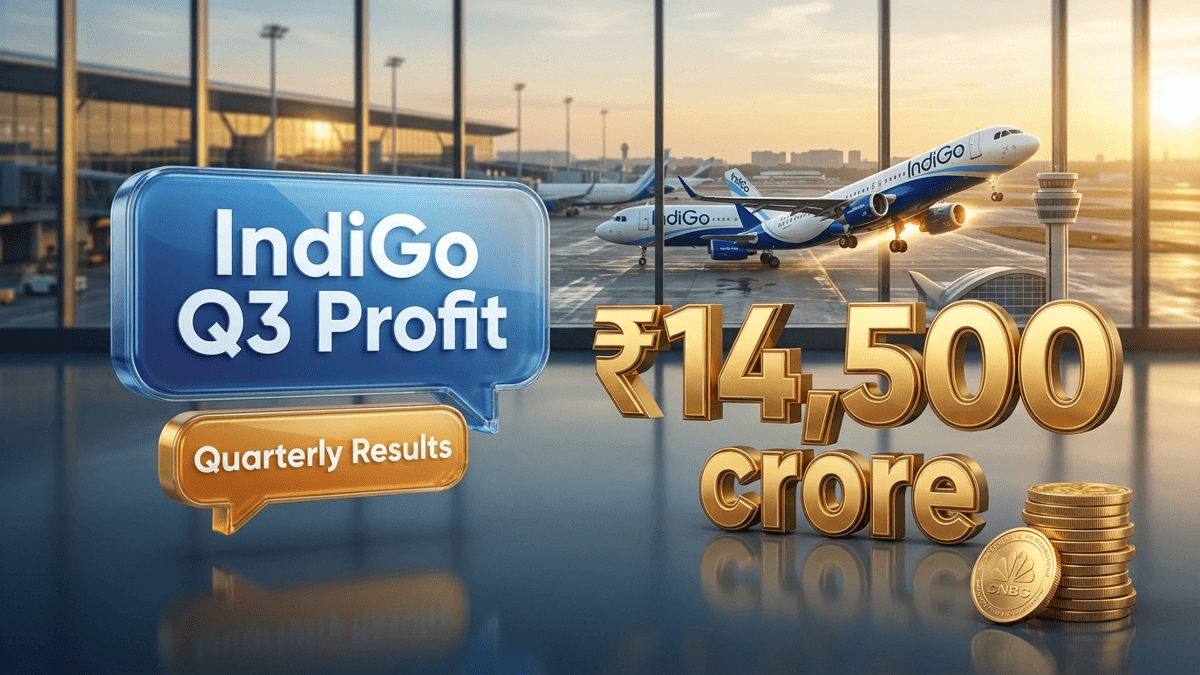
IndiGo Q3 Profit Drops 15% as Crude Oil Price Hits $95
Quick Summary (Featured Snippet)
- Interglobe Aviation Ltd shares Ltd reported Q3 results on May 19, 2026.
- Key reason: Surging jet fuel prices due to global crude hitting $95 per barrel.
- Impact: Net profit declined by 15% as operating margins faced severe compression.
- Market reaction: Overall sentiment is negative with medium strength due to high fuel sensitivity.
What Happened
Interglobe Aviation Ltd share Ltd reported a significant contraction in its bottom line for the third quarter, primarily driven by the adverse crude oil price impact on NSE stocks. The budget carrier saw its net profit slide by 15% compared to the previous year, as the global benchmark for energy prices breached the $95 mark during the reporting period.
The financial performance, as per regulatory filing, highlights the vulnerability of the aviation sector to volatile input costs. On May 19, 2026, the airline disclosed that its fuel expenses had surged by over 22% year-on-year.
This increase is largely attributed to the fact that the firm maintains unhedged fuel costs, making its profit and loss account highly sensitive to fluctuations in the international energy market. In May 2026, the sudden spike in procurement costs outpaced the growth in passenger yields, leading to the reported earnings miss.

Based on exchange disclosure, the total income for the quarter stood at ₹14,500 crore, which represents a growth of 8% over the corresponding period last year. However, the operating profit margin narrowed by 450 basis points, falling to 12.5%.
The management noted that while passenger demand remained robust with a load factor of 86%, the inability to fully pass on the fuel price hike to travelers resulted in the margin squeeze. The stock reacted to these figures with a downward bias in early trade on the National Stock Exchange.
The broader context involves geopolitical supply constraints that pushed the MCX crude oil live price today to levels not seen in several quarters. For the market leader in the Indian skies, the cost of Aviation Turbine Fuel (ATF) now accounts for approximately 42% of its total operating expenses.
This is a significant jump from the 36% level recorded in the same quarter of the previous fiscal year. The company remains focused on capacity expansion, having added 12 new aircraft to its fleet during the quarter, bringing the total count to 380 units.
Why This Matters
The recent surge in energy costs has profound implications for the Indian macroeconomic landscape, particularly concerning inflation and the fiscal trajectory. As the crude benchmark hit $95, the Reserve Bank of India (RBI) faces renewed pressure regarding interest rate trajectories.
Every $10 increase in the price of oil typically adds about 40 basis points to the Consumer Price Index (CPI) inflation in India. With the current account deficit under watch, the rise in the import bill for fossil fuels threatens to weaken the rupee, which was trading at ₹84.20 against the dollar on May 19, 2026.
From a sectoral perspective, the aviation industry is the most immediate casualty, but the impact radiates across the Nifty Services Sector. High fuel prices act as a headwind for consumer discretionary spending.
When airfares rise by 10% to 15% to compensate for fuel costs, it often leads to a slowdown in leisure travel demand. Furthermore, the NSE Energy Index real-time data shows that while upstream producers might benefit, the downstream users and the broader transportation sector face structural challenges.

For the broader equity market, the performance of the budget carrier serves as a bellwether for institutional sentiment. According to exchange data, Foreign Portfolio Investors (FPIs) have been net sellers in the aviation and paints sectors over the last 15 days, offloading shares worth ₹2,400 crore.
This movement of capital is linked to the earnings visibility of companies with high operating leverage. The Nifty 50, which has a significant weightage in energy-sensitive stocks, saw a volatility index (India VIX) spike of 8% following the earnings announcement.
Market Implications and Crude Oil Price Impact on NSE Stocks
The overall sentiment following the earnings release is Negative, with a Medium strength rating. The primary market drivers identified are the extreme volatility in global energy prices and the inherent high operating leverage of the aviation business model.
As the crude benchmark remains elevated at $95, the ability of the airline to sustain its growth trajectory without sacrificing profitability is being monitored. The sentiment is influenced by the fact that the firm does not employ aggressive fuel hedging strategies, leaving it exposed to price shocks.
The implications for sectoral indices are significant, particularly for the Nifty Services Sector and the Nifty Midcap 100. The budget carrier, being a heavyweight in these indices, has a notable impact on their daily movements.
On the day of the announcement, the sectoral index for services declined by 1.8%, while the broader market saw a more muted reaction. Market participants are also monitoring the Reliance Industries share price impact, as refining margins are tied to the same global energy dynamics.
Risk factors remain a critical concern for the upcoming quarters. Execution risk is at the forefront, as the company must implement dynamic pricing strategies effectively to protect margins without losing market share.
There is also a regulatory context; if airfares continue to rise, there could be pressure to maintain travel affordability. Additionally, the sensitivity of consumer discretionary spending to ticket pricing means that a 5% drop in load factors could lead to a further 10% erosion in operating profits.
What to Watch Next
Immediate Catalysts (Next 1-3 months):
– Monthly traffic data for May 2026 — expected in the first week of June 2026 to gauge demand elasticity.
– ATF price revision by Oil Marketing Companies (OMCs) on June 1, 2026 — critical for margin forecasting.
– US Federal Reserve policy meeting in June 2026 — impact on the dollar index and fuel procurement costs.
– Q4 FY26 earnings guidance update — expected by late June 2026 as per company announcement.
Medium-term Catalysts (Next 3-12 months):
– OPEC+ production quota decision in late 2026 — will determine if oil stays above the $90 threshold.
– Delivery schedule of the next 25 Airbus A321neo aircraft — impact on fuel efficiency and capacity.
– Potential inclusion of ATF under the Goods and Services Tax (GST) regime — a long-standing industry demand.
– Festive season booking trends for Q3 FY27 — starting in September 2026 to assess consumer resilience.
Key Monitoring Metrics:
– Crude oil price (Brent) — current level: $95 — watch for movements toward $100.
– Operating Profit Margin — current level: 12.5% — watch for a slide toward 10%.
– Fuel as a % of Revenue — current level: 42% — watch for direction toward the historical mean of 35%.
– Passenger Load Factor — current level: 86% — watch for any drop below the 80% threshold.
– Yield per Available Seat Kilometer (YASK) — current level: ₹4.80 — watch for an increase to offset costs.
FAQs
1. What happened in this development?
InterGlobe Aviation Ltd reported its Q3 financial results on May 19, 2026, revealing a 15% decline in net profit. This drop was primarily caused by the crude oil price hitting $95 per barrel, which significantly increased the cost of jet fuel. Despite an 8% growth in total revenue, the airline’s operating margins were squeezed by a 22% rise in fuel expenses.
2. Why does this matter in the current market context?
This development is crucial because it highlights the crude oil price impact on NSE stocks and the broader Indian economy. With oil at $95, there is a direct threat to inflation targets as energy costs permeate through the supply chain. The aviation sector serves as a leading indicator for consumer discretionary health; a slowdown here often precedes a broader cooling in the Nifty Services Sector.
3. Which sectors, assets, or indices are affected?
The primary impact is seen in the aviation and logistics sectors, with the Nifty Services Sector index dropping 1.8% following the news. The NSE Energy Index real-time data also shows movement, as upstream companies might benefit while downstream users face higher costs. Additionally, the Reliance Industries share price impact is being monitored due to its refining exposure.
4. What are the key risks or uncertainties?
The foremost risk is the continued volatility in the MCX crude oil live price today, which could push fuel costs higher if it stays above $95. Execution risk is also high, as the airline needs to balance fare hikes with passenger volumes. Regulatory risk remains a factor, as the government might monitor airfare trends. Lastly, the global geopolitical situation remains a primary uncertainty for supply chains.
5. What is the regulatory or policy context?
According to exchange data, the airline’s disclosures are in compliance with SEBI’s Listing Obligations and Disclosure Requirements (LODR). From a policy perspective, the industry is watching for any movement on the inclusion of ATF under GST. The RBI’s monetary policy committee is also a key player, as it manages the inflation-growth trade-off with the repo rate currently at 6.5%.
6. What key metrics or indicators should be monitored?
Investors and analysts should focus on the following specific metrics to gauge the future trajectory:
– Brent Crude Price — current level: $95 — watch for levels at $88 or $102.
– Aviation Turbine Fuel (ATF) Price — current level: ₹1,15,000 per kilolitre — watch for the next revision on June 1, 2026.
– Passenger Load Factor — current level: 86% — a drop below 82% would be a notable signal.
– Rupee-Dollar Exchange Rate — current level: ₹84.20 — watch for any depreciation beyond ₹85.00.
7. What is the broader outlook for this segment?
The near-term outlook for the aviation segment is cautious, as the 15% profit drop suggests that the phase of post-pandemic recovery is facing headwinds. In the medium term, the outlook depends on whether oil prices stabilize below $90 and if the airline can successfully integrate its new fleet of 380 aircraft. While demand remains strong with 8% revenue growth, high fuel costs will likely keep the Nifty Services Sector under pressure.

News Author
Aliceblue News Desk






