
5 IPO Red Flags Every Investor Must Check Before Applying in 2026
Blog by Aliceblue News Desk
02 June 2026
8 minutes
Imagine sitting in your office, scrolling through your trading app, when a notification pops up: a massive new “Green Tech” IPO is opening tomorrow. Your WhatsApp groups are already buzzing with Grey Market Premium (GMP) rumors of 70% gains. You feel that familiar rush, the fear of missing out on the next multibagger.
However, many Indian retail investors jump into these offers only to see the stock tank on listing day because they missed the warning signs hidden in the 500-page prospectus. This article will teach you how to move past the hype and identify five critical red flags in an IPO before you block your hard-earned money via ASBA.
Quick Definition
An IPO red flag is a specific warning sign found in a company’s Draft Red Herring Prospectus (DRHP) that indicates financial instability, poor management, or overvaluation. Spotting these signs helps investors avoid companies that are using the public market primarily as an exit strategy for early founders.
What Are IPO Red Flags in the Stock Market?
In the Indian stock market, an IPO (Initial Public Offering) is the bridge that takes a private company to the NSE or BSE. While the promotional banners focus on “disruptive technology” or “market leadership,” the real story is buried in the DRHP, the legal document filed with SEBI.
A red flag is any data point, such as surging debt, promoter selling, or inconsistent earnings, that suggests the company’s current success might be a “window-dressed” illusion designed to attract public money at the peak of a cycle.
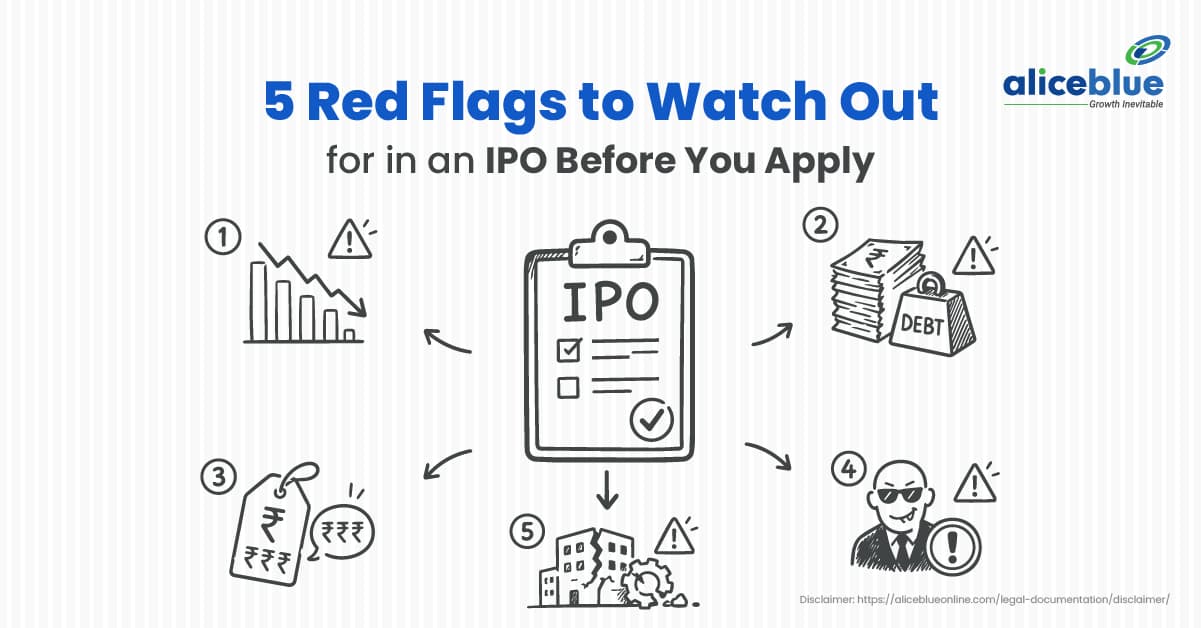
5 IPO Red Flags You Must Never Ignore
1. Excessive Offer for Sale (OFS)
An IPO can consist of a “Fresh Issue” (new shares) or an “Offer for Sale” (existing shareholders selling).
- The Red Flag: When the IPO is 80% to 100% OFS, no new money is entering the company.
- Why it matters: It indicates that the Promoters or Venture Capitalists are using the IPO as an “exit door.” If the people who built the business are desperate to sell their stake at the current price, why should you be eager to buy it?
2. Negative Operating Cash Flow
A company can show a “Net Profit” on paper while still being broke.
- The Red Flag: Look for Cash Flow from Operations (CFO) in the financial statements. If the company is profitable but the CFO is negative, it means they aren’t actually collecting cash from their customers.
- Why it matters: You cannot pay salaries or dividends with “accounting profit.” Continuous negative cash flow suggests the company is burning through cash to survive, which is a major sustainability risk.
3. Sudden Revenue or Profit Spike
“Window dressing” is a common tactic where a company artificially inflates its performance right before going public.
- The Red Flag: A sudden, massive jump in revenue or profit in the 12 months leading up to the IPO, after years of flat or slow growth.
- Why it matters: Unless there is a clear, structural reason for this growth (like a new factory opening), these spikes are often temporary. Once the company is listed, the performance often reverts to its mediocre mean, causing the stock price to tank.
4. High Debt-to-Equity Ratio
In a “higher-for-longer” interest rate environment like May 2026, debt is a silent killer.
- The Red Flag: A Debt-to-Equity ratio significantly higher than industry peers, combined with a “Use of Proceeds” dedicated to repaying loans.
- Why it matters: If you are investing in an IPO just so the company can pay off its old bank loans, your capital isn’t being used for growth. You are essentially bailing out the company’s past mismanagement.
5. Related Party Transactions
Transparency is the foundation of trust in the stock market.
- The Red Flag: Frequent financial dealings between the company and entities owned by the Promoters or their relatives (e.g., renting office space from the CEO’s brother at high rates).
- Why it matters: This is a classic way for Promoters to siphon money out of a public company into their private pockets. It shows poor corporate governance and a lack of respect for minority shareholders.
Example
Imagine a Fintech company, “QuickPay India,” launching a ₹2,000 crore IPO. The DRHP shows that ₹1,800 crore is an OFS for a PE fund exiting the business. Furthermore, while the company reported a ₹50 crore profit last year, its Cash Flow from Operations was -₹120 crore.
Finally, the “Objects of the Issue” state that the remaining funds will be used for “General Corporate Purposes”. These are three immediate red flags that suggest the company is overvalued and lacks a clear growth path.
How to Identify a Bad IPO Before Listing Day
To spot a bad investment, you must follow a logical auditing process:
- Analyze the “Objects of the Issue”: Identify if the money is staying in the company for growth or leaving it to pay off old debts.
- Verify Promoter Skin in the Game: Check if the founders are selling more than 25% of their holding; if they are leaving, why should you enter?
- Audit the Cash Flow: Don’t just look at “Net Profit.” Check “Cash Flow from Operations” to see if the company is actually collecting money from its customers.
- Benchmarking the Valuation: Compare the company’s P/E ratio with those of its already-listed industry peers. If the IPO is 3x more expensive than an established leader, it is overpriced.
- The Litigation Scan: Check the “Outstanding Litigations” section. High-value legal battles can wipe out future profits instantly.
The Benefits of Being a Skeptical IPO Investor
- Capital Preservation: By filtering out “toxic” IPOs, you avoid the 30-40% wealth erosion that often follows overvalued listings.
- Focused Investing: You can save your ASBA funds for “Quality Issues” that have a higher probability of long-term wealth creation.
- Emotional Discipline: You stop being a victim of “FOMO” (Fear Of Missing Out) and start acting like a professional analyst.
Why Some IPOs Crash After Listing
Ignoring these warnings can be expensive. Many “New Age” tech IPOs in the recent past have listed at a premium only to fall 60% within the first year as their lack of profitability became clear.
The biggest risk is being “stuck” in a low-quality stock while better opportunities in the secondary market pass you by.
Expert Tips for Safe IPO Investing
- The 3-Day Rule: Never apply on Day 1. Watch the Qualified Institutional Buyer (QIB) subscription. If the institutions are staying away, it’s a sign that the valuation is too high.
- Check the Abridged Prospectus: SEBI now requires a 10-page “summary” via a QR code on application forms. It’s the fastest way to see the “Risk Factors.”
- Compare the P/E Ratio: If a listed market leader is trading at 25x earnings, don’t pay 60x for an unproven IPO.
- Ignore GMP: Grey Market Premium is easily manipulated. Look at the P/E ratio relative to peers instead.
Fresh Issue vs Offer for Sale (OFS): Key Differences Explained
Feature | Quality IPO | Red Flag IPO |
Main Component | Fresh Issue (for growth) | Offer for Sale (for exit) |
Cash Flow | Positive & Growing | Negative or Inconsistent |
Valuation | At par with industry peers | Massive premium over peers |
Promoter Stake | Promoters retaining majority | Promoters selling a major stake |
Fresh Issue vs Offer for Sale (OFS): Key Differences Explained
- Trusting the “Grey Market” Blindly: GMP is often manipulated by operators to create artificial demand.
- Applying in Multiple Categories: Applying via both Retail and HNI categories from the same PAN will lead to rejection.
- Ignoring the Debt-to-Equity Ratio: Companies with high debt in a high-interest-rate environment (like mid-2026) are prone to default.
Should Beginners Invest in IPOs?
IPO investing is suitable for active traders looking for short-term listing gains and long-term investors seeking to enter a growth story early.
However, it is not suitable for those who cannot do basic fundamental research. If you prefer steady, predictable returns, you might be better off with blue-chip stocks in the secondary market.
Conclusion
As we navigate the IPO boom in 2026, remember that not every “new” stock is a “good” stock.
A successful investor is part detective; you must look for the red flags like excessive OFS, high debt, and aggressive valuations.
By using the tools provided on the Alice Blue platform and reading the DRHP summary, you can ensure that you are investing in a company’s future, not just funding a promoter’s exit.
Frequently Asked Questions
Not necessarily. Institutional investors often have higher risk appetites or short-term hedging strategies. Always verify the “Objects of the Issue” yourself to ensure the long-term fundamentals align with your goals.
Yes, bull market hype can drive short-term premiums. However, these gains often evaporate quickly once the “cooling period” ends. For long-term wealth, fundamentals matter more than Day 1 excitement.
No, retail investors can only withdraw or modify bids while the subscription window is open (usually 10 AM to 5 PM). Once the issue closes, your application is locked until allotment.
Simply scan the code to instantly access the Standardised Abridged Prospectus. This 12-category summary is designed by SEBI to help you spot risks in under 10 minutes.
SEBI mandates disclosure, not merit. As long as a company transparently reports its losses and risks in the DRHP, it is allowed to list. The final decision to accept that risk rests with you.
No, fundamentally strong companies in “unhyped” sectors often have low Grey Market Premiums but offer consistent long-term compounding. High GMP is frequently a sign of speculation rather than value.

Blog by Aliceblue News Desk


