
Best Option Strategies for Consistent Monthly Income in India (2026)
Blog by Aliceblue News Desk
07 August 2026
10 minutes

Options can be sold as well as bought, and selling them is one way traders in India generate monthly cash flow from the market instead of only buying and hoping for a big move. This blog explains four strategies used for this purpose: covered calls, bull put spreads, iron condors, and short strangles, along with how each one works and the numbers behind them. This content is for educational purposes only and does not constitute investment advice or a recommendation to trade any specific strategy.
Covered calls, bull put spreads, iron condors, and short strangles are four strategies commonly used in India for monthly option income. Covered calls are typically used by people who already hold stock or Nifty futures, while bull put spreads and iron condors function as standalone trades with a known maximum loss. Market participants often track India VIX when choosing between these setups, since VIX below 15 usually reflects a calmer market, while readings above 20 reflect higher expected movement.
Table of Contents
- Why Option Sellers Get Paid
- The 4 Strategies and How Each One Works
- A Nifty Covered Call Example, Verified Numbers
- What India VIX Measures
- What These Strategies Have in Common
- Where This Approach Can Add Income
- Where the Risk Comes From
- Points Beginners Often Learn the Hard Way
- Covered Call vs Iron Condor: Structural Differences
- Common Errors Seen in Option Selling
- Who Tends to Use These Strategies
- Closing Note
- Questions People Ask
- Sources Used
Why Option Sellers Get Paid
Buying an option is a bet on a big price move. Selling one works differently; the seller gets paid upfront, called a premium, and profits if the market stays flat or moves only slightly. That premium lands in the seller’s account the moment the option is sold.
Most options expire worthless, which is the mechanical reason this approach exists. Each day that passes without a large move reduces the option’s value, a process known as time decay, and it forms the basis of every strategy described here.
The 4 Strategies and How Each One Works
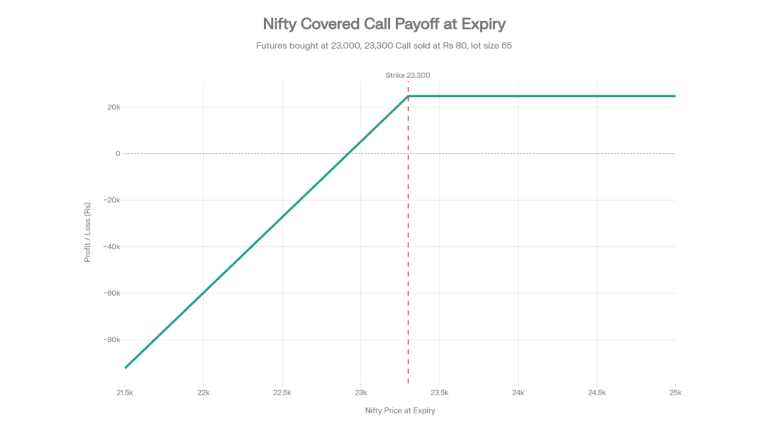
Covered Call: An investor who already owns the stock or Nifty futures sells a call option against that position.
- The trader owns at least 1 lot of the stock or index futures.
- A strike price above the current price is selected, referred to as out of the money, meaning that level has not been reached.
- The call is sold, and the premium is credited immediately.
- If the price stays below the strike, the premium and the underlying position are both retained. If the price crosses the strike, gains on the position stop growing beyond that level.
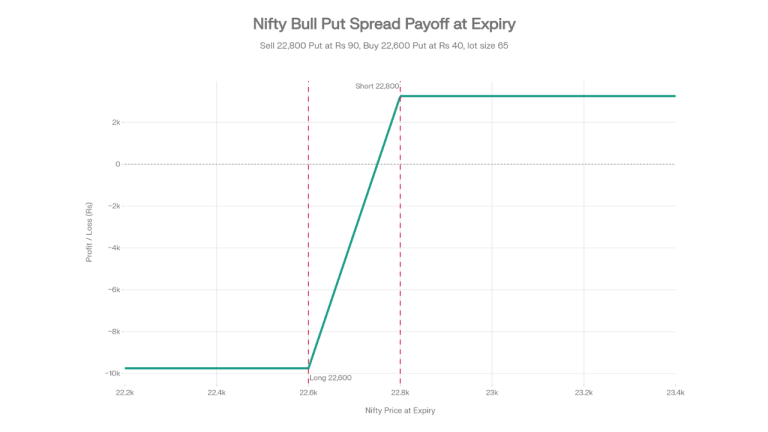
Bull Put Spread: A put is sold, and a cheaper put further away is bought as a hedge.
- A put is sold close to the current price.
- A put further below it is bought, which limits the maximum possible loss.
- The net premium received represents the maximum profit; the difference between strikes minus that premium represents the maximum loss.
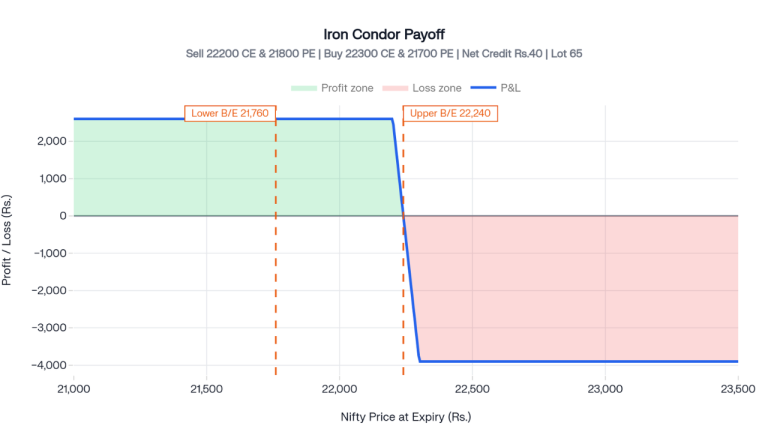
Iron Condor: A four-leg, non-directional structure that works when the price stays within a range.
- A call above the price and a put below it are sold.
- A further call and further put options are bought as protection on both sides.
- Net premium is collected, and the loss is capped regardless of how far the price moves.
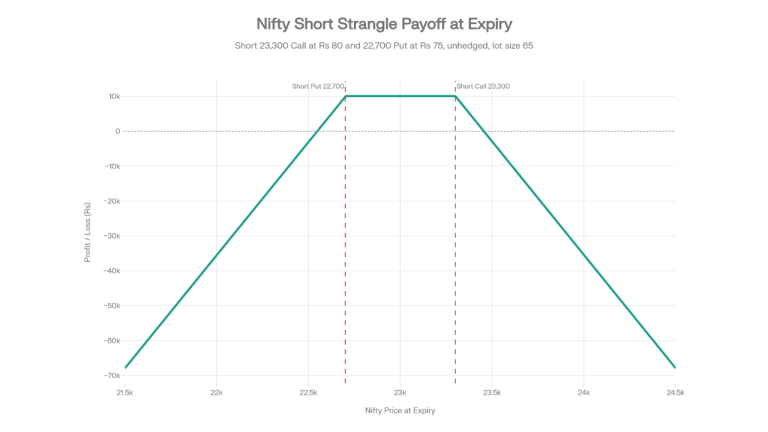
Short Strangle: Structurally similar to the condor but without the protective legs, resulting in a higher premium and higher risk.
- An out-of-the-money call and an out-of-the-money put are sold together.
- This structure is more commonly used when the India VIX is low, and the price movement is limited.
- Because there is no hedge, the loss potential is open-ended unless a stop loss is applied.
A Nifty Covered Call Example, Verified Numbers
NSE revised the Nifty 50 lot size to 65 units, effective from the January 27, 2026, monthly expiry, down from 75.
In this illustration, Nifty futures are held at 23,000, and the 23,300 Call, 300 points away, is sold for a premium of Rs 80 per unit. With a lot size of 65, the premium collected works out to 80 multiplied by 65, which equals Rs 5,200 for that month.
If Nifty stays below 23,300 at expiry, the call expires worthless, and the full Rs 5,200 premium is retained, along with any gain on the futures position. If Nifty rises above 23,300, the futures gain stops growing at 300 points, which is 300 multiplied by 65, or Rs 19,500. Adding the Rs 5,200 premium brings the total to Rs 24,700 in this scenario. These figures are illustrative and depend on actual market prices at the time of the trade.
What India VIX Measures
India VIX is NSE’s volatility index. It reflects how much movement the market expects in Nifty 50 over the next 30 days, calculated from Nifty options prices. Regulatory oversight of exchange-traded derivatives, including index options, sits with the Securities and Exchange Board of India (SEBI), which issues periodic circulars covering derivatives risk management and position limits. A reading below 15 generally reflects a calmer market, 15 to 20 is considered a normal range, and above 20 typically reflects a nervous market or an approaching event such as a Budget or RBI policy meeting. It measures expected movement, not direction.
What These Strategies Have in Common
- Premium is credited immediately when the option is sold, rather than paid for.
- Time decay works in the seller’s favour, since option value erodes with each passing day.
- Iron condors and bull put spreads have a built-in cap on loss through the hedge leg.
- None of these requires a directional view; profit depends on the underlying staying within a range.
- Margin gets blocked for the duration of the trade, and requirements vary by broker and current volatility. Broker margin calculators reflect the exact figure for any specific trade.
Where This Approach Can Add Income
These structures generate income during periods when the market moves little, which covers a large portion of most calendar years. For existing stockholders, a covered call effectively monetises the unused upside on a position, which lowers the effective holding cost.
- Monthly cash flow, comparable to rental income from an owned asset.
- A reduced average cost on stocks used for covered calls.
- Profit potential in flat market conditions.
- Adjustable risk exposure, based on how far the strike sits from the current price.
Where the Risk Comes From
A sharp move can result in a loss larger than the premium collected, particularly in an unhedged strangle. A covered call also means gains beyond the strike price are not captured; a 500-point Nifty rally, for example, would only be partially captured.
- Open-ended risk exists on naked strangles without protective legs.
- Gains during strong rallies are capped once the underlying crosses the short strike.
- Margin requirements can increase during volatility spikes.
- Positions held past their intended exit point, in anticipation of a reversal, are a common source of larger losses.
- Events such as RBI policy days, the Union Budget, and results season are associated with sharper price moves that affect option sellers.
Points Beginners Often Learn the Hard Way
- Bull put spreads and iron condors have a defined maximum loss known before entry, unlike naked strangles.
- Margin funds are locked until expiry or until the position is closed.
- Many traders set an exit point in advance, for instance, closing a position once the loss reaches twice the premium collected.
- Trading volume and price movement around RBI meetings or Budget day tend to be higher than usual.
- A common pattern observed is closing positions once 50 to 70 percent of the maximum possible gain has been captured, rather than holding until expiry.
- Position sizing with a single lot is a common way traders familiarise themselves with a strategy’s behaviour before scaling.
Covered Call vs Iron Condor: Structural Differences
What matters | Covered Call | Iron Condor |
Requires holding stock or futures | Yes | |
Maximum loss | Not fixed, tied to the underlying position | |
Market condition, it fits | Flat to mildly rising | Range-bound, low VIX environments |
Legs involved | One additional leg on an existing position | Four legs |
Typical use case | Traders already holding stock or futures | Traders without an existing holding seeking defined risk |
Common Errors Seen in Option Selling
- Selling without a hedge exposes the position to losses beyond the premium collected during a sharp move.
- Overnight increases in margin requirements during volatility spikes are a documented risk for option sellers.
- Prices tend to move faster in the final one to two days before expiry, a dynamic referred to as gamma risk, which increases position management difficulty.
- Delayed adjustment of a threatened side has been linked to larger realised losses in several trader accounts.
- Strikes offering unusually high premiums are typically closer to the current price, which is associated with a higher probability of the strike being reached.
Who Tends to Use These Strategies
These strategies are generally used by traders who are already familiar with basic options terminology, allocate separate trading capital, and are able to check positions on a regular basis. Existing holders of stock or index positions commonly use covered calls as an income overlay on those holdings.
Traders who cannot monitor the market regularly, or who find volatile sessions stressful, may find these structures harder to manage, since they require attention, particularly in the final week before expiry. Long-term investors focused primarily on SIP-based wealth accumulation typically do not use this category of strategy.
Conclusion
Monthly option income in India is generated through structures like covered calls, bull put spreads, iron condors, and short strangles, each suited to a different market condition. No single structure works across every market phase, and traders often move between them based on prevailing volatility, frequently referencing India VIX as one input. Outcomes depend on risk management practices and market conditions at the time of each trade, and past patterns do not guarantee future results.
Frequently Asked Questions
Defined risk structures like bull put spreads and iron condors have a known maximum loss, which differs from naked strangles, where the loss is not capped. Understanding margin requirements and having an exit plan are commonly cited prerequisites before entering such trades.
This depends on capital deployed, strike selection, and prevailing volatility, and there is no fixed or assured outcome. Losing months can offset gains from winning months depending on market conditions.
Iron condors and bull put spreads have a fixed maximum loss due to the hedge leg, whereas naked selling does not. Covered calls carry risk tied to the underlying position itself.
Yes, NSE revised the Nifty 50 lot size from 75 to 65 units, effective from the January 27, 2026, monthly expiry, with Bank Nifty moving from 35 to 30 units.
Yes, a hedge caps the maximum loss but does not eliminate it. If the price moves beyond the protective strike, the maximum loss built into the structure is realised.
A covered call requires holding the underlying stock or futures, while an iron condor is a standalone options structure that does not require holding anything. Their risk profiles and margin requirements also differ, as detailed in the comparison table above.
Weekly review is common, with more frequent monitoring in the final week before expiry due to increased price sensitivity. Adjustments made closer to expiry are generally considered harder to execute effectively.

Blog by Aliceblue News Desk


