Demat Account for Students in India: How to Open and Best Options
Blog by Aliceblue News Desk
20 August 2026
13 minutes
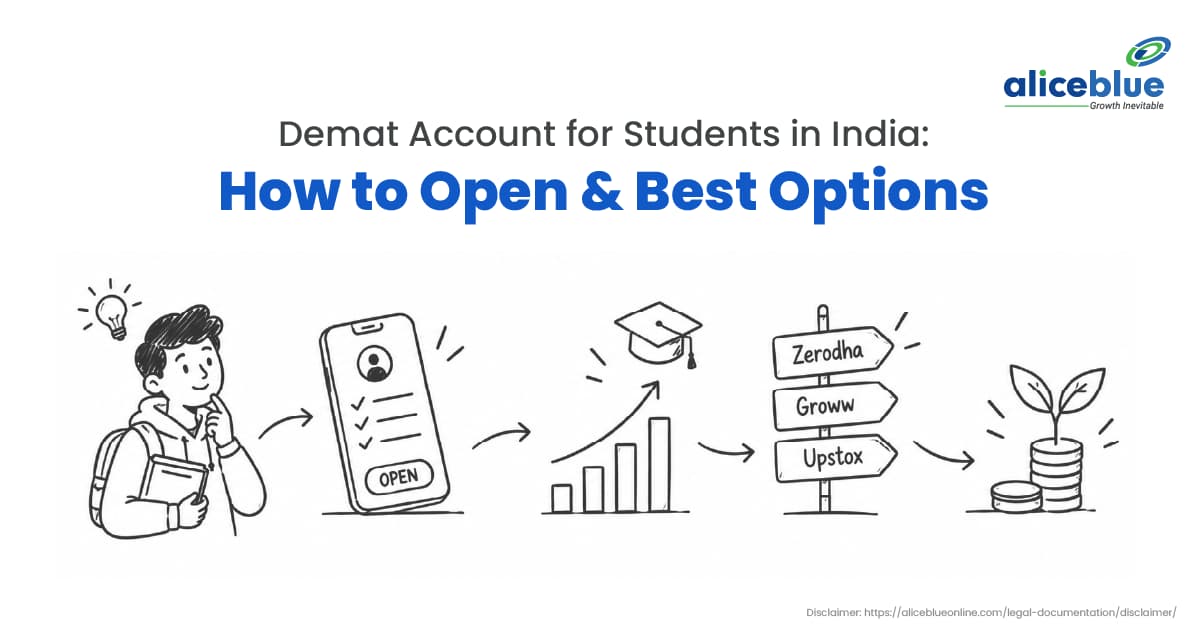
A Demat Account for Students in India helps students hold shares, ETFs, bonds, mutual fund units and other securities in digital form. Students aged 18 or above can open a regular Demat and trading account with PAN, Aadhaar, bank details and KYC. Students below 18 can have a minor Demat account operated by a parent or legal guardian.
SEBI states that a minor Demat account can be opened in the minor’s name and operated by a guardian until the minor becomes a major.
Table of Contents
- What Is a Demat Account for Students in India?
- Can Students Open a Demat Account in India?
- How to Open a Demat Account for Students?
- Documents Required for Student Demat Account
- Practical Example With Numbers
- Key Features of a Student Demat Account
- Advantages of a Demat Account for Students
- Risks and Limitations Students Should Know
- Tips for Beginners
- Demat Account vs Trading Account
- Minor Demat Account vs Regular Student Demat Account
- How to Choose the Best Demat Account for Students?
- Common Mistakes to Avoid
- Who Should Open a Student Demat Account?
- Conclusion
- FAQs
ec ullamcorper mattis, pulvinar dapibus leo.
What Is a Demat Account for Students in India?
A Demat account is an account used to hold investments in electronic form. For students, it is the first account needed to hold shares, ETFs, bonds and other securities safely.
Think of it like a digital locker for market investments. When a student buys shares of an Indian company, the shares are not given as paper certificates. They are stored in a Demat account.
In India, investors cannot open a Demat account directly with NSDL or CDSL. They must open it through a registered Depository Participant, also called a DP. A DP can be a stockbroker, bank or financial institution.
A student’s Demat account can be used to hold:
- Shares
- ETFs
- Bonds
- Mutual fund units
- Government securities
- Sovereign Gold Bonds
- IPO shares after allotment
For a student, a Demat account is more than an investment account. It is a way to understand how the stock market works in real life. Students can learn how shares are credited, how holdings are tracked, how prices move and how long-term investing works.
Students who are new to this topic can first read Alice Blue’s guide on What Is a Demat Account to understand the basic meaning, types and uses.
Can Students Open a Demat Account in India?
Yes, students can open a Demat account in India. The account type depends on the student’s age.
If the student is 18 years or older, they can open a regular Demat and trading account in their own name. They need PAN, Aadhaar, bank account details and KYC documents.
If the student is below 18 years, a minor Demat account can be opened in the minor’s name. The account will be operated by a guardian until the minor turns 18. CDSL also states that a minor cannot be a joint holder in another Demat account.
This means there are two broad cases:
Student Type | Account Type | Who Operates It? |
Student aged 18 or above | Regular Demat and trading account | Student |
Student below 18 | Minor Demat account | Parent or legal guardian |
A regular student Demat account gives more control because the student can place buy and sell orders directly. A minor’s Demat account is mainly controlled by the guardian and has more limits.
How to Open a Demat Account for Students?
Opening a Demat account is now mostly online. Here is the step by step process for students aged 18 or above.
1. Choose a registered stockbroker or DP
Start by choosing a broker or DP that offers online account opening, clear charges, easy app access and proper support. Students should not choose a broker only because of ads or referral offers.
Alice Blue allows users to open a Demat account online, making it easier for beginners to start their market journey.
2. Keep PAN, Aadhaar and bank details ready
SEBI’s Demat account FAQ states that an investor has to approach a DP, fill the account opening form and submit approved proof of identity and proof of address documents. PAN is also required during account opening.
For online opening, students should keep all details ready before starting the process. This helps avoid errors and delays.
3. Complete KYC
KYC means Know Your Customer. It is the identity verification process required for financial accounts.
During KYC, the student’s PAN, Aadhaar, address, bank details and identity are checked. If the mobile number is linked with Aadhaar, online verification becomes easier.
Students can also check Alice Blue’s guide on Demat account eligibility and documents before starting the process.
4. Add bank account details
The Demat and trading account must be linked to a bank account. This bank account is used to add funds, withdraw money and receive dividend or corporate benefit credits.
Students should use their own active bank account. The name in the bank account should match the name in PAN and Aadhaar.
5. Select the right trading segments
Students should be careful while selecting trading segments. Equity delivery is usually the easiest starting point because it means buying shares and holding them.
Intraday, F&O, currency and commodity trading carry higher risk. Students should not activate these segments unless they understand margin, price movement and possible losses.
6. Add nominee details
Nomination should not be skipped. NSDL’s investor FAQ says SEBI has mandated nomination for Demat accounts held by individuals. If the account holder does not want to give a nomination, a written and signed declaration is needed.
7. Review charges before submitting
Before opening the account, students should check:
- Account opening charges
- Annual maintenance charges
- Brokerage
- DP charges
- Pledge charges
- Call and trade charges
- Other transaction costs
Students should also read Alice Blue’s Demat Account Guide to understand how Demat and trading accounts work together.
8. Start with small amounts
Once the account is active, students should start small. The first goal should be learning, not fast profit. Buying one ETF unit or a small quantity of shares can teach more than watching random market videos.
Documents Required for Student Demat Account
Here is a simple document checklist for students.
Document | Why It Is Needed |
PAN card | Identity and tax record |
Aadhaar card | Address and identity verification |
Mobile number | OTP and account updates |
Email ID | Statements and alerts |
Bank account proof | Fund transfer and payouts |
Signature proof | Account verification |
Photo | Identity record |
Income proof | Usually needed for F&O activation |
For a minor Demat account, documents of both the minor and guardian are usually required. SEBI states that the guardian and minor must comply with applicable KYC norms while opening a minor Demat or trading account.
Students can also refer to Alice Blue’s eKYC guidelines to understand the online account opening steps.
Practical Example With Numbers
Let us say Arjun is a 19 year old college student. He has saved ₹6,000 and wants to learn investing without taking high risk.
He opens a Demat and trading account and decides to use the money only for learning.
Investment Choice | Amount | Reason |
Nifty 50 ETF | ₹2,500 | To learn index investing |
Large cap stock | ₹2,000 | To learn shareholding |
IPO reserve | ₹1,500 | To learn IPO application |
Total | ₹6,000 | Learning based investing |
After three months, suppose his ETF value rises from ₹2,500 to ₹2,700.
Gain = ₹2,700 minus ₹2,500 = ₹200
Return percentage = ₹200 divided by ₹2,500 multiplied by 100 = 8 percent
Now suppose his stock value falls from ₹2,000 to ₹1,820.
Loss = ₹2,000 minus ₹1,820 = ₹180
Loss percentage = ₹180 divided by ₹2,000 multiplied by 100 = 9 percent
This teaches Arjun three things:
- Different investments move differently
- Profit and loss are part of investing
- Small amounts are enough to learn
The Demat account helps him track what he owns, how much he invested and how his holdings are performing.
Students interested in IPOs can check Alice Blue’s IPO page to understand open and upcoming IPOs.
Key Features of a Student Demat Account
Digital holding of securities: Shares and other securities are held electronically, so students do not have to manage paper certificates.
Easy access to holdings: Students can check shares, ETFs and other holdings online.
Linked with trading account: The trading account is used to buy and sell. The Demat account stores the securities.
Useful for IPOs: If IPO shares are allotted, they are credited to the Demat account.
Monthly statements: Students can check holdings and transactions through account statements. Alice Blue’s guide on how to download a Demat account statement can help beginners.
Long term use: The same account can be used after college for investing, trading and portfolio tracking.
Advantages of a Demat Account for Students
Helps students learn early
A Demat account gives students practical exposure to the Indian stock market. They learn how shares are bought, stored and sold.
Builds money discipline
When students invest small amounts, they learn budgeting and patience. This is better than chasing quick profit.
Gives access to different investment options
Students can use a Demat account to hold shares, ETFs, bonds and IPO shares. Mutual fund units can also be held in Demat form.
Helps in IPO investing
A Demat account is needed to receive shares if an IPO application is allotted. This helps students understand IPO application, allotment and listing.
Encourages long term thinking
Students usually have time on their side. Starting early with small amounts can help them learn the value of staying invested.
Reduces paper work
Electronic holding makes tracking easier. It also reduces the risk of losing paper share certificates.
Risks and Limitations Students Should Know
Market loss is possible
A Demat account only stores investments. It does not protect students from market loss. Share prices can fall due to company news, market weakness or poor business performance.
Trading can distract students
Easy app access can make students check prices too often. This may affect studies and lead to overtrading.
F&O is not suitable for most beginners
F&O trading can lead to fast losses. Students should not enter F&O only because friends or influencers are doing it.
Minor accounts have limits
A minor cannot enter into a contract with a stockbroker to purchase or sell securities. SEBI says a trading account in the name of a minor can be opened only for selling securities possessed by the minor in the allowed manner.
Charges can affect small portfolios
If a student invests very small amounts, charges can reduce returns. Always check brokerage and other fees before opening an account.
Social media tips can be risky
Many students follow tips without checking facts. This can lead to poor decisions and losses.
Tips for Beginners
- Start with small amounts that you can afford to keep aside.
- Learn equity delivery before trying intraday or F&O.
- Do not use borrowed money for trading.
- Do not invest your education fees or emergency money.
- Read about the company before buying shares.
- Use ETFs if you want to learn market movement with lower stock selection risk.
- Check charges before placing trades.
- Review your holdings once or twice a month, not every hour.
Use Alice Blue’s blog section to learn about stocks, IPOs, mutual funds and trading basics.
Demat Account vs Trading Account
Many students think a Demat account and trading account are the same. They are connected, but they have different roles.
Parameter | Demat Account | Trading Account |
Main use | Holds securities | Places buy and sell orders |
Example | Stores shares after purchase | Used to buy shares on NSE or BSE |
Needed for delivery investing | Yes | Yes |
Needed for IPO allotment | Yes | Usually linked |
Shows holdings | Yes | Shows orders and trades |
Beginner use | To store investments | To execute transactions |
Simple example: The trading account is where the order is placed. The Demat account is where the shares are stored after purchase.
Minor Demat Account vs Regular Student Demat Account
Point | Minor Demat Account | Regular Student Demat Account |
Age | Below 18 years | 18 years or above |
Operated by | Guardian | Student |
Trading control | Limited | Full control as per selected segments |
KYC | Minor and guardian | Student |
Joint holding | Minor cannot be joint holder | Joint holding may be allowed as per rules |
Best suited for | Parent led investing | Student led learning and investing |
A minor account is useful when parents want to invest in the child’s name. A regular student account is better for students who are legally adults and want to learn investing directly.
How to Choose the Best Demat Account for Students?
The best Demat account for students should be easy to use, low cost and clear in charges. Students should not choose an account only because of a free offer.
Before choosing a Demat account, check these points:
- Is account opening online?
- Are charges easy to understand?
- Is the mobile app beginner friendly?
- Can you invest in shares, ETFs, mutual funds and IPOs?
- Can you download reports and statements easily?
- Is customer support available when needed?
- Are educational blogs and guides available?
- Is the broker registered and reliable?
Students who want to start online can visit Alice Blue’s open Demat account page. For mutual fund investing, they can also explore Alice Blue Mutual Fund.
Common Mistakes to Avoid
Opening an account without learning basics
Do not open an account just because friends are trading. First learn what shares, ETFs, IPOs and Demat accounts mean.
Activating all segments at once
Beginners do not need every trading segment. Start with equity delivery and learn slowly.
Investing all money in one stock
Putting all savings into one stock is risky. Spread your money carefully.
Ignoring charges
Small investments can be affected by charges. Check brokerage, DP charges and annual costs.
Following tips blindly
A stock tip is not research. Always ask why you are buying a stock.
Not checking statements
Check Demat statements and contract notes. They help you verify holdings and charges.
Trading with borrowed money
Borrowed money can create stress. Students should invest only from money they can afford to keep aside.
Who Should Open a Student Demat Account?
A student Demat account is suitable for students who want to learn investing in a practical way. It is useful for students from commerce, finance, business, economics or any background where money management is important.
It suits students who:
- Are 18 or above
- Have PAN, Aadhaar and bank account
- Want to invest small amounts
- Want to learn shares, ETFs and IPOs
- Can avoid panic buying and selling
- Are ready to learn before trading
A minor Demat account may suit parents who want to invest for their child’s future. But the guardian must operate the account until the minor becomes major, as stated by SEBI.
This account may not suit students who want quick returns, trade using borrowed money or follow social media tips without research.
Conclusion
A Demat Account for Students in India is a good starting point for learning investing with real market experience. Students aged 18 or above can open a regular Demat and trading account with PAN, Aadhaar, bank details and KYC. Students below 18 can have a minor Demat account operated by a guardian. The right account should have clear charges, easy access, useful reports and beginner learning support. Start small, learn equity delivery first, avoid risky trades in the beginning and treat the account as a learning tool before using it for bigger investments.
If you’re planning to start investing, you can open a demat account with Alice Blue and get started.
FAQs
Yes, a student can open a Demat account in India. If the student is 18 or above, they can open a regular Demat and trading account in their own name. If the student is below 18, a minor Demat account can be opened and operated by a guardian.
Yes, a minor Demat account can be opened in the minor’s name. The account is operated by the guardian until the minor becomes major. CDSL also states that a minor cannot be a joint holder in another Demat account.
Yes, PAN is required for opening a Demat account. SEBI’s Demat account FAQ mentions PAN as part of the account opening requirement.
Students aged 18 or above may activate F&O only after meeting broker and exchange requirements. Beginners should avoid F&O until they understand margin, lot size, risk and possible losses.
The best Demat account for students is one with low charges, easy online opening, a simple app, clear reports, IPO access and good learning support. Students should compare costs and features before opening an account.

Blog by Aliceblue News Desk


