Difference Between NRI Demat Account and Normal Demat Account
Blog by Aliceblue News Desk
18 April 2025
6 minutes
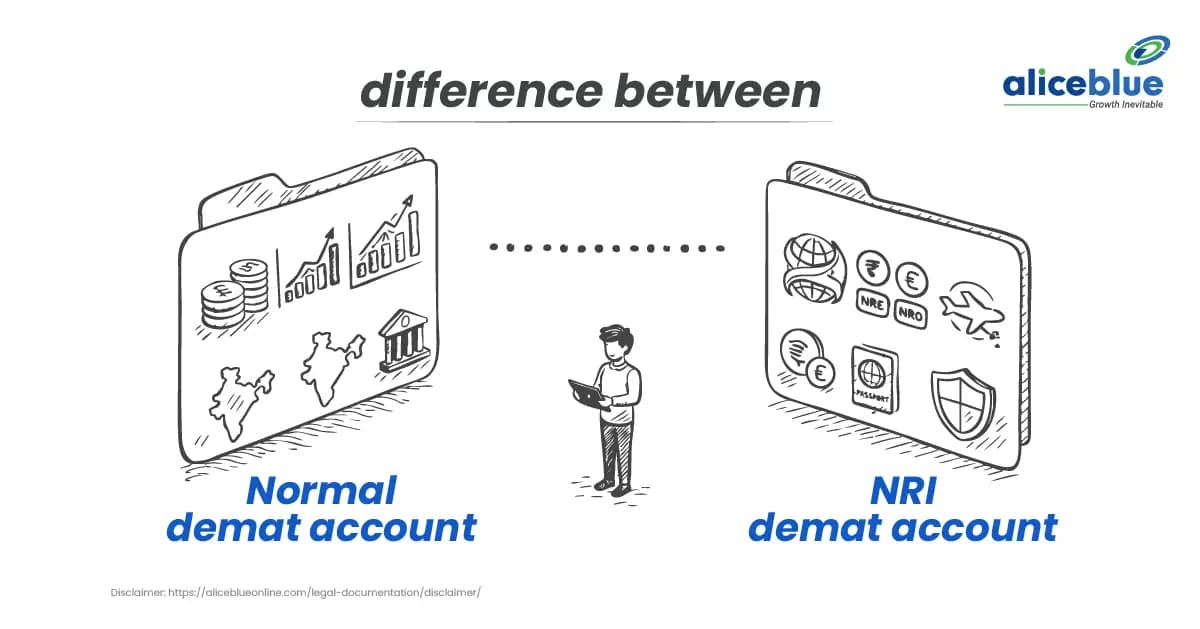
The difference between a normal demat account and an NRI demat account lies in investor residency, bank linkage, and repatriation rules. While both accounts can hold the same shares, an NRI demat account is governed by FEMA and RBI guidelines, requiring NRE/NRO bank routing and additional compliance during selling, dividends, IPOs, and buybacks.
Two demat accounts can show the same ISINs, the same quantities, and the same corporate actions, yet still behave as if they sit on different rails. That contradiction is usually where the NRI demat question begins.
In Indian equities, the holdings page often looks identical, whether shares sit in a normal demat account or an NRI demat account. The difference surfaces not in the stock itself, but in the settlement, payout, repatriation, and regulatory reporting trail, especially when shares are sold or cash moves.
What Is a Normal Demat Account?
A normal demat account is the standard dematerialised account used by a resident individual in India to hold securities electronically, such as listed equity shares, ETFs, bonds, and other eligible instruments.
It operates within the resident market framework:
- Resident KYC and address profile
- Linked to a resident savings or current bank account
- Standard exchange settlement and payouts
- No non-resident or repatriation tagging
Example:
A resident investor buys 25 shares of HDFC Bank on the NSE. After settlement, the shares are credited to the demat account and funds move through the resident bank route. Most of the time, settlement routing is invisible unless bank details change or a payout fails.
What Is an NRI Demat Account?
An NRI demat account is a demat account mapped to a Non-Resident Indian (NRI) profile and aligned with India’s foreign exchange framework under FEMA.
The holdings can look identical to any other demat account, but the account operates under a different rule set because cash flows, reporting, and repatriation must be classified and monitored.
NRI equity investing is structured around two bases:
- Repatriable (typically linked to an NRE account)
- Non-repatriable (typically linked to an NRO account)
Many brokers maintain separate demat accounts for these two bases to avoid mixing payout and remittance trails.
Example:
Two investors buy 50 shares of TCS at the same price. Both see the same holding in their demat accounts. After selling, the resident investor’s proceeds follow the resident payout route. The NRI investor’s proceeds must be credited to the correct NRE or NRO account, often alongside bank-side reporting checks.
Key Differences Between Normal Demat and NRI Demat Accounts
The difference is not the security being held, but the investor classification and settlement logic attached to that holding.
|
Feature |
Normal Demat (Resident) |
NRI Demat (Non-Resident) |
|
Residency status |
Resident under FEMA |
Non-resident under FEMA |
|
Bank linkage |
Resident savings/current account |
NRE and/or NRO accounts |
|
Repatriation |
Not applicable |
Repatriable or non-repatriable |
|
RBI reporting |
Not required |
Required via authorised dealer bank |
|
Listed equity route |
Standard exchange settlement |
RBI-permitted portfolio investment routes |
|
Demat structure |
Usually one demat |
Often separate NRE & NRO demats |
|
Monitoring limits |
Standard market limits |
Additional FEMA/RBI monitoring |
|
Friction points |
Mostly at onboarding |
Often at payout, remittance, IPOs, buybacks |
|
Documentation |
KYC, bank mapping |
Overseas address, tax residency, bank proofs |
Where the Difference Becomes Visible (Market Moments)
Dividend credit (cash leg):
Dividends reflect as entitlements in both accounts, but bank credit follows resident routing or NRE/NRO mapping.
Sell and payout day:
A sell trade in Reliance looks routine on the exchange. The difference appears when proceeds must be routed through the correct repatriation basis.
Buyback or tender offers:
The demat debit is straightforward. Cash payout is where classification issues often surface.
IPO allotments and rights issues:
Demat credit may look normal, but payment routing and category constraints highlight the NRI framework.
Rules and Guidelines That Shape the Account
FEMA: Residency Framework
FEMA defines whether an investor is resident or non-resident. Once an individual becomes a non-resident, account classification and banking routes must change, even if the same shares continue to be held.
Example:
An investor holds Infosys shares and later relocates overseas. The holding remains unchanged. The difference appears when selling, because the settlement expects a non-resident payout route.
RBI: Investment Routes and Monitoring
RBI governs how NRI portfolio investments are routed through authorised dealer (AD) banks and monitored under portfolio investment frameworks (commonly referred to as PIS, where applicable).
Restrictions can exist above the investor, at the company or aggregate level, which can cause rejections even when liquidity is available.
Example:
An NRI places a buy order in a liquid mid-cap stock. The order is delayed because bank-side mapping or investment limits are not aligned, not because of market conditions.
SEBI: Intermediary Controls
SEBI regulates brokers and depository participants. For NRIs, SEBI-mandated processes often intersect with FEMA and RBI classification, requiring brokers to maintain accurate client categorisation.
Example:
A broker requests updated FATCA/CRS declarations or overseas address proof during a review. The holdings haven’t changed; compliance records have.
Can an NRI Convert a Normal Demat Account Into an NRI Account?
Yes. Conversion is common because residency changes are common.
It is a reclassification exercise, aligning account records, bank linkages, and trading permissions with non-resident status.
What typically changes during conversion:
- Client profile updated from resident to non-resident
- Bank linkage shifted to NRE/NRO routes
- Holdings may be segregated by repatriation basis
- Trading permissions aligned to NRI frameworks
Example:
An investor bought Reliance shares while resident and later became an NRI. The portfolio looks unchanged. Friction appears only at selling, when payout routing must be unambiguous.
A normal demat account runs on resident rails. An NRI demat account carries residency tagging and repatriation logic into settlement and reporting. Both accounts can hold the same shares, but they do not operate under the same assumptions once money moves.
If you’re planning to start investing, you can open a demat account with Alice Blue and get started.
Frequently Asked Questions
Yes. The ISIN is the same. The difference lies in investor classification and payout routing.
Many setups keep repatriable and non-repatriable holdings separate to avoid payout classification issues.
PIS refers to RBI-linked frameworks through which certain NRI equity investments are routed and monitored via banking rails.
In most broker implementations, NRI equity trading is delivery-based rather than intraday, to maintain clean settlement trails.
Yes. NRIs can trade exchange-traded F&O, typically on a non-repatriation basis, subject to broker and regulatory controls.
The shares can continue to be held, but account records usually need regularisation to reflect non-resident status.

Blog by Aliceblue News Desk
The Alice Blue Team is a passionate group of analysts delivering expert market insights, comprehensive coverage of stocks, economy, commodities, and personal finance through clear, actionable research.


