Benefits of Demat Account – What Are The Benefits Of A Demat Account?
Blog by Aliceblue News Desk
17 January 2024
9 minutes
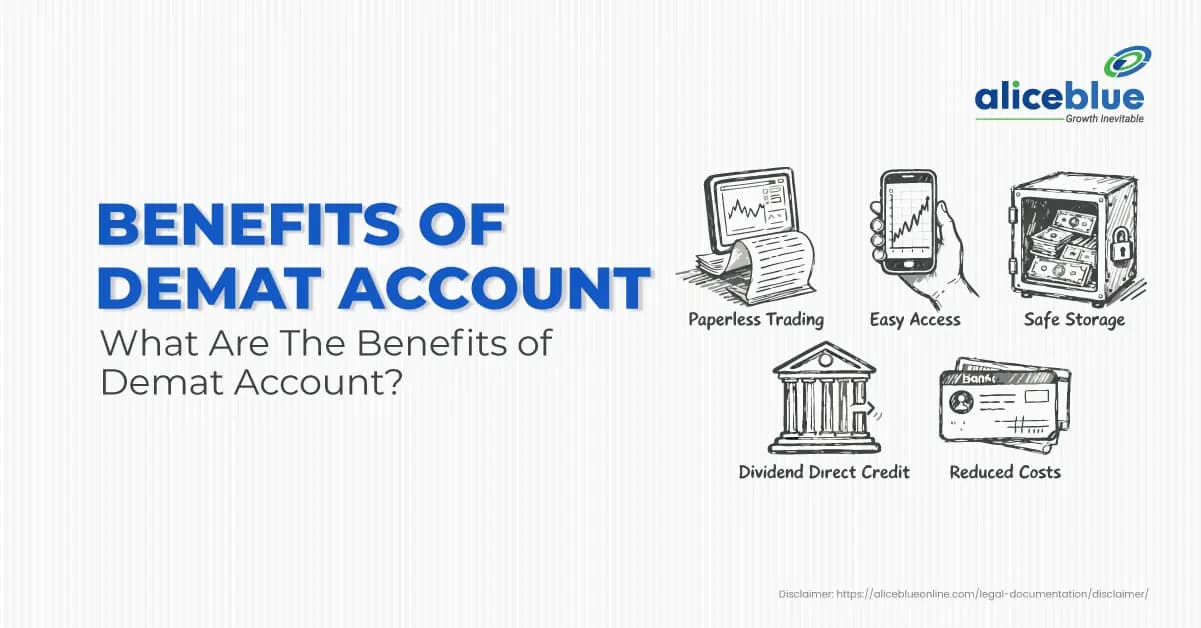
India added over 4 crore new Demat accounts in 2023–24 alone. That means roughly 11,000 new investors joined the market every single day. Yet a large number of them opened a Demat account only because their broker asked them to, without understanding what it actually does or how it protects their money.
A Demat account is not just a technical formality. It is the backbone of safe investing in India. It determines how fast you receive your shares, how securely your investments are stored, and what financial options you unlock as your portfolio grows.
This article explains every meaningful benefit of a Demat account in plain terms, including ones most guides skip, so you can make informed decisions from day one.
What Is a Demat Account?
A Demat account, short for Dematerialisation Account, is a digital account that holds your financial securities in electronic form. Think of it the way you think of a bank account, except instead of money, it stores your investments.
Before Demat accounts were introduced in India in 1996, investors received physical paper share certificates every time they bought stock. Those certificates could be forged, lost in transit, or destroyed. The shift to electronic holding eliminated all of those risks and made trading far more efficient.
Today, any investor who wants to buy or hold shares on the NSE or BSE must have a Demat account. These accounts are maintained by two SEBI-regulated depositories, NSDL (National Securities Depository Limited) and CDSL (Central Depository Services Limited).
How a Demat Account Works
When you buy shares, the process has two parts, the transaction and the holding. Your trading account handles the buying and selling. Your Demat account holds what you buy. Most brokers offer both as a linked 2-in-1 account.
Here is the step-by-step process:
- You place a buy order through your broker’s app or platform
- The exchange matches your order with a willing seller on NSE or BSE
- Settlement occurs on T+1, under India’s current settlement cycle, shares are credited to your Demat account the next working day after the trade
- Your holdings update automatically, the shares appear in your account just like a bank deposit
- When you sell shares, they are debited from your Demat account, and the sale proceeds are credited to your linked bank account
The entire process is automated. You do not fill out forms, sign documents, or visit any office.
Types of Demat Accounts in India
Before you open an account, it helps to know which type suits your situation:
|
Account Type |
Who It’s For |
Key Feature |
|
Regular Demat Account |
Indian residents |
Standard account with full access to all securities |
|
Basic Services Demat Account (BSDA) |
Small investors with holdings under ₹4 lakh |
Zero or reduced AMC charges |
|
Repatriable Demat Account |
NRIs (linked to NRE bank account) |
Allows fund repatriation outside India |
|
Non-Repatriable Demat Account |
NRIs (linked to NRO bank account) |
Funds cannot be sent outside India |
If you are a beginner investor in India with limited capital, a BSDA can save you annual maintenance charges while you build your portfolio.
A Real-World Example
Ravi, a 26-year-old software professional in Pune, decides to invest ₹15,000 in the market. He buys 10 shares of a mid-cap company at ₹1,500 each through his broker app. The next morning, those 10 shares appear in his Demat account.
Three months later, the company announces a 1:1 bonus issue, meaning investors get one additional share for every share they hold. Ravi wakes up to find 10 extra shares automatically credited to his Demat account. He did not apply anywhere. He did not fill out a form.
Six months after that, he needs urgent funds. Instead of selling his shares at a loss, he pledges them as collateral and gets a Loan Against Securities from his broker at a lower interest rate than a personal loan. His investments stay intact.
This is what a Demat account makes possible at every stage of the investing journey.
Benefits of a Demat Account
1. Your Investments Are Safe From Physical Risks
Before Demat accounts existed, investors lost entire shareholdings because of fire, flood, theft, or postal mishandling. With a Demat account, your securities live on encrypted servers maintained by NSDL or CDSL. There is no paper to lose and no certificate to forge.
2. Faster Settlement With T+1 Cycle
India moved to T+1 (trade plus one day) settlement in 2023. This means shares you buy today are credited to your Demat account by the next business day. Previously, this took weeks with physical certificates. For active traders, this speed matters significantly when managing positions.
3. Automatic Credit for Corporate Actions
Every time a company in your portfolio announces a dividend, bonus issue, stock split, or rights entitlement, the credit happens directly in your Demat account without any action from you. You do not need to track it, apply for it, or visit a registrar. This is one of the most underappreciated benefits for long-term investors.
4. One Account for Multiple Asset Classes
A single Demat account can hold:
- Equity shares (NSE and BSE listed)
- Government securities and bonds
- Exchange-Traded Funds (ETFs)
- Mutual fund units
- Sovereign Gold Bonds (SGBs)
- IPO allotments
You do not need separate accounts for each product. Everything sits in one dashboard.
5. Easy Access to IPOs
When you apply for an Initial Public Offering (IPO) through ASBA (Application Supported by Blocked Amount), allotted shares are credited directly to your Demat account. Without one, IPO participation is not possible.
6. Loan Against Securities
This benefit is rarely mentioned in beginner guides. Your Demat account holdings can be pledged as collateral to get a Loan Against Securities (LAS) from banks or NBFCs. The interest rate on LAS is typically lower than that of a personal loan because the lender holds your assets as security. You keep your investments, and you get liquidity when you need it.
7. Simple Transfer of Shares
Transferring shares between Demat accounts, whether gifting to a family member or moving to a different broker, requires only a digital instruction called a Delivery Instruction Slip (DIS). No physical paperwork or courier is involved.
8. Transparent Portfolio Tracking
Every holding, every transaction, and every corporate action is logged in your Demat account with date and time stamps. You can generate account statements, check CAGR on holdings, and monitor sector allocation — all from one place. This level of visibility was impossible with physical certificates.
9. Freeze Facility for Security
If you suspect unauthorised access or are going through a legal matter, you can request a temporary freeze on your Demat account. This prevents any debit transactions until you reverse the instruction.
Demat Account Charges You Should Know
Understanding charges before opening an account helps you avoid surprises:
|
Charge Type |
What It Is |
Typical Range |
|
Account Opening Fee |
One-time fee to open the account |
₹0 to ₹300 (many brokers offer free opening) |
|
Annual Maintenance Charge (AMC) |
Yearly fee to keep the account active |
₹0 to ₹750 per year |
|
Transaction Charges |
Per-transaction debit fee when you sell |
₹10 to ₹20 per transaction or percentage-based |
|
Custodian Fee |
Charge by the depository for holding securities |
₹0.5 to ₹1 per ISIN per month |
|
Pledge/Unpledge Charges |
When you pledge shares for a loan |
₹25 to ₹50 per request |
|
Dematerialisation Fee |
Converting old physical certificates to digital |
₹30 to ₹50 per certificate |
Tip: If you are a small investor with holdings under ₹4 lakh, open a BSDA; it comes with zero or minimal AMC under SEBI regulations.
How to Open a Demat Account Online
Opening a Demat account today takes under 15 minutes if you have your documents ready:
- Choose a SEBI-registered broker — Compare AMC, trading platform quality, and brokerage charges
- Visit the broker’s website or app and click on “Open Demat Account.”
- Enter your PAN and Aadhaar details — Aadhaar-based e-KYC verifies your identity digitally
- Complete video KYC or in-person verification — Most brokers complete this within the same session
- Link your bank account — Required for fund transfers in and out
- Receive your account credentials — Your Demat account number (also called BO ID) is issued within 24–48 hours
Documents required: PAN card, Aadhaar card, bank account details, a passport-size photograph, and a cancelled cheque or bank statement.
Demat Account vs Physical Share Holding
|
Factor |
Demat Account |
Physical Certificates |
|
Storage |
Digital, on encrypted servers |
Paper at home or in a bank locker |
|
Risk |
Minimal |
High — loss, theft, forgery |
|
Settlement |
T+1 (next business day) |
Several weeks |
|
Corporate actions |
Auto-credited |
Manual application required |
|
Transfer process |
Digital instruction only |
Physical delivery of documents |
|
Cost |
Low, transparent charges |
Stamp duty + handling + postal fees |
|
Portfolio tracking |
Real-time, from one screen |
Manual record-keeping |
|
Loan eligibility |
Pledge shares for LAS |
Not applicable |
Risks and Limitations
A Demat account is highly beneficial, but these limitations are worth knowing before you open one:
- AMC on inactive accounts — Even if you stop investing, you may still be charged an annual fee. If you no longer need the account, close it formally to avoid ongoing charges
- Cybersecurity responsibility falls on you — The depositories keep servers secure, but if you share your login credentials or fall for a phishing link, your account can be compromised. Always enable two-factor authentication
- Internet dependency — All access requires a stable internet connection. This can be a practical limitation in regions with unreliable connectivity
- Overchecking behaviour — Easy, real-time access to portfolio values sometimes leads new investors to make impulsive decisions based on short-term price movements
- Charges vary across brokers — AMC and transaction fees can differ significantly. Not comparing brokers before opening an account can cost you more over time
Common Mistakes Beginners Make
- Opening a Demat account without linking a trading account — A Demat account stores shares, but you need a trading account to buy and sell them. Most brokers offer both together, but confirm this before opening
- Skipping the nominee registration — This step is optional during opening, but important for your financial security. If something happens to you, your nominee receives your holdings without a lengthy legal process
- Not checking AMC before signing up — Many beginners choose a broker based on app design alone and later discover high annual fees. Compare at least three brokers before deciding
- Ignoring the BSDA option — Small investors with limited capital often pay full AMC when a BSDA would cost them nothing. Check your eligibility before opening a regular account
- Using the same password as other apps — Your Demat account holds real money. A weak or reused password is a genuine security risk. Use a unique, strong password and activate two-factor authentication immediately
Who Should Open a Demat Account?
Well-suited for:
- First-time investors starting with equity shares, ETFs, or IPOs
- Long-term investors who want to hold a diversified portfolio in one place
- Active traders who need fast settlement and real-time portfolio visibility
- Investors who want to participate in IPOs or rights issues
- Anyone looking to earn dividends or benefit from bonus shares without manual tracking
Less relevant for:
- Investors who only use fixed deposits, PPF, or savings schemes — these do not require a Demat account
- Those not yet ready to monitor investments even occasionally, since an idle Demat account may attract AMC charges
The real value of a Demat account goes beyond just digital storage. It is what makes investing in India fast, safe, and scalable. The automatic credit of corporate actions alone, dividends, bonus shares, rights issues, saves investors from a significant amount of manual tracking and paperwork every year.
For anyone starting their investment journey in India, a Demat account is not optional. But understanding what it does before opening one puts you in a far stronger position than most new investors who simply click “open account” without knowing why.

Blog by Aliceblue News Desk
The Alice Blue Team is a passionate group of analysts delivering expert market insights, comprehensive coverage of stocks, economy, commodities, and personal finance through clear, actionable research.


