Difference Between Dematerialisation And Rematerialisation
Blog by Aliceblue News Desk
09 April 2024
11 minutes
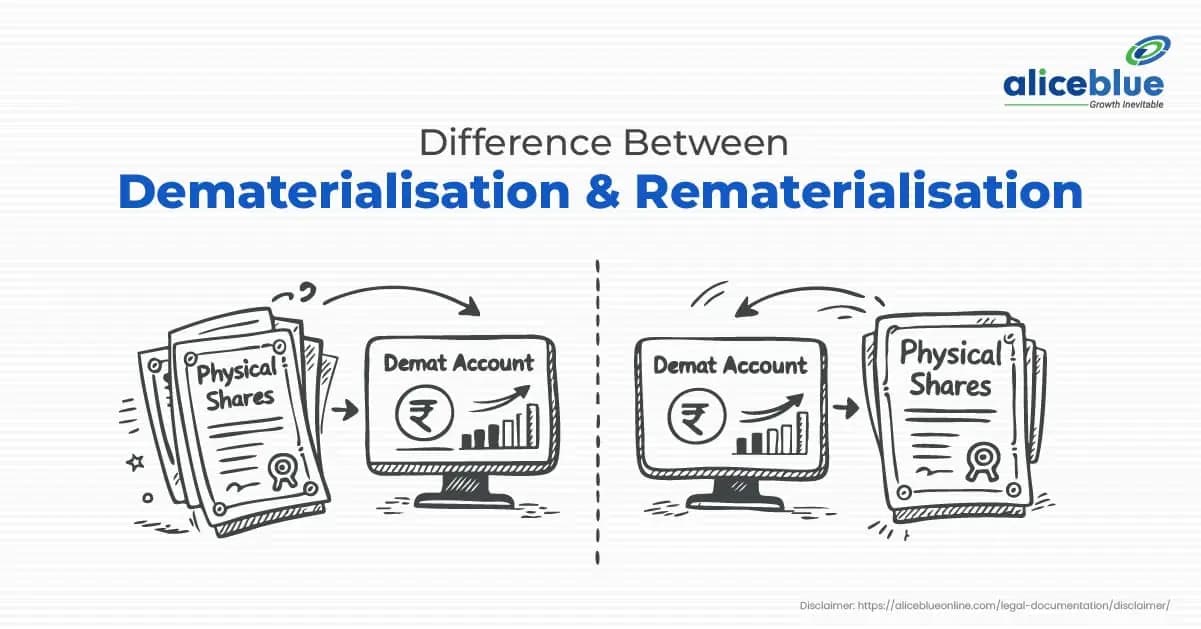
Table of Contents
Quick Definition
Dematerialisation is the conversion of physical paper share certificates into electronic records credited to a Demat account. Rematerialisation is the reverse – converting electronic securities held in a Demat account back into printed physical share certificates. NSDL and CDSL, India’s two central depositories operating under the Depositories Act, manage both processes through registered Depository Participants.
How Dematerialisation Actually Works
The process moves through five stages between you, your broker (acting as a Depository Participant), the central depository, and the company’s Registrar and Transfer Agent.
Step 1 – Open a Demat Account: You need a Demat account with a SEBI-registered Depository Participant before anything else can happen. If you don’t have one, this is the starting point.
Step 2 – Submit a Demat Request Form: Fill out and sign a DRF for each security you want to convert, identified by its ISIN. The form specifies exactly what you’re submitting.
Step 3 – Surrender Physical Certificates: Write “Surrendered for Dematerialisation” across the face of each original physical certificate – but only after verifying all the details on the DRF first. Attach the defaced certificates to the DRF and submit both to your DP. Don’t write on the certificates before you’ve confirmed everything is correct, because a defaced certificate with an error is significantly harder to work with.
Step 4 – DP Processing: Your DP creates a Demat Request Number in the depository system and forwards the physical documents to the company’s RTA for verification.
Step 5 – Verification and Electronic Credit: The RTA verifies the certificate details, confirms the registered holder’s signature, and approves the conversion. Electronic shares are credited to your Demat account. The physical certificates are formally destroyed. From this point, the shares exist only in digital form.
The entire process typically takes 15 to 30 business days from submission.
How Rematerialisation Works
Step 1 – Submit a Rematerialisation Request Form: Submit an RRF to your DP specifying which security and how many units you want converted back to paper.
Step 2 – Balance Lock and Verification: Your DP confirms that the specified quantity of shares is available in your account, unpledged and unencumbered, and locks that balance – debiting it from your digital holdings.
Step 3 – Depository and RTA Processing: The DP transmits the request through NSDL or CDSL to the company’s RTA.
Step 4 – Certificate Printing and Delivery: The RTA prints fresh physical share certificates with distinct folio numbers and dispatches them to your registered address by post. This stage alone takes time – the total rematerialisation process runs 30 to 45 business days, longer than dematerialisation.
An Example of Each
Ramesh inherits 200 paper share certificates of Tata Steel that his grandfather purchased in 1990. He can’t sell them as-is – SEBI prohibits trading physical certificates on public exchanges. He opens a Demat account, fills out a DRF, submits the original certificates to his broker, and waits. About three weeks later, 200 digital shares of Tata Steel appear in his Demat account. He can now sell, hold, or pledge them as needed.
Anita owns 500 digital shares of an unlisted company in her Demat account. They’re not listed on any exchange; she has no intention of selling anytime soon, and she’s paying annual DP maintenance charges for shares she isn’t trading. She submits an RRF. Her electronic balance is debited, and the company issues fresh physical certificates in her name. No more maintenance fees, physical proof of ownership in hand.
Step-by-Step Process Comparison
How Dematerialisation Works
- Open a demat account with a SEBI-registered Depository Participant (DP).
- Fill out a Dematerialisation Request Form (DRF) and write “Surrendered for Dematerialisation” on each physical certificate.
- Submit the DRF along with the original certificates to your DP.
- The DP verifies and forwards the request to the company’s RTA.
- Once verified, the physical certificates are permanently cancelled.
- Equivalent shares are credited electronically to your demat account within 15 to 30 days.
How Rematerialisation Works
- Fill out a Rematerialisation Request Form (RRF) specifying the number of shares and the ISIN.
- Submit the RRF to your DP.
- The DP blocks the specified shares in your demat account to prevent trading during processing.
- The DP forwards the request to NSDL or CDSL.
- The depository passes the request to the company’s RTA.
- The RTA issues new physical certificates with unique folio and certificate numbers.
- Certificates are dispatched to your registered address, typically within 30 days or more.
Key Features: Demat vs Remat
Dematerialisation:
Digital holdings are identified by a unique ISIN – International Securities Identification Number. Shares become immediately tradeable on exchanges under the current T+1 settlement cycle. Corporate actions – dividends, stock splits, bonus shares – are automatically credited to your linked accounts without any action required from you.
Rematerialisation:
Shares are held as printed certificates with distinct folio and certificate numbers. No Demat account means no annual maintenance charges from a DP. But physical certificates are entirely non-tradeable on public stock exchanges – to sell them, you’d need to dematerialise again first
Dematerialisation vs Rematerialisation: The Full Comparison
Feature | Dematerialisation | Rematerialisation |
Conversion Direction | Physical paper → electronic form | Electronic form → paper certificates |
Form Required | Demat Request Form (DRF) | Rematerialisation Request Form (RRF) |
Storage Medium | Digital Demat account via DP | Physical paper held by shareholder |
Market Tradeability | Fully tradeable on exchanges | Cannot be traded on public exchanges |
Maintenance Cost | Annual DP account fees apply | Zero recurring DP fees |
Safety | High – protected against physical loss | Risk of loss, damage, theft, forgery |
Identification | Unique ISIN | Distinct certificate and folio numbers |
Processing Time | 15 to 30 business days | 30 to 45 business days |
Advantages of Each
Dematerialisation advantages:
Enhanced security eliminates physical risks – theft, fire, flood, forgery, damage in transit. Instant market access enables trading, pledging for margin, and portfolio monitoring online. Zero stamp duty applies to online transfers of digital securities, unlike physical transfers. And the automated corporate actions benefit means you never miss a dividend or bonus credit because you forgot to submit a form.
Rematerialisation advantages:
The cost saving for dormant unlisted holdings is real – if you’re not trading and not planning to trade, eliminating annual maintenance charges is a legitimate financial decision. Physical certificates also provide direct proof of ownership independent of broker platforms, digital infrastructure, or depository systems – which matters in some legal and estate contexts.
Risks on Both Sides
- Dematerialisation creates technical dependency. Your access requires internet connectivity, broker platform stability, and DP operational continuity. Annual maintenance charges accumulate every year regardless of trading activity. These are manageable risks for most investors, but they exist.
- Rematerialisation risks are more severe. SEBI prohibits trading physical securities on public markets – rematerialised shares become illiquid by definition. Physical certificates can be destroyed by fire or water, lost during a house move, or stolen. And the 30 to 45-day processing time means there’s no quick exit if circumstances change and you need to sell.
Difference in Cost
Dematerialisation Costs
- Account opening fee: One-time, varies by DP (free with many discount brokers)
- Annual Maintenance Charge (AMC): Approximately Rs. 300 to Rs. 900 per year
- Per-request processing fee: Typically Rs. 30 to Rs. 150 per DRF submission
Rematerialisation Costs
- Per-certificate fee: Charged by the DP, typically Rs. 10 to Rs. 50 per certificate
- Printing charges: Levied by the company’s RTA
- Courier and dispatch charges: For delivering physical certificates to your address
Practical Tips for Navigating Either Process
- Verify name and signature details obsessively before submission. The name on your PAN card, bank account, and Demat account must match the name on the physical share certificate exactly. A discrepancy – even a minor spelling difference – delays the process significantly. Minor typographical differences can be handled with a self-attested ID and notarised affidavit. Legal name changes require supporting documentation like a Gazette notification or marriage certificate.
- If you hold legacy paper shares from transactions prior to April 1, 2019, take advantage of SEBI’s special window valid through February 4, 2027 for completing transfers and dematerialisation. Don’t leave this until the last moment – the window has been extended before, but it won’t extend indefinitely.
- Keep attested copies of everything you submit. A fresh Client Master List attested by your DP should accompany share conversion requests. The paperwork trail matters if anything goes wrong or requires follow-up.
- Only write “Surrendered for Dematerialisation” on physical certificates after cross-checking every detail on the DRF. A defaced certificate with an error creates complications that delay the process and require additional documentation to resolve.
Common Mistakes That Create Problems
- Submitting DRFs without verifying that your current signature matches the specimen signature recorded with the company’s RTA is a common delay trigger. Signatures change over decades. If your signature today looks nothing like what’s on file from 1995, additional documentation will be required.
- Trying to sell physical certificates directly on stock exchanges is impossible – SEBI regulations explicitly prohibit it. The only path to selling physical shares is dematerialisation first.
- Delaying dematerialisation on older physical shares to the point where unclaimed dividends cause the underlying shares to be transferred to the Investor Education and Protection Fund – IEPF – is an entirely avoidable complication. IEPF recovery is possible but bureaucratically demanding. Don’t let inaction create this problem.
- Assuming that rematerialisation is a cost-free decision ignores the illiquidity it creates. If you rematerialise listed shares and later need to sell them, you need to dematerialise again – another 15 to 30-day process during which market prices may move adversely.
What to Do With Lost Physical Certificates
If physical certificates are lost or damaged before dematerialisation, the process isn’t over. Apply to the company’s RTA for duplicate certificates by filing an FIR, publishing a newspaper notice in a local publication, and submitting an indemnity bond. Once duplicate certificates are issued, they can be submitted with a fresh DRF for dematerialisation. It’s a longer process than the standard one, but it’s a defined and navigable path.
What to Do About Corporate Actions on Old Certificates
Physical certificates from decades ago may represent a different number of shares than stated on the certificate, because of stock splits, bonus issues, or restructuring events in the intervening years. Submit the original certificates normally – the RTA will calculate all historical corporate actions and credit the updated total quantity to your Demat account automatically.
Who Should Use Which Process
Use dematerialisation if you’re an active trader, a long-term investor in listed equities, or someone who has inherited or discovered physical share certificates and wants to access the liquidity and security of digital holdings. For virtually all investors in virtually all situations involving listed securities, dematerialisation is the right direction.
Use rematerialisation if you hold shares of unlisted companies for the extreme long term, want to eliminate ongoing DP maintenance fees on dormant holdings you have no intention of trading, or require physical certificate documentation for specific legal purposes – certain trust agreements, court proceedings, or estate-related requirements where physical possession has legal significance.
Conclusion
The direction of travel for Indian securities markets is entirely digital. Dematerialisation is the standard mechanism for holding, trading, and transferring securities – and for anyone with physical certificates of any kind, converting them to digital form is almost always the right move. Rematerialisation serves a genuine but narrow purpose: long-term holders of unlisted securities who want to eliminate maintenance fees and hold physical documentation for specific non-trading purposes.
Know what you hold. Check whether physical certificates exist in family records or estate documents. If they do, dematerialise them before they create complications or get transferred to IEPF. The process takes a few weeks and a modest amount of paperwork – the result is full liquidity, automated corporate actions, and holdings that are secure against every form of physical risk.
Frequently Asked Questions
No – SEBI regulations explicitly prohibit the sale or transfer of physical share certificates on public stock exchanges. Dematerialisation into a Demat account is mandatory before any exchange-based trading can occur.
Typically 15 to 30 business days after submitting the Demat Request Form and original certificates to your DP. The timeline depends on how quickly the company’s RTA processes the verification.
No – it’s entirely optional and rarely used. Most long-term investors maintain digital holdings for the security, liquidity, and automated corporate action benefits that Demat form provides.
A Demat Request Form converts physical certificates to digital holdings. A Rematerialisation Request Form converts digital holdings back to physical certificates. They’re the formal instruments for opposite conversion directions.
Apply to the company’s RTA for duplicate certificates by filing an FIR, publishing a newspaper notice, and submitting an indemnity bond. Once duplicate certificates are issued, submit them with a fresh DRF for dematerialisation.

Blog by Aliceblue News Desk
The Alice Blue Team is a passionate group of analysts delivering expert market insights, comprehensive coverage of stocks, economy, commodities, and personal finance through clear, actionable research.