How to Profit from Range-Bound Markets Using the Iron Condor Strategy
Blog by Aliceblue News Desk
14 August 2026
6 minutes
An Iron Condor is a four-legged options trade. You sell one call and one put near the current price, then buy one call and one put farther away for protection. If Nifty stays inside your range till expiry, you keep the premium. If it breaks out, your loss stays capped.
Table of Contents
- What Is the Iron Condor Strategy
- How the Iron Condor Works
- Example With Numbers
- Payoff Chart
- Key Features
- Advantages
- Risks
- Tips for Beginners
- Iron Condor vs Short Strangle vs Iron Butterfly
- Common Mistakes
- Who Should Use It
- FAQs
What Is the Iron Condor Strategy
An Iron Condor is an options setup built for a sideways market. It uses a put spread and a call spread together, so the trade can make money when the underlying stays in a defined band.
The reason traders use this setup is simple. Selling an option without protection can be risky, but the Iron Condor adds two hedge legs, so the loss is limited from the start. It is mostly used when the market looks quiet and the trader expects price to move less than usual.
How the Iron Condor Works
Here is the basic setup.
- Pick the index or stock. Nifty and Bank Nifty are common because they are liquid and have active expiry cycles.
- Check the range. Support, resistance, and India VIX help traders judge whether the market may stay calm.
- Sell an out of the money call. This brings in premium.
- Buy a further out of the money call. This acts as protection if the market rises too much.
- Sell an out of the money put. This also brings in premium.
- Buy a further out of the money put. This protects the downside.
- Keep the same expiry for all four legs.
- Add up the premium received and premium paid. The balance is your maximum profit.
- Find breakeven. If price stays between the breakeven points at expiry, the trade stays profitable.
Example With Numbers
Let us say Nifty is at 24,800 and you expect it to stay between 24,700 and 24,900 this week. NSE reduced the Nifty lot size to 65 from the January 2026 contract series, and that revision is confirmed in the official circular.
Leg | Action | Strike | Premium |
Call side | Sell | 24,900 CE | 65 rupees received |
Call side | Buy | 25,100 CE | 20 rupees paid |
Put side | Sell | 24,700 PE | 60 rupees received |
Put side | Buy | 24,500 PE | 18 rupees paid |
Net premium on the call side is 45 rupees. Net premium on the put side is 42 rupees. Total credit is 87 rupees per share.
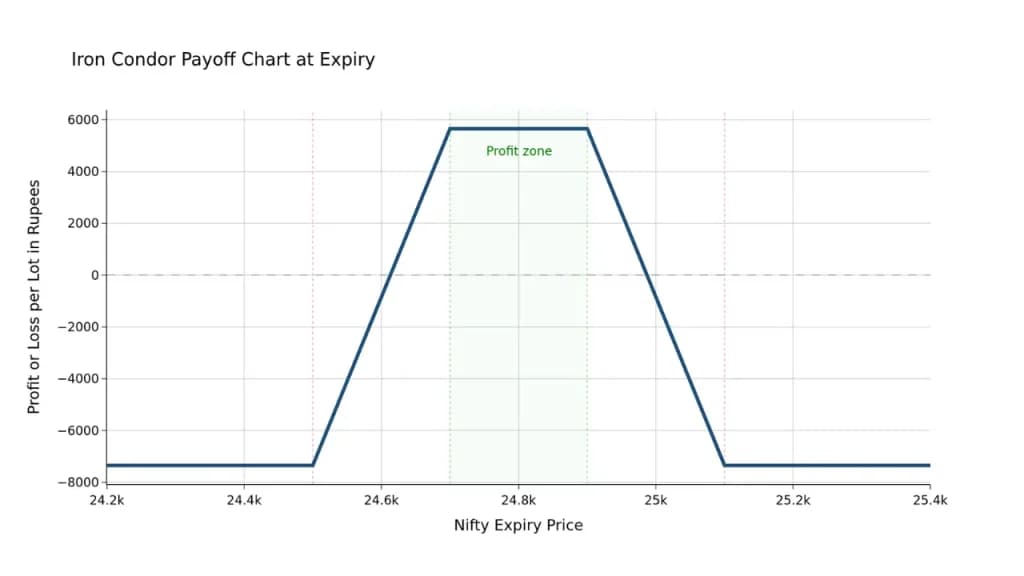
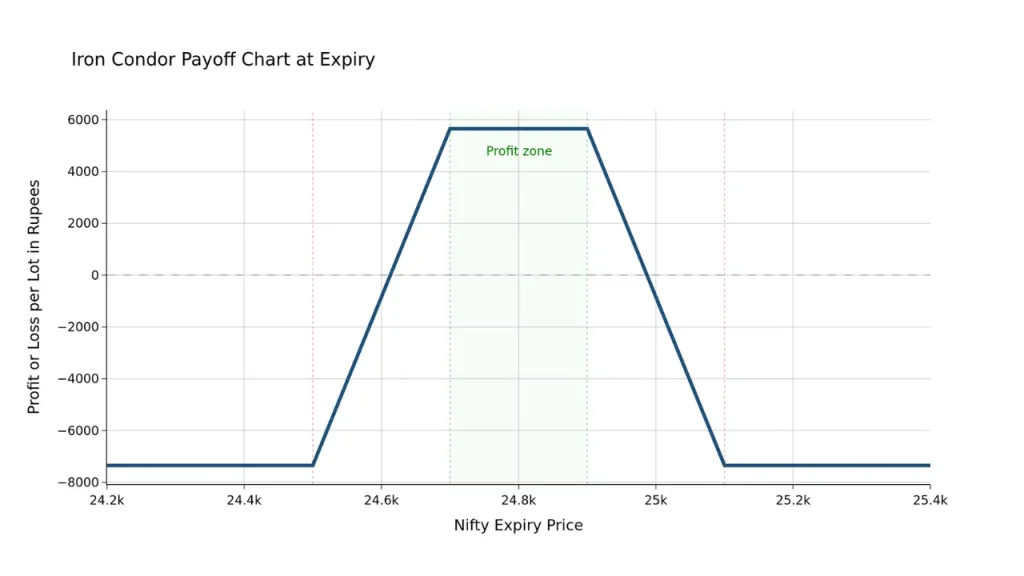
With a Nifty lot size of 65, the maximum profit is 5,655 rupees. That happens if expiry finishes between 24,700 and 24,900.
The strike width is 200 points on both sides. So the maximum loss comes to 7,345 rupees if Nifty moves beyond the hedge strikes.
The lower breakeven is 24,613. The upper breakeven is 24,987.
See the payoff chart below to understand how the profit zone, breakeven levels, and maximum loss change as Nifty moves at expiry.
Key Features
- Four legs in one trade. Two sold options and two bought options work together.
- Profit is fixed. The most you can make is the net premium.
- Loss is fixed. The hedge legs cap the downside.
- Time decay helps. If the market stays quiet, the sold options lose value.
- It is a neutral strategy. The trader is not betting on up or down, only on range.
Advantages
The main advantage is clear risk. You know your best case and worst case before you enter the trade. That makes position sizing easier. It also works in quiet markets where option buyers often struggle because time decay works against them.
Risks
The biggest risk is a sudden breakout. A sharp move after RBI policy, Budget news, or a global shock can push price outside your range fast. The trade still has a capped loss, but that loss can hurt if the position is too large. Another mistake is waiting too long and hoping the market will come back inside the range.
Tips for Beginners
- Start with Nifty or Bank Nifty instead of stock options.
- Check India VIX before entry.
- Stay away from major news days.
- Set your exit rule before entering the trade.
- Use a margin calculator first.
- Begin with one lot only.
Iron Condor vs Short Strangle vs Iron Butterfly
Parameter | Iron Condor | Short Strangle | Iron Butterfly |
Legs | Four | Two | Four |
Maximum loss | Capped | Unlimited | Capped |
Margin | Lower | Higher | Lower |
Maximum profit | Moderate | Higher | Higher in a tight range |
Best for | Beginners and cautious traders | Experienced traders | Traders expecting a narrow range |
Common Mistakes
- Selling strikes too close to spot. That shrinks the profit zone.
- Ignoring news risk. A major event can break the range.
- Forgetting breakeven. Small moves outside the range can still cause loss.
- Taking too much lot size.
- Refusing to exit when the trade is clearly broken.
Who Should Use It
This strategy suits traders who want defined risk and can watch the market regularly. It works best in calm expiry weeks when Nifty or Bank Nifty is moving inside a clear range.
It is not a good fit for someone looking for big directional gains or someone who cannot monitor positions during the week.
Conclusion
The Iron Condor is useful when the market is stuck in a range, and the trader wants fixed risk. The setup works because you sell premiums on both sides and protect the trade with hedge legs. Keep the range realistic, keep the size small, and do not ignore breakeven levels.
FAQs
Yes. The risk is defined, so it is easier to manage than naked option selling. Beginners should still start small.
The loss is the strike width minus the premium received, multiplied by lot size. In this example, that is 7,345 rupees.
Yes. Many traders exit after reaching a profit target or when the price approaches a short strike.
Nifty and Bank Nifty are the usual choices because they are liquid and expiry-based.
It helps show whether the market may stay quiet or expand in range.
Nifty lot size is 65 units from the January 2026 contract series.

Blog by Aliceblue News Desk


