How Multiple Loan Enquiries Affect CIBIL Score
Blog by Aliceblue News Desk
09 September 2026
7 minutes
Quick Definition
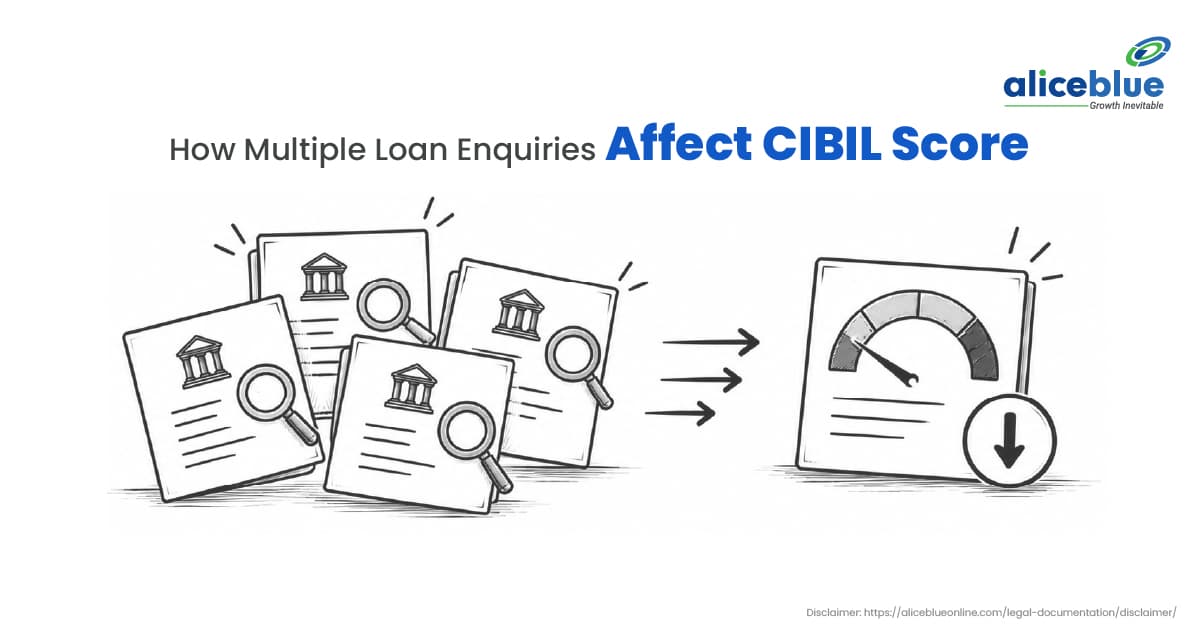
A loan enquiry is an administrative log created on your credit profile whenever a lender accesses your report to evaluate your creditworthiness. Hard enquiries – generated by formal credit applications – reduce your score by 5 to 10 points each and remain visible to all future lenders for 24 months. Soft enquiries – self-checks and lender pre-screening – have zero impact and aren’t visible to third-party institutions.
Before applying for a loan, it helps to understand what your CIBIL score means and which factors can influence it.
Table of Contents
Table of Contents
What Are Loan Enquiries? Hard Enquiry vs Soft Enquiry
Not all enquiries are the same. Banks and lenders perform two types of credit checks:
Enquiry Type | What It Is | Does It Affect Your CIBIL Score? | Visible to Other Lenders? | Example |
Hard Enquiry | Lender pulls your full report when you formally apply for a loan/credit card | Yes, it can lower the score | Yes | Applying for a personal loan, a home loan, a car loan, or a credit card |
Soft Enquiry | Lender or you check your score without a formal application | No effect | No | Checking your own score, pre-approved offers, and background checks |
Only hard enquiries (the ones made when you actually apply) affect your CIBIL score. They signal to lenders that you are actively seeking new credit.
How Multiple Loan Enquiries Affect Your CIBIL Score
New credit enquiries are a smaller but meaningful factor in your CIBIL score, generally considered part of the ‘recent credit behaviour’ category in most scoring models.
Here’s what actually happens when you apply for multiple loans:
- 1-2 enquiries (spaced out): Usually minimal or no visible drop.
- 3-4 enquiries in 30-45 days: Most common scenario, where the score typically shows a noticeable drop (often in the 15–30 point range for many profiles) may occur.
- 5+ enquiries in a short window: Score impact can be significant in such cases, especially if multiple risk factors are present and sends a strong “credit-hungry” signal to other lenders.
Why the impact feels quicker in 2026:
The RBI has pushed for more frequent credit data reporting (phased rollout starting April 2026, with shifts toward weekly or near-fortnightly updates). This means hard enquiries and other changes now reflect in your score faster than the old monthly cycle.
Important rate-shopping exception:
If you apply for the same type of loan (e.g., multiple personal loans or multiple home loans) within a short rate-shopping window (typically a few weeks, depending on the scoring model), most scoring models treat them as one single enquiry. This protects people who are genuinely comparing rates.
Why This Matters for Traders and Investors
If you actively trade in equities, derivatives, or other leveraged instruments, your credit profile plays a bigger role than you might expect.
- Lower CIBIL scores can reduce access to margin funding facilities offered by brokers and NBFCs.
- Frequent enquiries may signal liquidity stress, making lenders cautious about extending short-term credit lines.
- A weaker score can lead to higher interest costs on margin funding, directly affecting trading profitability.
- Some brokers and financing partners internally assess credit behaviour before offering enhanced leverage limits.
Impact on Margin Funding and Leverage Access
Many traders rely on margin funding or loan against securities (LAS). Multiple loan enquiries can indirectly impact this:
- Reduced creditworthiness may lead to lower approved funding limits
- Higher perceived risk can result in stricter collateral requirements
- Interest rates on margin funding may increase due to risk-based pricing
- Some lenders may decline fresh leverage requests if recent enquiries are high
How Many Loan Applications Are “Too Many” in 2026?
Safe guidelines based on current CIBIL and lender behaviour:
- 0-2 hard enquiries per year → Almost no impact.
- 3-4 enquiries in 30-45 days → Moderate impact (20-40 point drop possible).
- 5+ enquiries in a short period → High risk signal, and lenders may reject applications or offer higher interest rates.
Tip: Different types of credit (personal loan + credit card + car loan) in quick succession are treated more harshly than multiple applications for the same loan type.
Industry observations suggest that a meaningful portion of loan rejections (often estimated in the 10–20% range in risk-based underwriting scenarios) can be linked to high recent enquiry activity, especially when combined with other risk signals like high utilisation or low income stability.
Real-Life Examples: What Happens When You Apply for Multiple Loans
- Example 1 – Rate Shopping (Smart Way)
You apply for 4 personal loans within 20 days → Treated as one enquiry → Score drops only 5-10 points.
- Example 2 – Mixed Applications (Risky Way)
You apply for 1 personal loan + 1 credit card + 1 car loan in 15 days → 3 separate hard enquiries → Score drops 25-45 points.
- Example 3 – Desperate Applications
5+ enquiries in one month → Score can fall 50+ points, may reduce approval likelihood depending on overall profile, and quoted interest rates rise.
The New RBI Credit Reporting Changes & Their Impact
From April 2026 onward, the RBI has initiated changes to make credit reporting more frequent (moving away from purely monthly updates toward faster cycles, with full operational shifts continuing into mid-2026).
- Good news: Negative impacts (and positive changes) now appear and fade faster.
- Bad news (for multiple applications): You may see the score drop sooner if you apply too many times.
- Overall benefit: On-time payments and responsible behaviour help your score recover more quickly.
Credit Bureau Insights on Multiple Enquiries
Credit bureaus like TransUnion CIBIL, and other global scoring models highlight a few consistent patterns:
- Multiple hard enquiries in a short time are interpreted as higher credit risk behaviour
- “Credit-hungry” behaviour can reduce lender confidence even if your score is still in a good range
- The impact of enquiries is amplified when combined with:
- High credit utilisation
- Recent delinquencies
- Thin credit history
- Conversely, borrowers with strong repayment history may see a muted impact from occasional enquiries.
Conclusion
Multiple loan enquiries can hurt your CIBIL score, but the damage is completely avoidable and temporary. In 2026, with faster credit reporting, you now have both quicker visibility of risks and quicker recovery, making smart shopping habits more important than ever.
Start today:
- Check your free CIBIL score at cibil.com (soft enquiry)
- Use pre-approved offers and rate-comparison sites first
Curious about your credit health? Understand what the CIBIL score ranges from 300 to 900 means for your loan eligibility.
Frequently Asked Questions
Technically, no. CIBIL doesn’t have a “rejection” category. The drop you see is caused by the Hard Enquiry the bank made to check your eligibility. However, if you are rejected and immediately apply to another bank, and they reject you too, you create a trail of hard enquiries that signals “credit desperation,” which can negatively impact your score over time.
In 2026, most BNPL services are treated as formal “Small Ticket Personal Loans” (STPL). Every time you sign up for a new “Pay Later” limit at checkout, the provider likely performs a hard inquiry. Because these are reported weekly now, stacking 3-4 BNPL sign-ups in a single shopping spree can drop your score just as fast as a traditional credit card application.
Both. When you apply for a joint loan (like a home loan with a spouse), the lender pulls the CIBIL report for both individuals. This results in a hard enquiry on both of your reports. If you’re “rate shopping,” ensure both of you are only applying within that 14 to 45-day window to minimise the collective damage.
Only if the enquiry was unauthorised. If you filled out an application or clicked “Check Eligibility” (and gave consent), that enquiry is a factual record of you seeking credit. It stays for two years. However, if a bank pulls your report without your permission, you can raise a dispute on the CIBIL website to have it scrubbed.
No, the “single enquiry” logic only works for similar loan types. If you apply for three home loans, CIBIL treats it as a single search for a house. If you apply for a car loan, a personal loan, and a credit card, CIBIL sees three different credit needs, and you will take three separate hits to your score.

Blog by Aliceblue News Desk


