
Option Buying vs Option Selling in 2026: Risk, Capital, and Which Side Suits You
Blog by Aliceblue News Desk
30 June 2026
13 minutes
You open your trading account on a Thursday morning. Nifty expiry is tomorrow. A 24,200 Call option is available at ₹80. Do you buy it hoping for a rally? Or do you sell it and collect ₹80 per unit, betting Nifty stays put?
Most beginners freeze here. Not from lack of confidence. From not knowing what actually happens on each side of that trade. The risk is different. The capital required is different. The market conditions that favour each side are completely different.SEBI’s September 2024 study confirmed that 93% of individual F&O traders in India lost money between FY22 and FY24, with aggregate losses crossing ₹1.81 lakh crore. The average loss per trader was ₹2 lakh over three years. Both buyers and sellers contributed to that number, but for very different reasons. This article explains exactly why, and helps you figure out which side you should actually be on right now.
What Is Option Buying?
When you buy an option, you pay a premium upfront to hold a right. That right is either to buy (Call option) or sell (Put option) the underlying asset at a fixed price before expiry. You are not obligated to do anything. If the market moves in your favour, your option gains value. If it does not, you lose only what you paid.
Buy a Call option when you expect the price to rise. Buy a Put option when you expect the price to fall. The maximum you can lose on any bought option is exactly the premium you paid, nothing more.
For a complete introduction to how Call and Put options work, read Alice Blue’s guide on What Is Options Trading.
What Is Option Selling?
When you sell an option (also called option writing), you take the opposite side of a buyer’s contract. You collect the premium immediately. In exchange, you take on the obligation to fulfil the contract if the buyer exercises it.
Sell a Call option when you believe the underlying will stay flat or fall. Sell a Put option when you believe it will stay flat or rise. Your maximum profit is the premium you collected. Your loss, in an unhedged position, has no fixed ceiling.
SEBI requires option sellers to maintain margin deposits to cover potential losses. After SEBI’s updated F&O margin rules, effective May 2026, and NSE’s February 2026 circular introducing a 15% additional exposure margin, a short Nifty position now requires roughly ₹90,000 to ₹1,50,000 in total margin, depending on the strike and current market conditions.
How Time Decay (Theta) Actually Works
Every option loses value every single day as it gets closer to expiry. This daily erosion is called Theta.
Think of a bought option like a melting block of ice. On Monday, it loses a small amount. By Wednesday evening, the same block melts far faster. Theta accelerates significantly in the final 48 hours before expiry. An option losing ₹10 per day on Monday can lose ₹40 to ₹60 per day by Wednesday evening.
For option buyers, Theta is a daily cost. Even if the market moves slightly in your direction, this erosion can cancel out your gains if the move is not fast enough.
For option sellers, Theta is daily income. Every hour that passes without a major market move adds to the profit as the sold option becomes cheaper to buy back.
Alice Blue has a detailed explanation of how Theta works across different expiry windows in the blog Theta in Options Trading: Time Decay Explained.
This acceleration of Theta in the final two days is exactly why buying options on Tuesday for Thursday expiry, without a clear catalyst, is one of the most expensive beginner mistakes in Indian options markets.
How Implied Volatility (Vega) Affects Each Side
Implied Volatility (IV) measures how much movement the market is expecting in the underlying asset. In India, IV is tracked through the India VIX index, published by NSE.
When India VIX is below 15, the market is calm, and options are cheap. This is a better environment for buyers because premiums are low, meaning you pay less for the same potential upside.
When India VIX rises above 15 to 18 or higher, premiums inflate. Options become expensive. This environment suits sellers because they collect a higher premium and benefit when volatility falls back down after the event passes.
Vega is the Greek letter that measures how sensitive an option’s price is to a 1% change in IV. Buyers have positive Vega and benefit from rising IV. Sellers have negative Vega and get hurt when IV rises. A full breakdown of all five Option Greeks, including Theta, Vega, Delta, Gamma and Rho, is available in Alice Blue’s guide Option Greeks: A Beginner’s Guide.
A common mistake buyers make is purchasing options just before a major event when VIX is already high, overpaying for the premium, and then watching their option lose value immediately after the event because IV collapses even if the market moved in their direction. This is called a Vega crush. Alice Blue’s dedicated blog on India VIX and How It Affects Options Pricing covers this in detail.
A Real Trade: Both Sides of the Same Nifty Position
Setup: Nifty is at 24,000. It is Monday morning. Weekly expiry is Thursday. A 24,200 Call option is priced at ₹80 per unit. The current Nifty 50 lot size is 65 units per lot, effective from January 2026, as per NSE’s lot size revision circular.
Option Buyer:
Pays ₹80 x 65 = ₹5,200 as premium. If Nifty rallies to 24,500 by Thursday, the 24,200 CE might be worth ₹310. Profit: (₹310 minus ₹80) x 65 = ₹14,950 on a ₹5,200 investment. If Nifty stays flat or falls, the option expires worthless. Full ₹5,200 is lost.
Option Seller:
Collects ₹80 x 65 = ₹5,200 upfront. If Nifty stays below 24,200 until Thursday, the option expires worthless, and the seller keeps ₹5,200. If a surprise event pushes Nifty to 24,600, the seller faces a loss of (₹400 minus ₹80) x 65 = ₹20,800, four times the premium collected. If Nifty gaps to 24,900 on an unexpected announcement, the loss reaches ₹45,500 from the same ₹5,200 trade.
That gap between ₹5,200 earned and ₹45,500 lost from the same market move is what every trader must understand before picking a side. To see how to read live Nifty option data before entering any position, read Alice Blue’s guide on How to Read the NSE Option Chain.
When to Buy Options vs When to Sell Options
Buy options when:
India VIX is below 13 to 14, and a major event is approaching. RBI monetary policy announcements, Union Budget, state election results, and quarterly earnings of index heavyweights all create fast directional moves that option buyers need. When premiums are still cheap and the market has not yet priced in the expected move, buying options gives you asymmetric exposure at a low entry cost.
Buy also when the market is in a technical breakout setup, price is coiling near a significant support or resistance level, and volume is picking up. A breakout from such levels can double or triple an option’s value within a single session.
Sell options when:
India VIX is high (above 18) and likely to fall after a major event has passed. Post-event, volatility collapses, and the inflated premiums collected as a seller erode rapidly. Sellers who wrote options before the event, with a hedge in place, capture this IV drop as profit.
Also, sell when the market has been range-bound for several sessions with no clear trend. Nifty trading between two well-defined levels for 5 to 7 days is exactly the environment where a sold strangle or spread position benefits from Theta decay without needing a directional view.
The final two days before weekly expiry are the most powerful window for sellers because Theta accelerates fastest during this period. For traders looking to build a structured options approach around these conditions, Alice Blue’s blog on How to Build a Consistent Options Trading System for Indian Markets is a useful next read.
Side-by-Side Comparison
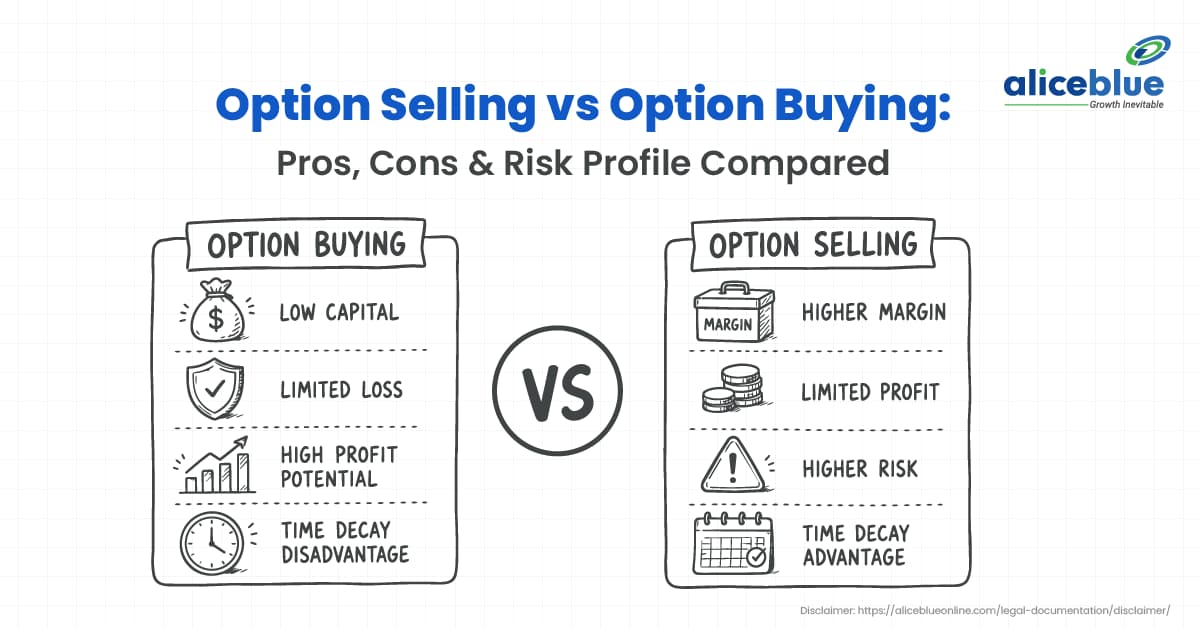
Parameter | Option Buying | Option Selling |
Capital required | Low: ₹2,000 to ₹10,000 per Nifty lot | High: ₹90,000 to ₹1,50,000 or more per Nifty lot |
Maximum profit | Unlimited | Capped at the premium collected |
Maximum loss | Limited to premium paid | Potentially very large |
Time decay (Theta) | Works against the buyer daily | Works in the seller’s favour daily |
Volatility (Vega) | Positive: benefits from rising IV | Negative: hurt by rising IV |
Typical win rate | 30 to 40% | 60 to 70% |
Best market condition | Strong directional move or event-driven | Sideways, range-bound, or post-event IV drop |
Suitable for | Beginners, event traders, and lower capital traders | Experienced traders with higher capital |
Advantages of Option Buying
Risk is fully defined before you enter. You will never receive a margin call on a bought option position.
Low capital to start. A Nifty option costs roughly ₹2,000 to ₹10,000, depending on the premium and strike, making it accessible for traders starting.
Asymmetric return potential on high conviction trades. A well-timed buy during a major market event can return 3x to 8x within a single session.
No margin requirement beyond the premium paid, as confirmed by NSE’s F&O margin framework.
Strong edge during event-driven setups when IV is low at entry and the expected move has not yet been priced into premiums by the market.
Advantages of Option Selling
Theta works for you every day without any market movement required. A sold option that sits in a calm market generates income passively as time passes.
Statistically, a higher win rate on individual trades. In range-bound markets, sellers collect premiums more often than not.
Structured income potential. Disciplined sellers running hedged strategies like Bull Put Spreads or Bear Call Spreads on Nifty and Bank Nifty weekly expiries can generate consistent returns. For a full guide on one of the most widely used selling structures, read Alice Blue’s blog on What Is a Diagonal Spread in Options.
Multiple strategic structures available. Iron Condors, strangles, and calendar spreads all use option selling as their core. Alice Blue’s guide on Iron Condor strategy explains how these hedged structures work with defined risk on both sides.
Risks of Option Buying
Theta works against you every single day. A slow-moving market is a losing environment for buyers, even if the direction is eventually correct.
You need to be right about direction and timing simultaneously. Being correct eventually does not help if expiry arrives first.
The win rate is lower than the selling. Buyers must ensure winning trades are significantly larger than losing ones to stay profitable across a series of trades.
Vega crush after events can hurt even correct directional trades. If IV falls sharply post-event, the option you bought may lose value despite the underlying moving in your favour.
Risks of Option Selling
Losses on naked positions have no ceiling. A sold Call on Nifty with no hedge leg has theoretically unlimited loss potential if the index keeps rising. A single gap-up event can cause losses that dwarf weeks of collected premium.
High margin requirements under SEBI’s updated 2026 F&O rules and NSE’s February 2026 circular make option selling significantly more capital intensive than before.
Constant monitoring is required. Sold positions cannot be left unattended, particularly around global market triggers and domestic event days.
The most dangerous pattern for option sellers is consistent small weekly wins followed by one large loss that reverses months of gains. SEBI’s data confirms this is not rare: 93% of retail F&O traders lost money between FY22 and FY24, with average losses of ₹2 lakh per person, and 75% of loss-making traders continued trading despite consecutive losses.
Common Mistakes to Avoid
Option buying mistakes:
Buying deep out-of-the-money options because they look cheap. A Nifty 25,500 CE at ₹5 when Nifty is at 24,000 needs a 6% move just to break even. These expire worthless the vast majority of the time.
Holding a losing position past your planned stop loss, hoping for a reversal. Options are wasting assets. Every day you hold a losing put option, Theta makes the exit worse.
Buying options on Tuesday or Wednesday for the same week’s Thursday expiry with no specific catalyst. Theta in the final 48 hours is too aggressive to fight without a strong setup.
Option selling mistakes:
Selling options without a predefined stop loss or exit plan. Sellers who stay in positions during fast-moving markets, telling themselves the premium will come back, are the traders responsible for the losses SEBI’s study captured.
Selling naked options as a beginner. Start with spread structures that cap the maximum loss. A Bull Put Spread limits downside to the difference between strikes minus the net premium collected.
Treating weekly premium collection as guaranteed income. It is only income after the position is closed at a profit. Before that, it is a live obligation.
Who Should Be on Which Side
Option buying fits you if your trading capital is under ₹1 lakh, you are within your first year of learning options, you have a specific directional view based on an upcoming event or technical setup, and you want losses to be defined while you are still learning.
Option selling fits you if you have at least ₹2 to ₹3 lakh dedicated to options, you have more than 12 months of real trading experience, you understand how margin calls work, you can monitor positions during market hours, and you are running hedged structures rather than naked positions.
If you have never traded an option before, buy first. Not because it is more profitable. It frequently is not. But losing ₹5,000 on a bought option teaches you how premiums move, how Theta erodes value, and how quickly markets turn, without the risk of a margin call arriving before you understand why. In India’s weekly expiry environment, where Theta accelerates fastest in the last 48 hours, learning to buy first gives you a direct experience of exactly how premium decays before you step into a position where that decay is your income and a sudden gap move is your risk.
Conclusion
Option buying gives you limited risk and unlimited upside, but requires precise timing and works against you every day through Theta. Option selling gives you a statistical edge in calm markets but demands real capital, active risk management, and the discipline to exit when a trade moves against you.
The right side depends on where you are in your trading journey, how much capital you have, and what the market is actually doing. Start with buying. Move to selling when you have felt enough trades to understand what you are taking on.
Frequently Asked Questions
Option buyers pay a premium for the right to buy or sell an asset, with risk limited to that premium. Option sellers collect that premium but take on the obligation to fulfil the contract, with potentially large losses if the market moves sharply against them.
Option selling has a higher win rate in individual trades but carries the risk of large losses in volatile or event-driven markets. Option buying has a lower win rate but limits every loss to the premium paid. For beginners, buying is safer because losses are always defined.
After SEBI’s updated 2026 margin rules and NSE’s February 2026 circular introducing a 15% additional exposure margin, selling a single Nifty options contract typically requires ₹90,000 to ₹1,50,000 or more in total margin. Buying a Nifty option requires only the premium, which ranges from roughly ₹2,000 to ₹10,000 per lot, depending on the strike.
As of January 2026, the Nifty 50 lot size is 65 units per contract, revised from 75 units. Bank Nifty lot size is 30 units, revised from 35. These changes came into effect from the January 2026 expiry series as per NSE’s circular.
Theta is the amount by which an option’s price decreases each day as it approaches expiry. For buyers, it is a daily cost. For sellers, it is daily income. Theta accelerates in the final 48 hours before expiry. Alice Blue’s full guide on Theta in Options Trading explains this with examples.
The right time is when India VIX is low (below 13 to 14), and a strong directional event is approaching. Buying when VIX is already high means paying an inflated premium that can collapse even if the market moves in your direction. Alice Blue’s blog on India VIX and Options Pricing explains exactly how VIX levels affect buyer and seller outcomes.

Blog by Aliceblue News Desk


