Scalping Strategies Every Trader Should Know
Blog by Aliceblue News Desk
16 February 2025
10 minutes
Scalping is a short-term trading approach where traders enter and exit positions quickly to capture small price movements. It requires close attention to price action, execution, liquidity and risk management.
Quick Definition
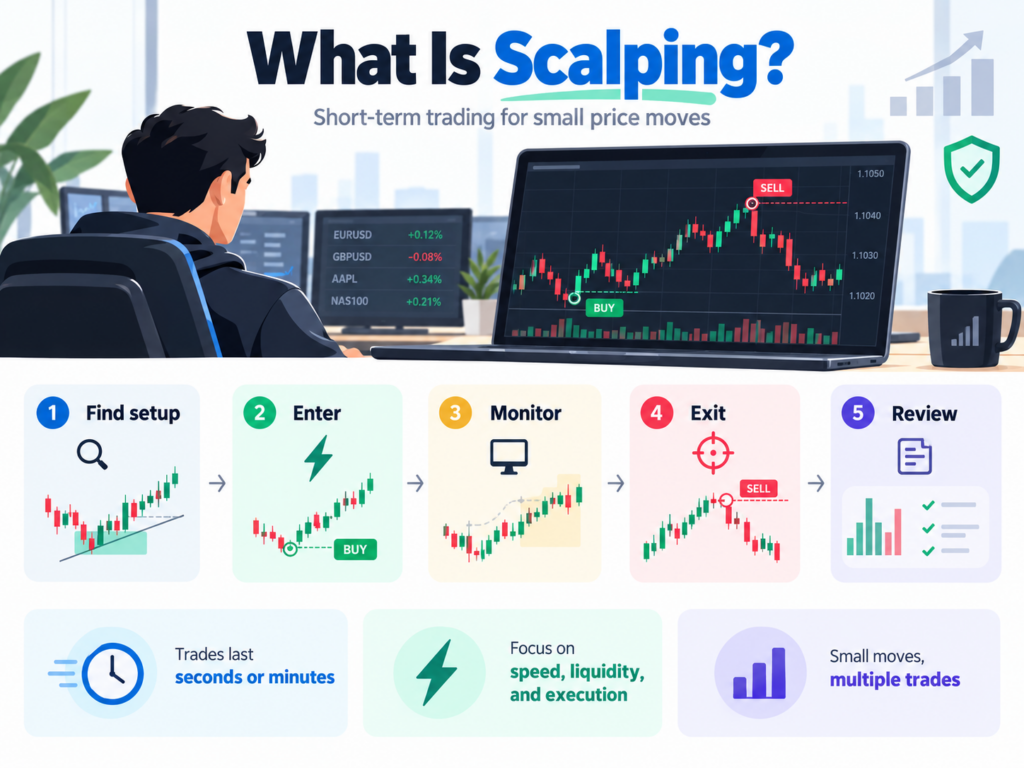
Scalping is a short-term trading approach where traders make multiple trades and hold positions for a few seconds or minutes, aiming to capture small price movements.
Unlike positional trading, scalping focuses on short-term market moves. Since the expected price movement per trade can be small, transaction costs, spreads and slippage can have a meaningful impact.

What is Scalping Trading?
Scalping trading is a short-term trading approach in which traders enter and exit positions quickly to capture small price movements.
A scalper may hold a position for seconds or minutes rather than hours or days. The focus is generally on short-term price action, volume, liquidity and execution.
For example, a trader may identify a breakout on a liquid stock or index, enter after the breakout and exit when the expected move loses momentum.
Scalping does not mean that every trade will be profitable. Frequent trading can also increase transaction costs and losses if trades are poorly timed or risk is not controlled.
How Does Scalping Work?
Scalping generally follows a simple process:
Identify a setup → Enter a position → Monitor the trade → Exit the position → Review the trade
A scalper may use a 1-minute, 5-minute or another short-term chart depending on the instrument and trading approach.
Before entering a trade, traders may look at:
- Price movement
- Support and resistance
- Volume
- Market trend
- Bid-ask spread
- Technical indicators
- Liquidity
- Recent news or events
Execution is also important because a small price movement may leave limited room after brokerage, exchange charges and slippage.
Types of Scalping Strategies
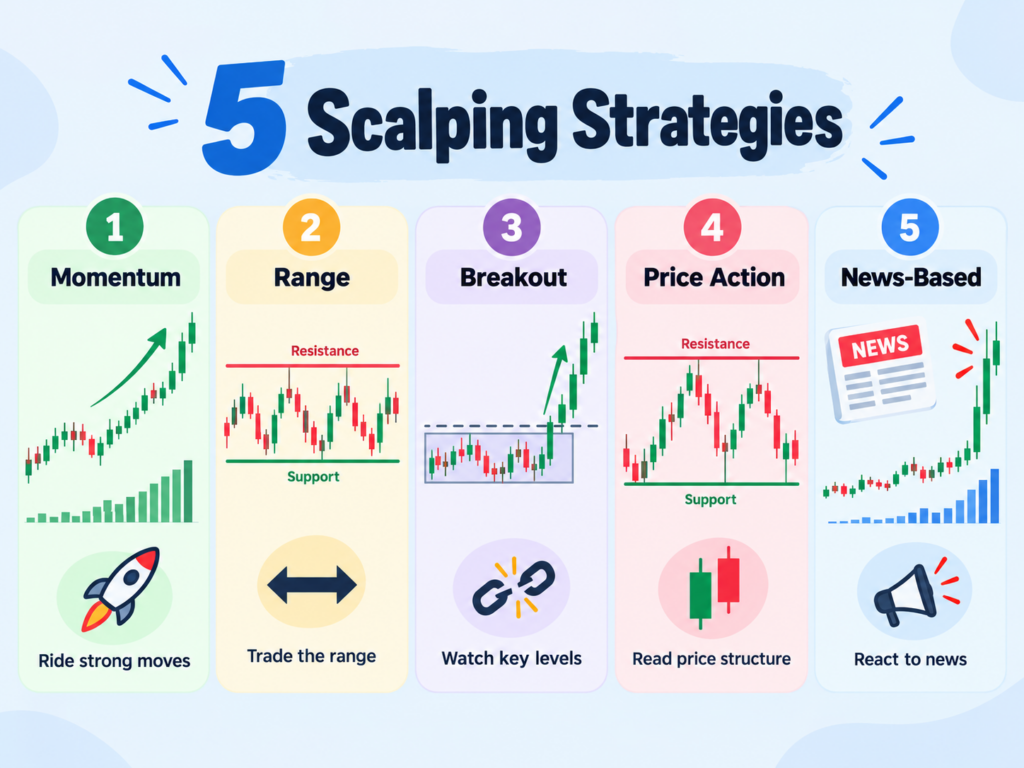
There is no single approach that works in every market condition. Some commonly used scalping approaches include momentum, range, breakout and price-action scalping.
1. Momentum Scalping
Momentum scalping focuses on short-term price movement in one direction.
A trader may look for:
- Strong price movement
- Increasing volume
- A breakout from a recent range
- Continuation after a pullback
For example, if a stock breaks above a resistance level with increased volume, a trader may look for a short-term continuation.
The challenge is determining whether the momentum is continuing or starting to weaken.
2. Range Scalping
Range scalping is used when price is moving between relatively defined support and resistance levels.
A trader may look for an entry near support and an exit near resistance, or the reverse for a short position where permitted.
However, a range can break at any time. A setup that works during sideways movement may stop working once a strong breakout occurs.
3. Breakout Scalping
Breakout scalping focuses on price moving beyond an important level such as support, resistance or a recent trading range.
Traders may monitor:
- Breakout level
- Volume
- Price momentum
- Retest of the level
- Stop-loss level
A breakout does not automatically mean that price will continue in the same direction. False breakouts can occur, which is why traders generally define their exit conditions before entering.
4. Price-Action Scalping
Price-action scalping focuses mainly on how price is moving rather than relying heavily on indicators.
Traders may study:
- Candlestick patterns
- Support and resistance
- Breakouts
- Pullbacks
- Higher highs and higher lows
- Lower highs and lower lows
Price action can also be combined with volume or one or two indicators for additional context.
5. News-Based Scalping
News-based scalping involves trading around short-term price movements following events such as corporate announcements, economic data or other market-moving information.
This approach can be difficult because prices may move rapidly and spreads or slippage can increase.
Instead of assuming that a news event will create a particular price direction, traders need to assess the actual price reaction and their risk before entering.
Technical Indicators Used for Scalping
Technical indicators can help traders study short-term market conditions, but no indicator can predict the next price movement with certainty.
Some commonly used indicators include:
Moving Averages:
Moving averages smooth price data and can help traders identify short-term direction.
Shorter-period moving averages react faster to price changes, while longer-period moving averages react more slowly.
A trader may compare two moving averages to study momentum or use a moving average as a reference for the current price.
Relative Strength Index (RSI):
RSI measures the strength of recent price movements on a scale from 0 to 100.
The commonly watched levels are:
- Above 70: traditionally considered overbought
- Below 30: traditionally considered oversold
However, an overbought reading does not automatically mean that price will fall, and an oversold reading does not automatically mean that price will rise.
For scalping, RSI can be used alongside price action rather than as a standalone trading signal.
Bollinger Bands:
Bollinger Bands consist of a moving average and upper and lower bands based on price variation.
Scalpers may use them to study:
- Expansion and contraction in price movement
- Price movement within a range
- Possible breakouts
- Short-term extensions from the average
Price touching an upper or lower band should not automatically be treated as a buy or sell signal.
MACD:
Moving Average Convergence Divergence, or MACD, is used to study momentum and changes in trend.
Scalpers may monitor the MACD line, signal line and histogram for changes in short-term momentum.
Since MACD is based on moving averages, it can react more slowly than price during very short-term moves.
VWAP:
Volume Weighted Average Price, or VWAP, shows the average traded price of an instrument during a session, weighted by volume.
Intraday traders may use VWAP as a reference point when studying price and volume.
For example, a trader may observe whether price is holding above or below VWAP while also looking at volume and price structure.
Pros and Cons of Scalping Trading
Scalping can offer a way to focus on short-term price movements, but it also comes with specific challenges.
| Pros of Scalping | Cons of Scalping |
| Short holding periods | Requires continuous attention |
| Positions can be closed within the trading session | Frequent trades can increase costs |
| Focuses on short-term price movements | Slippage can affect trade outcomes |
| Can be applied to liquid instruments | Requires quick decision-making |
| No overnight position if all trades are closed before the session ends | Repeated losses can add up quickly |
| Entry and exit rules can be clearly defined | Emotional trading can lead to overtrading |
Does Scalping Reduce Market Risk?
A short holding period can reduce exposure to some overnight events, but it does not make scalping low-risk.
Prices can move sharply within seconds or minutes. Fast markets can also result in slippage or execution at a different price than expected.
So, shorter holding time should not be confused with lower overall trading risk.
Common Mistakes in Scalping
1. Overtrading
Taking too many trades simply because the market is moving can increase transaction costs and make it difficult to follow a trading plan.
2. Ignoring Transaction Costs
When the expected price movement is small, brokerage, taxes, exchange charges and other costs can have a larger effect on the overall result.
Scalpers should understand the applicable costs before trading frequently.
3. Using Excessive Leverage
Leverage can increase the size of a position relative to the trader’s own funds, but it also increases the impact of price movements on the position.
A small adverse move can therefore result in a relatively large loss.
Leverage is not a requirement for scalping.
4. Entering Without an Exit Plan
A trader should know what would make them exit a trade before entering it.
This may include a predefined stop-loss, a price level that invalidates the setup or a time-based exit.
5. Chasing Price
Entering after a sharp move simply because the price is moving quickly can lead to poor entries.
A scalping setup should have a defined reason for entry rather than being based only on fear of missing a move.
6. Trading Illiquid Instruments
Low liquidity can lead to wider bid-ask spreads and greater slippage.
Scalpers generally need to pay close attention to liquidity because their expected price movement may be small.
7. Ignoring Market Conditions
A setup that works during a strong trend may not work in a range-bound market. Similarly, a range-based setup may fail during a breakout.
Understanding the intraday price structure is therefore important.
8. Continuing After Repeated Losses
Trying to recover losses immediately by increasing trade size or taking more trades can increase risk.
If trading conditions are not working as expected, taking a break can be better than forcing another trade.

How to Manage Risk While Scalping
Risk management is especially important in scalping because traders may take multiple positions during a single session.
Some common practices include:
- Decide the maximum amount you are willing to lose before entering a trade.
- Use an appropriate position size.
- Define your stop-loss level where suitable.
- Avoid increasing position size to recover a previous loss.
- Keep track of brokerage and other trading costs.
- Avoid excessive leverage.
- Set a daily loss limit if it forms part of your trading plan.
- Stop trading when market conditions no longer match your setup.
The goal is not to eliminate losses. It is to ensure that a single trade or a series of trades does not expose the account to more risk than planned.
Scalping Tools on Alice Blue
Fast access to market information and order placement can be useful for traders who follow short-term setups.
Alice Blue provides several tools that can be relevant to short-term traders.
The Scalper Terminal brings charts, option-chain information and order-related tools into a single trading interface.
For options traders, 1LYOptions includes features such as Scalp Mode, pre-market information, chart-based order placement and options tools.
These tools can make order placement and monitoring more convenient, but a trading platform or indicator does not determine whether a trade will be profitable.
Scalping Strategies: Quick Summary
Scalping is a short-term trading approach focused on small price movements. Traders may hold positions for seconds or minutes and can take multiple trades during a session.
Common approaches include:
- Momentum scalping: Following strong short-term price movement.
- Range scalping: Trading between support and resistance.
- Breakout scalping: Trading price movement beyond an important level.
- Price-action scalping: Using price structure and candlestick behaviour.
- News-based scalping: Trading short-term price reactions to market-moving events.
Moving averages, RSI, Bollinger Bands, MACD and VWAP are commonly used for short-term analysis.
However, scalping also involves risks such as transaction costs, slippage, rapid price movements and overtrading. A clear trading plan and defined risk limits are therefore important.
Scalping Strategies Every Trader Should Know: FAQs
1. What is scalping trading?
Scalping is a short-term trading approach where traders enter and exit positions quickly to capture small price movements. Trades may last for seconds or minutes, depending on the setup and market conditions.
2. What is the best scalping strategy for beginners?
There is no single best scalping strategy for every trader or market condition.
A beginner can start by learning one simple approach, such as range, breakout or momentum scalping, and understand its entry, exit and risk rules before trading it with real money.
3. Which indicators are commonly used for scalping?
Moving averages, RSI, Bollinger Bands, MACD and VWAP are commonly used for short-term analysis.
Their usefulness depends on the trading setup and market conditions. No single indicator should be treated as a guaranteed buy or sell signal.
4. Is scalping suitable for stocks and options?
Scalping can be used in different market segments, but liquidity, spreads, price movement and execution conditions matter.
Options can move quickly, and their prices are affected by factors beyond the movement of the underlying asset. Traders should understand these risks before scalping options.
5. How much capital is needed for scalping?
There is no fixed minimum capital amount for scalping.
The amount required depends on the instrument, position size, applicable margin rules and the trader’s risk limits. Position size should be based on the amount the trader is prepared to risk rather than a fixed capital figure found online.

Blog by Aliceblue News Desk
The Alice Blue Team is a passionate group of analysts delivering expert market insights, comprehensive coverage of stocks, economy, commodities, and personal finance through clear, actionable research.