What Is a Short Straddle Strategy and When to Sell It in India?
Blog by Aliceblue News Desk
17 August 2026
8 minutes
A short straddle means selling a call and a put on the same strike and same expiry, and hoping the market barely moves. Indian traders usually reach for this when option premiums look rich, the chart is going nowhere, and no big event is sitting on the calendar.
Table of Contents
- What Is a Short Straddle Strategy?
- How a Short Straddle Works
- Short Straddle Example With Numbers
- Key Features of the Strategy
- When to Sell a Short Straddle
- Advantages
- Risks and Limitations
- Tips for Beginners
- Short Straddle vs Long Straddle
- Common Mistakes to Avoid
- Who Should Use This Strategy?
- Frequently Asked Questions
Ask a new trader how to make money in options, and most will say you need to guess which way the market is headed. A short straddle breaks that rule. Here, you get paid for betting that the market goes nowhere. You sell a call and a put at the same strike, collect the premium upfront, and if the price stays parked near that strike till expiry, both options die worthless, and you keep the money. This piece walks through how that setup actually plays out in Indian markets, when traders reach for it, and where it can bite back hard.
What Is a Short Straddle Strategy?
A short straddle has two legs: you sell a call and a put, both at the same strike, both expiring on the same date. The premium you collect from selling both is the most you can ever make on this trade.
Why would anyone want that? Because options are built to lose value as time runs out, something traders call time decay. If Nifty just sits there and does nothing for a week, both the call and put you sold keep shrinking in price, and that shrinkage is your profit. So this trade is not a bet on direction. It is a bet on boredom.
How a Short Straddle Works
- Pick something liquid. Nifty and Bank Nifty are the usual choices because getting in and out is easy.
- Look at the current price and find the nearest strike.
- Sell the call at that strike.
- Sell the put at the same strike.
- Add up what you received from both.
- Keep an eye on the price. A sudden run in either direction starts costing you fast.
- Get out early if the market picks a direction and runs with it.
Two numbers matter here, the breakevens.
Upper breakeven = strike price plus total premium received
Lower breakeven = strike price minus total premium received
Stay inside that band till expiry, and the trade works in your favour.
Short Straddle Example With Numbers
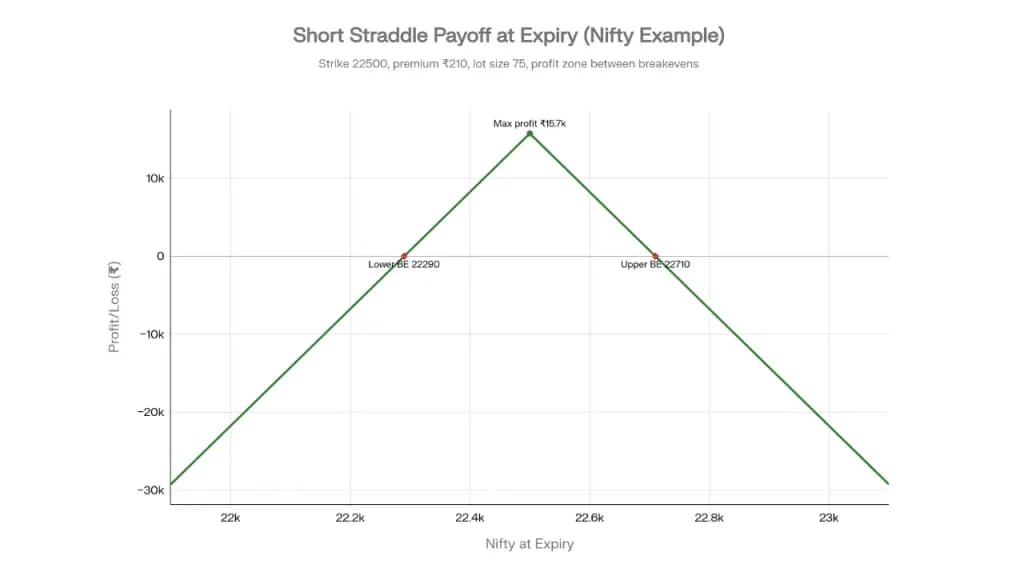
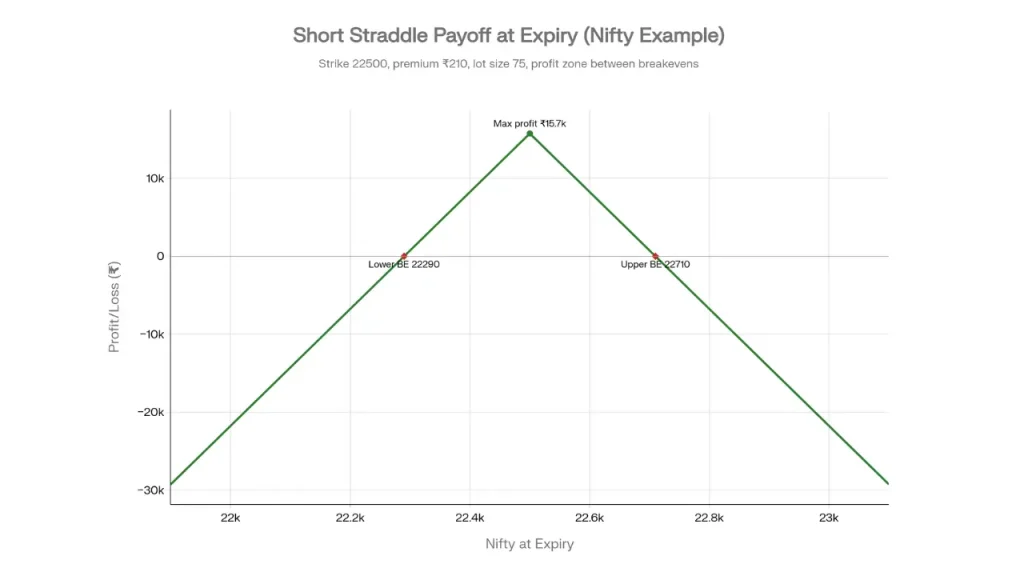
Say Nifty is hovering near 22,500. A trader sells the 22,500 call for ₹100 and the 22,500 put for ₹110, pocketing ₹210 in total. With a lot size of 75, that ₹210 turns into ₹15,750, which is the absolute ceiling on profit, and only if Nifty closes right at 22,500.
Nifty at expiry | What happens | Result |
22,500 | Both options expire worthless | Maximum profit of ₹15,750 |
22,600 | Price stays close to strike | Small profit or small loss, depending on premium decay |
22,800 | Price moves up strongly | Loss starts increasing |
22,250 | Price moves down strongly | Loss starts increasing |
That curve says everything the table can’t. The peak sits right at 22,500, the trade stays in profit between 22,290 and 22,710, and past those two points, there is no cushion. Losses just keep climbing.
Key Features of the Strategy
- Same strike, same expiry for both legs.
- Money hits your account the moment you enter, not at exit.
- Rewards a flat, boring market.
- Time decay is on your side, every single day.
- One sharp move can undo weeks of small gains.
- Liquidity matters. Nifty and Bank Nifty are far easier to manage than thinly traded stock options.
When to Sell a Short Straddle
A few conditions usually line up before traders sell this:
- Volatility looks stretched and seems due to cool off.
- Price action has gone flat for a few sessions.
- Nothing major is scheduled, no earnings, no RBI policy day, no budget, no election result.
- The option chain shows decent volume, not just wide, empty quotes.
- There is enough margin parked, and an exit plan has already been decided.
This setup tends to show up right after a volatility spike, when premiums have swelled, but the trader suspects the fear will fade rather than turn into an actual breakout.
Advantages
When the market genuinely goes quiet, this is one of the more efficient ways to make it pay. You don’t need to be right about direction, only about how much the market won’t move.
- Time works for you instead of against you.
- No need to pick a side, bullish or bearish.
- Works cleanly in liquid index options.
- Rewards patience over prediction.
Risks and Limitations
Here’s the catch nobody skips over for long: the loss side has no ceiling. A strong move either way, and the math flips against you fast, exactly like the chart above shows, once the price crosses either breakeven.
- Loss can, in theory, keep growing.
- Margin requirements run high because of that open-ended risk.
- A single news headline or policy surprise can undo the setup in minutes.
- Traders often hold too long, hoping the price snaps back, and that hope gets expensive.
- Thin liquidity in some stock options makes a clean exit harder than expected.
This is not a “set and forget” trade. It demands attention, a firm stop, and a size you’re actually comfortable losing.
Tips for Beginners
- Stick to index options before touching individual stocks.
- Check what’s on the economic calendar before you enter.
- Never use your entire margin limit on one trade.
- Decide your maximum acceptable loss before you place the order, not after.
- Trade one lot until you’ve actually watched a straddle move through a full week.
- Check the position more than once a day.
- If it starts going wrong, exit. Don’t wait for it to “come back.”
Before trying this, get comfortable with plain call and put buying first, and understand how premiums shrink as expiry nears. That foundation makes this strategy far less confusing.
Short Straddle vs Long Straddle
Parameter | Short Straddle | Long Straddle |
Position | Sell call and put | Buy call and put |
Market view | Expects a quiet market | Expects a big move |
Profit source | Premium collected | A large move, either direction |
Risk | Open ended | Capped at the premium paid |
Time decay | Works for you | Works against you |
Best fit | Range-bound conditions | High volatility ahead |
Flip the logic, and you get a long straddle: pay a premium, hope for fireworks. A short straddle is the opposite bet, quiet money, quiet market.
Common Mistakes to Avoid
- Entering right before a big event and hoping it stays calm.
- Treating the margin blocked as your worst-case loss. It isn’t.
- Skipping a stop loss because “it looked fine yesterday.”
- Trading strikes with barely any volume.
- Going in with a lot size bigger than you can actually manage.
- Assuming a quiet Monday means a quiet Friday too.
Who Should Use This Strategy?
This fits someone who already understands how options behave, checks positions through the day, and isn’t rattled by watching a live loss tick upward while deciding what to do. It suits active traders far more than long-term investors.
It’s probably not for:
- Someone trading options for the first time,
- Anyone who prefers to buy and forget,
- Traders who can’t check the market during work hours,
- Anyone who loses sleep over open-ended risk.
Conclusion
Selling a short straddle is really a bet that the market will do very little for a while. When that bet plays out, the profit comes almost entirely from time passing, not from being clever about direction. But the moment the market breaks out of its range, the same trade turns risky fast, and there’s no built-in floor to the loss. Anyone trying this for the first time should keep the size small, know the breakevens cold, and have an exit decided before the trade even goes live.
Frequently Asked Questions
You sell a call and a put at the same strike and expiry, betting the market stays roughly where it is.
When premiums look rich, the market’s gone flat, and there’s no major event sitting on the calendar.
Not really a starting point. It suits traders who already have a handle on option premiums and risk control.
Whatever premium you collected upfront, and only if the market closes right at your strike on expiry.
An unlimited loss if the market breaks out sharply in either direction.
Same strike for both legs in a straddle, different strikes in a strangle. The strangle usually pays less but gives you more room before it starts losing.
Yes, traders often roll the losing side, close one leg, or add a hedge once the market starts trending.

Blog by Aliceblue News Desk


