
What Is IPO Withdrawal Rate and What Does a High Withdrawal Mean?
Blog by Aliceblue News Desk
22 May 2026
10 minutes
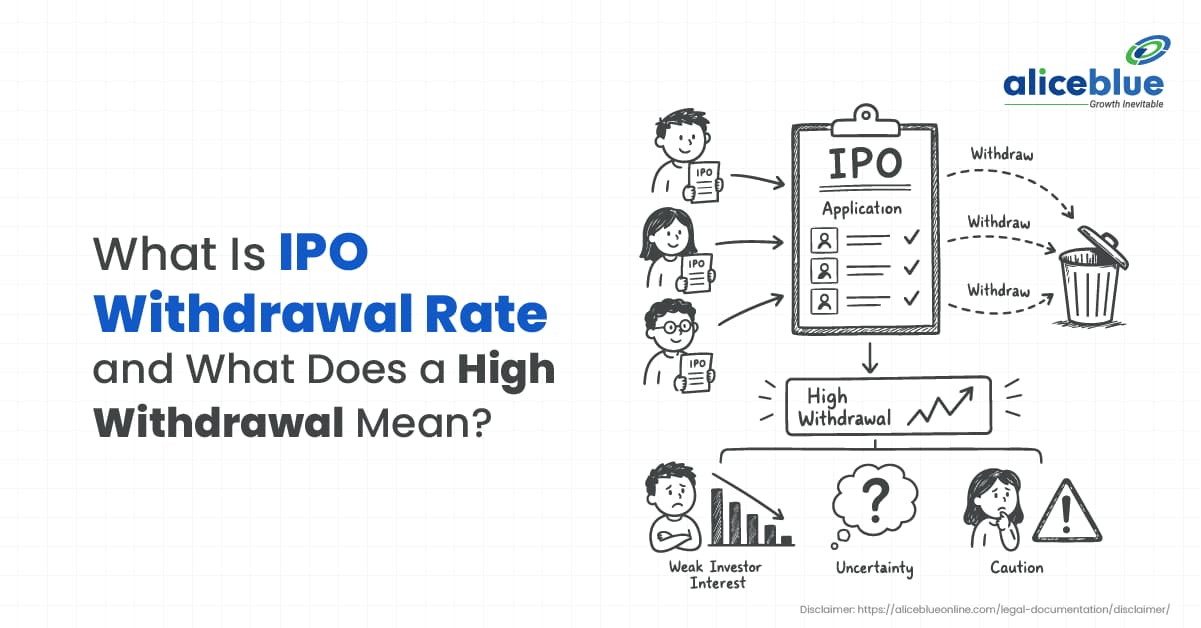
You apply for an IPO on Day 1. The subscription numbers look decent. The grey market premium is positive. By Day 3, the numbers have barely moved from where they were on Day 1. A few people in your investing group mentioned they pulled their applications. Should you be worried?
That situation tells you something important. The metric sitting behind it is the IPO withdrawal rate, and understanding it can help you make better decisions before a stock ever lists on the exchange.
What Is the IPO Withdrawal Rate?
The IPO withdrawal rate is the proportion of investors who cancel their applications after submitting them, before share allotment takes place.
One important clarification upfront: this number is not officially published by NSE, BSE, or SEBI. You will not find a withdrawal rate figure on any exchange portal. Investors estimate it by comparing subscription momentum from Day 1 to Day 3. When the final Day 3 subscription is significantly lower than the pace set on Day 1, it reflects a meaningful volume of bid cancellations.
To understand how subscription data is structured across retail, HNI, and QIB categories, read Alice Blue’s detailed guide on
IPO Subscription Status Explained: QIB, HNI and Retail.
This is also completely different from a company withdrawing its IPO, which means the entire public offer is cancelled. What we are discussing here is individual investors cancelling their own applications while the IPO remains active for everyone else.
How IPO Application Withdrawal Works
In India, SEBI allows investors to cancel applications during the subscription window, which typically spans three working days. Applications are submitted through ASBA (Application Supported by Blocked Amount), meaning the money is blocked in your bank account but not debited until allotment.
Here is how the process works:
- Application submission — You apply through your broker, bank, or UPI platform. The application amount is blocked under ASBA, not deducted from your balance.
- Withdrawal during subscription — You can cancel your bid between 10:00 AM and 4:30 PM on any day the subscription is open. The exact cut-off time may vary slightly by platform.
- Post-closure withdrawal — After the IPO closes, digital cancellation is generally not available. However, retail investors can send a written request to the registrar before allotment is finalised. This is not guaranteed, and the registrar’s decision is final.
- Fund release — Once withdrawal is processed, the blocked funds return to your account. If the withdrawal happens after the bid closure date, funds are released only after the registrar instructs the bank following finalisation of allotment.
No charges or penalties apply for withdrawing an IPO application.
For a full overview of how SEBI governs the IPO process for investors, refer to Alice Blue’s guide on
Withdrawal Rules by Investor Category
Not every investor type has the same freedom to withdraw. SEBI’s book-building regulations set clear rules to prevent large investors from manipulating subscription data.
Investor Category | Can Withdraw? | Key Rule |
Retail Investors (up to Rs 2 lakh) | Yes | Can cancel or modify bids freely before IPO closes |
Employee or Shareholder Category | Yes | Same freedom as retail investors |
HNI / Non-Institutional Investors | No | Can only increase bid amount, cannot reduce or cancel |
Qualified Institutional Buyers (QIBs) | No | Cannot withdraw after IPO closes |
The HNI and QIB restrictions exist for a specific reason. If large investors could cancel bids freely, they could inflate Day 1 subscription numbers, attract retail participation on the back of that hype, and then exit before final allotment. SEBI’s restrictions prevent exactly this.
Why Investors Withdraw Applications
Understanding common reasons helps you interpret what the subscription movement is actually telling you.
Market falls during the subscription window — If the broader indices drop sharply between Day 1 and Day 3, retail investors tend to preserve cash by cancelling applications.
GMP drops during subscription — The grey market premium is an informal indicator of expected listing gains. When GMP falls steeply between Day 1 and Day 3, investors read that as a fading short-term opportunity and pull their bids. To understand how GMP works and what it signals, read Alice Blue’s
Grey Market Premium (GMP) in IPO: Complete Guide.
Negative news about the company surfaces — Concerns about the company’s debt, promoter background, or peer comparison that emerge during the subscription period often trigger cancellations from investors who applied without doing detailed research.
Better opportunity available simultaneously — When two or more IPOs are open at the same time, investors sometimes shift their blocked funds toward the one with stronger demand signals.
Speculative applications losing appeal — Many retail investors apply based on GMP trends alone, without reading the DRHP or financials. When the short-term listing trade weakens, those bids disappear quickly.
A Real Market Situation: LIC IPO (May 2022)
The LIC IPO is one of the clearest examples of weak subscription momentum reflecting genuine demand weakness.
The IPO opened on 4 May 2022 with a price band of Rs 902 to Rs 949. On Day 1, the issue was subscribed to just 0.67 times overall. By Day 2, it crossed 1x, but the NII and QIB portions were still well below their quotas. The IPO ultimately closed at 2.95 times overall on the final day, with the NII portion at 75% and QIBs at 56% of their allotted quota even at closing.
The stock is listed at Rs 875, a discount of approximately 7.8% to its issue price of Rs 949. Investors who tracked the sluggish subscription buildup, the absence of QIB enthusiasm, and the lack of GMP momentum had a clear signal well before listing day. This is exactly what weak subscription momentum, partly driven by investors reconsidering their applications, looks like in a real IPO.
To understand what drives strong versus weak IPO listings, read Alice Blue’s article on
How to Estimate the Withdrawal Rate Yourself
Since no official figure exists, here is a practical method using publicly available data on NSE and BSE:
- Note the Day 1 subscription figure — Check the IPO subscription page on NSE or BSE at the end of Day 1. You can also track this through Alice Blue’s
- IPO Subscription Status page.
- Track Day 2 and Day 3 momentum — If an IPO opens at 3x on Day 1 and closes at 2.5x on Day 3, bids were clearly pulled during the window.
- Cross-reference GMP movement — A GMP that contracts sharply between Day 1 and Day 3 almost always corresponds with rising cancellations.
- Check category-wise final data — Retail and NII subscription data is published separately on NSE and BSE. A weak retail close relative to Day 1 figures is a reliable sign of withdrawals.
- Watch QIB participation on Day 3 — QIBs typically enter on Day 3. If QIB participation is unusually low even at close, it signals institutional disinterest, which reinforces retail withdrawal behaviour.
As a rough reference point: if the Day 3 subscription is 30 to 40% lower than the pace suggested by Day 1 figures across retail and NII categories, that is worth treating as a signal of meaningful withdrawal activity.
What a High Withdrawal Rate Signals
When a large proportion of investors pull bids before allotment, it points to one or more of the following:
Weak conviction behind initial applications — Early demand was driven by excitement, not by research. When the excitement fades, the bids go with it.
Valuation concerns — Investors reconsidered after comparing the company’s price to earnings or price to sales ratio against listed peers during the subscription window.
Less buying support on listing day — Fewer committed investors at allotment means less organic buying interest when the stock begins trading, which creates listing day pressure.
Inflated early demand — High Day 1 figures sometimes reflect investors placing speculative bids. When that trade thesis weakens, those bids are the first to disappear.
This matters in the current market context. In 2025, nearly 47 out of 103 companies that went public were trading below their IPO price by year-end. By early 2026, seven out of eight mainboard IPOs delivered negative listing gains. In an environment like this, subscription quality matters far more than subscription quantity.
IPO Withdrawal Rate vs IPO Subscription Rate
These two metrics tell very different stories and need to be read together.
Metric | What It Measures | What It Tells You |
IPO Subscription Rate | Total bids received vs shares offered | Volume of interest, not quality of intent |
Estimated Withdrawal Rate | Drop in subscription from Day 1 to Day 3 pace | Whether early demand was committed or speculative |
GMP Movement | Informal expected listing gain | Short-term market sentiment about the IPO |
All Three Together | Combined reading | A realistic picture of actual investor commitment |
An IPO that shows 8x subscription on Day 1 but closes at 4x on Day 3, with GMP falling 60% in between, is a completely different investment situation from one that opens at 3x and closes at 6x with a stable or rising GMP.
To understand how oversubscription affects your allotment chances, read Alice Blue’s guide on
What Is Oversubscription in IPO and How Does It Affect Your Allotment.
Mistakes Beginners Make
Trusting only Day 1 subscription numbers
Day 1 figures attract the most attention on financial media. They also reflect the most speculative demand. The Day 3 close is the number that shows you who stayed.
Ignoring GMP contraction
GMP is informal and unregulated, but as a sentiment indicator, it works. A GMP that falls sharply during the subscription window almost always corresponds with rising bid cancellations.
Not using the withdrawal option when the situation changes
Many retail investors do not realise they can cancel their application freely before the cut-off time on the final day. If GMP has collapsed and subscription momentum has stalled, withdrawing is a free and valid option available to you.
Confusing the company IPO withdrawal with the investor application withdrawal
These are entirely different events. A company withdrawal cancels the entire offer, and every investor gets their blocked funds released. An investor withdrawal cancels only that individual’s bid while the IPO continues normally for everyone else.
Applying based on Day 1 hype without reading financials
Investors who apply based on subscription buzz without reviewing the company’s revenue, debt levels, or peer valuation are the ones most likely to withdraw on Day 2 or Day 3 when they eventually do that research.
Conclusion
The IPO withdrawal rate is a signal you read from subscription movement, GMP behaviour, and the gap between Day 1 enthusiasm and Day 3 commitment. When that gap is large, it tells you something the headline subscription number does not. In a market where nearly half of 2025 IPO listings ended the year below issue price and early 2026 mainboard listings have continued that trend, reading subscription quality alongside subscription quantity is one of the simplest checks a retail investor can run before applying.
To track live IPO subscription data and apply for upcoming IPOs, open an account with Alice Blue and access real-time IPO updates directly through the platform.
Frequently Asked Questions
It is the proportion of investors who cancel their applications after submitting them, before share allotment. Since SEBI does not publish this figure officially, investors estimate it by tracking how subscription momentum changes from Day 1 to Day 3.
Withdrawing online is generally not possible after the closing date. You can submit a written request to the registrar before allotment is finalised, but approval is not guaranteed and depends on the registrar.
No. Withdrawing an IPO application before allotment carries no charges or penalties. Blocked funds under ASBA are released back to your account after the process is completed.
It typically indicates weakening investor confidence, concerns about valuation, falling GMP, or a broader market downturn during the subscription window. It often precedes a weak listing or below-issue-price performance.
No. HNIs can only increase their bid amount, not reduce or cancel it. This is an SEBI regulation that applies to all Non-Institutional Investors.
No. QIBs cannot withdraw after the IPO closes. This rule prevents institutional investors from inflating subscription data and then exiting before allotment.

Blog by Aliceblue News Desk


