

Trading Timings & Sessions
Raise Support TicketIndian stock market (BSE and NSE)
> Pre-Opening Session: 9:00 AM to 9:15 AM IST.
> Normal Trading Session: 9:15 AM to 3:30 PM IST.
> Closing Session: 3:30 PM to 4:00 PM IST.
> Post-Closing Session: 3:40 PM to 4:00 PM IST (for placing After-Market-Orders).
> Muhurat Trading: Special one-hour session on Diwali, timings vary annually.
> Block Deal Sessions:
Morning: 8:45 AM to 9:00 AM.
Afternoon: 2:05 PM to 2:20 PM.
Commodity market in India (MCX)
> Morning Session: 9:00 AM to 5:00 PM IST.
> Evening Session: 5:00 PM to 11:30 PM IST (extends to 11:55 PM during US Daylight Saving Time).
Indian stock market
Pre-Opening Session: 9:00 AM to 9:15 AM IST.
Order Entry Window: 9:00 AM to 9:08 AM IST.
Investors can place, modify, or cancel orders during this period.
Order Matching Window: 9:08 AM to 9:12 AM IST.
Orders are matched, and the opening price is determined.
Buffer Period: 9:12 AM to 9:15 AM IST.
A brief period for the system to finalize the transition to the normal market.
AMOs allow you to place buy or sell orders for securities after the regular trading hours of the market have closed. These orders are then queued by your broker and sent to the exchange for execution when the market opens on the next trading day. As of now, only POA clients are eligible for AMO orders.
Before regular trading begins, there is a pre-open session from 9:00 AM to 9:15 AM
It helps the market open smoothly, reduces volatility, and prevents sudden price jumps.
The pre-open session lasts 15 minutes and is divided into three phases:
1. Order Entry Period: 9:00 AM – 9:08 AM
2. Order Matching & Trade Confirmation Period: 9:08 AM – 9:12 AM
3. Buffer Period: 9:12 AM – 9:15 AM
During this phase:
1. You can place, modify, or cancel both limit and market orders.
2. The system randomly stops accepting changes between 9:07 AM and 9:08 AM.
3. The system verifies whether you have sufficient margin or funds. Insufficient funds result in automatic order rejection.
4. It checks for self-trades (buying and selling to yourself); such orders are cancelled automatically.
The system displays useful details such as:
• Expected opening price
• Total buy and sell quantities
• Comparison with yesterday’s closing price
Order modifications stop at a random time between 9:07 AM and 9:08 AM.
Once the system freezes order changes, no further edits are allowed.
In this phase:
• You cannot place, modify, or cancel any order.
• The system determines the opening price, known as the equilibrium price.
• It calculates this price by finding the level at which the maximum number of buy and sell orders can be matched.
• If multiple prices allow the same number of trades, the system picks the price with the smallest difference between buy and sell quantities.
Matching happens in the following sequence:
1. Limit orders matched with limit orders
2. Remaining limit orders matched with market orders
3. Market orders matched with market orders
After matching, trade details are shared with all members before market open.
The opening price is chosen where:
1. The maximum trades can take place at once (highest matched quantity).
2. If more than one price meets this condition, the price with the least imbalance between buy and sell orders is selected.
This is a short transition phase where:
• Any unmatched limit orders from the pre-open session are moved to the normal market session.
• These orders retain their original time stamp to ensure fairness.
• They may be converted into limit orders at the equilibrium price if required.
• You cannot place, change, or cancel any order.
If you attempt, you’ll see the message:
“Markets have not been opened for trading.”
No. Trading and order modification are not allowed between 9:12 AM and 9:15 AM.
This process mainly applies to current-month futures contracts for both stocks and indices, along with equity pre-open mechanisms as defined by the exchange.
The pre-open session helps:
• Reduce opening volatility
• Discover a fair opening price
• Ensure smoother market opening
• Manage large overnight pending orders efficiently
Only NSE and BSE equity segment stocks participate. Some stocks (like certain SME stocks) may not be part of the pre-open mechanism.
Pre-open session is applicable for both single stocks and indices futures in equity derivatives
market.
Pre-open shall not be applicable in following scenarios:
1. Spread & Option contracts on Indices and stocks.
2. Pre-open session shall not be conducted in Futures of underlying security on its exdate of corporate action due to scheme of arrangement.
The pre-open session comprises two sessions as mentioned below:
1. Order Collection Period
2. Order Matching Period
When a trade cancellation request is made on TWS for a pre-open trade, the system will not
Allow the cancellation. Instead, the following error message will be displayed:
“Trade executed during pre-open session not allowed to cancel”
The trade cancellations for pre-open session trades are restricted.
The following error messages shall be displayed on the NEAT Terminal for order rejections
during the pre-open session or before the normal market opens: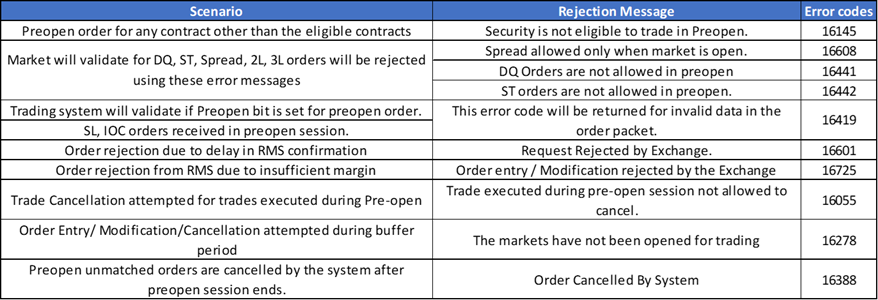
An AMO (After Market Order) is an order placed outside regular market hours. These orders are queued and sent to the exchange when the market opens or during the designated pre-open session.
Post Beginning of Day (BOD) processing, AMO is enabled for all segments. As soon as the client is allowed to log in after BOD, AMO functionality becomes available.
Pre-validation is a risk check performed by the Risk Management System (RMS) to ensure sufficient margins, limits, and compliance before orders are sent to the exchange.
• MCX, CDS, and Cash pre-open eligible orders are pre-validated by RMS.
• Once the pre-open message is received from the exchange, these orders are placed to the exchange.
• All Cash orders placed after 8:59 AM
• And orders not eligible for pre-open
These orders are pre-validated at 9:13 AM and will be sent to the exchange once the market open message is received.
• NFO (F&O) orders are pre-validated at 9:13 AM.
• Once the market opens, these validated orders are placed on the exchange.
No.
All AMO orders first undergo RMS pre-validation. Only successful orders are sent to the exchange when the relevant pre-open or market-open message is received.
Yes. AMO orders may be rejected due to:
• Insufficient margins
• RMS restrictions
• Invalid order parameters
• Exchange-level rules
Yes, but availability depends on the segment:
• Cash & F&O: from 3:31 PM
• CDS: from 5:01 PM
• MCX: from 11:56 PM

Still need a hand?
Raise a ticket and our support team will get back to you — or open an Alice Blue account and start investing today.
- Zero account opening charges
- Zero AMC for a lifetime
- Flat ₹20 per executed order